
Showing posts with label Citroen. Show all posts
Showing posts with label Citroen. Show all posts
Tuesday, 9 February 2016


Wednesday, 19 March 2014

Saturday, 24 September 2011
Goodwood Revival #6 - Dress Code
The Goodwood Revival is probably the nations largest annual period dress party covering the years from when Goodwood operated as a second world war airbase to 1966 when the race track around the airfield closed to regular competition.

This year Ford of Britain was celebrating it's centenary at Goodwood so the period dress on view went right back to 1911. Above Laurel & Hardy look alikes demonstrate a left hand drive 1924 Model T.

Willys Jeeps were built under licence by Ford of Britain during WW2, note this is also a left hand drive, presumably because it was foreseen that most of these vehicles would be required for the invasion of Europe. This particular vehicle appeared in the blue as used on airfields by the Royal Airforce and the driver is attired in a Royal Air Force officers uniform.

These two ladies dressed up as land girls part of a huge civilian Women's Land Army who replaced the male agricultural work force that had gone to war. Typically Land Girls wore somewhat unbecoming if practical trousers in place of skirts and dresses.

Moving into the paddock and forward a decade team mechanics are requested to wear period dress in the Goodwood Revival paddock, anyone visiting the pit area is also requested to dress in period. Above a mechanic tends Peter Thorntons 1955 Austin Healey 100 S.

Recently retired from competitive driving Sir Stirling Moss came close to loosing his life at Goodwood in 1962 after an accident that effectively ended his top level career. Stirling is seen here on a demonstration run in perhaps the ultimate Goodwood period accessory a Mercedes Benz 300 SLR raced solo by his team mate Juan Manuel Fangio in the 1955 Mille Miglia to 2nd place 22 minuets behind Moss and Dennis Jenkinson in the #722 300 SLR.

Competitors and spectators from far and wide come to the Goodwood Revival here a party from France who came with a splendid 1950's Citroen H Van and Citroen DS enjoy breakfast before the racing gets under way.

Throughout the three day Revival a scramble event was run for bikes dating from 1957 to 1966. Here the riders in period outfits are waiting to be let loose on a full lap of the racing circuit.

THe Ford Popular 103E was in production from 1953 to 1959 by which time early models such as this 1953 model were to be found on the F2 Stock Car circuit. Note the owners period brogue shoes, suit and trilby. Hard to believe this photo was taken last week.

This Left Hand Drive Goodwood Revival Transport Corps Fiat 600 Multipla was built in 1961, when tested in 1956 the 6 seat Multipla was found to be capable of reaching 50 mph from rest in 43 seconds and having a top speed of 57.1 mph. The driver of this taxi wears a patterned dress that matches the lime green colour of the lower half of the vehicle.

The gentleman to the right of this Hillman Super Minx convertible wears an outfit typical of many Goodwood Revival spectators, check sports jacket though his flat hat has deer stalker ear flaps.

Goodwood is set in a rural area of West Sussex, the ultimate period farming accessory for the Revival has to be the Ford Triple D, Doe Dual Drive, tractor built in 1963. Invented by George Pryor who wanted a more powerful tractor than any of those available to him, he came up with the idea of taking two Fordson tractors and attaching them together with an articulated coupling that with the aid of hydraulic rams could steer the vehicle through a 90 degree turn. This is a latter 130 hp model manufactured by Ernest Doe & Sons using two Ford F5000 tractors. The main draw back of the vehicle was that it was too powerful for most of the existing implements so stronger implements had to also be manufactured by Ernst Doe & Sons. Around 300 of these vehicles were sold in the UK and USA, recently a 1962 Triple D fetched a staggering £61,000 at auction.

Carry on Films were a low budget saucey national institution in 1960's Britain, featuring fairly simple plots of everyday people such as Doctors, Nurses, Policeman, Sailors and such, in 1963 the 'Carry On' team, which included a regular cast from one film to the next, released Carry On Cabby a tail of rival cab companies operated by a married couple. 48 years later at Goodwood this period Glam Cab Ford Cortina and its drivers look like they have come straight off set.

In the 50's & 60's if one wanted a convertible or estate / station wagon variant of a Ford one would usually have to take it to a coachworks like Crayford to have the work done, as was the case with this 1963 Ford Corsair, at the time this Corsair was built Mini skirts and boots were all the rage, I remember my English Teacher wearing an outfit like this at my London primary school in 1966 and she was the talk of the school for being so 'with it'.

Even the track marshals working along the start / finish straight, seen here rushing to the aid of Gerhard Berger, get into period dress for the Goodwood Revival.

There was a pot puri of military dress code on display at this years Revival covering Allied forces from WW2 through to Vietnam. Here two US personal fraternise with a British Army Sargeant and a Women's Auxiliary Air Force Sargeant.

Among the bravest spectators in period costume at an otherwise testosterone fuelled Goodwood were these two cross dressers,

while these two bikers were amongst those enjoying an equally wild side of dress code, note the fur lined parker of the 'Mod' in the back ground, back in the day 'Mods' and 'Bikers' were at each others throats as immortalised in the film Quadrophenia.

Finally bringing us to the end of the racing era at Goodwood in 1966 this cameraman epitomises the effect the Beatles Sgt Peppers Album had on fashions when it was released on the 1st of June 1966 one month and one day before the Goodwood circuit closed gates for thirty two years.
Thanks for joining me on this Goodwood Dress Code edition of 'Gettin' a lil' psycho on tyres', I hope you'll join me again tomorrow when I'll be looking at an unusual woody that was up for auction at the Bonham's revival sale. Don't forget to come back now !
This year Ford of Britain was celebrating it's centenary at Goodwood so the period dress on view went right back to 1911. Above Laurel & Hardy look alikes demonstrate a left hand drive 1924 Model T.
Willys Jeeps were built under licence by Ford of Britain during WW2, note this is also a left hand drive, presumably because it was foreseen that most of these vehicles would be required for the invasion of Europe. This particular vehicle appeared in the blue as used on airfields by the Royal Airforce and the driver is attired in a Royal Air Force officers uniform.
These two ladies dressed up as land girls part of a huge civilian Women's Land Army who replaced the male agricultural work force that had gone to war. Typically Land Girls wore somewhat unbecoming if practical trousers in place of skirts and dresses.
Moving into the paddock and forward a decade team mechanics are requested to wear period dress in the Goodwood Revival paddock, anyone visiting the pit area is also requested to dress in period. Above a mechanic tends Peter Thorntons 1955 Austin Healey 100 S.
Recently retired from competitive driving Sir Stirling Moss came close to loosing his life at Goodwood in 1962 after an accident that effectively ended his top level career. Stirling is seen here on a demonstration run in perhaps the ultimate Goodwood period accessory a Mercedes Benz 300 SLR raced solo by his team mate Juan Manuel Fangio in the 1955 Mille Miglia to 2nd place 22 minuets behind Moss and Dennis Jenkinson in the #722 300 SLR.
Competitors and spectators from far and wide come to the Goodwood Revival here a party from France who came with a splendid 1950's Citroen H Van and Citroen DS enjoy breakfast before the racing gets under way.
Throughout the three day Revival a scramble event was run for bikes dating from 1957 to 1966. Here the riders in period outfits are waiting to be let loose on a full lap of the racing circuit.
THe Ford Popular 103E was in production from 1953 to 1959 by which time early models such as this 1953 model were to be found on the F2 Stock Car circuit. Note the owners period brogue shoes, suit and trilby. Hard to believe this photo was taken last week.
This Left Hand Drive Goodwood Revival Transport Corps Fiat 600 Multipla was built in 1961, when tested in 1956 the 6 seat Multipla was found to be capable of reaching 50 mph from rest in 43 seconds and having a top speed of 57.1 mph. The driver of this taxi wears a patterned dress that matches the lime green colour of the lower half of the vehicle.
The gentleman to the right of this Hillman Super Minx convertible wears an outfit typical of many Goodwood Revival spectators, check sports jacket though his flat hat has deer stalker ear flaps.
Goodwood is set in a rural area of West Sussex, the ultimate period farming accessory for the Revival has to be the Ford Triple D, Doe Dual Drive, tractor built in 1963. Invented by George Pryor who wanted a more powerful tractor than any of those available to him, he came up with the idea of taking two Fordson tractors and attaching them together with an articulated coupling that with the aid of hydraulic rams could steer the vehicle through a 90 degree turn. This is a latter 130 hp model manufactured by Ernest Doe & Sons using two Ford F5000 tractors. The main draw back of the vehicle was that it was too powerful for most of the existing implements so stronger implements had to also be manufactured by Ernst Doe & Sons. Around 300 of these vehicles were sold in the UK and USA, recently a 1962 Triple D fetched a staggering £61,000 at auction.
Carry on Films were a low budget saucey national institution in 1960's Britain, featuring fairly simple plots of everyday people such as Doctors, Nurses, Policeman, Sailors and such, in 1963 the 'Carry On' team, which included a regular cast from one film to the next, released Carry On Cabby a tail of rival cab companies operated by a married couple. 48 years later at Goodwood this period Glam Cab Ford Cortina and its drivers look like they have come straight off set.
In the 50's & 60's if one wanted a convertible or estate / station wagon variant of a Ford one would usually have to take it to a coachworks like Crayford to have the work done, as was the case with this 1963 Ford Corsair, at the time this Corsair was built Mini skirts and boots were all the rage, I remember my English Teacher wearing an outfit like this at my London primary school in 1966 and she was the talk of the school for being so 'with it'.
Even the track marshals working along the start / finish straight, seen here rushing to the aid of Gerhard Berger, get into period dress for the Goodwood Revival.
There was a pot puri of military dress code on display at this years Revival covering Allied forces from WW2 through to Vietnam. Here two US personal fraternise with a British Army Sargeant and a Women's Auxiliary Air Force Sargeant.
Among the bravest spectators in period costume at an otherwise testosterone fuelled Goodwood were these two cross dressers,
while these two bikers were amongst those enjoying an equally wild side of dress code, note the fur lined parker of the 'Mod' in the back ground, back in the day 'Mods' and 'Bikers' were at each others throats as immortalised in the film Quadrophenia.
Finally bringing us to the end of the racing era at Goodwood in 1966 this cameraman epitomises the effect the Beatles Sgt Peppers Album had on fashions when it was released on the 1st of June 1966 one month and one day before the Goodwood circuit closed gates for thirty two years.
Thanks for joining me on this Goodwood Dress Code edition of 'Gettin' a lil' psycho on tyres', I hope you'll join me again tomorrow when I'll be looking at an unusual woody that was up for auction at the Bonham's revival sale. Don't forget to come back now !
Monday, 20 June 2011
Ian vs Danny - Tour Britannia Castle Combe
Back in 1973 a multidisciplinary event was organised that brought together the world of racing and rallying called the Avon (tyres not cosmetics) Tour of Britain in which competitors took part in a wide range of production (safety modified only) vehicles in a wide range of race, rally and even drag events across the length and breadth of Great Britain.
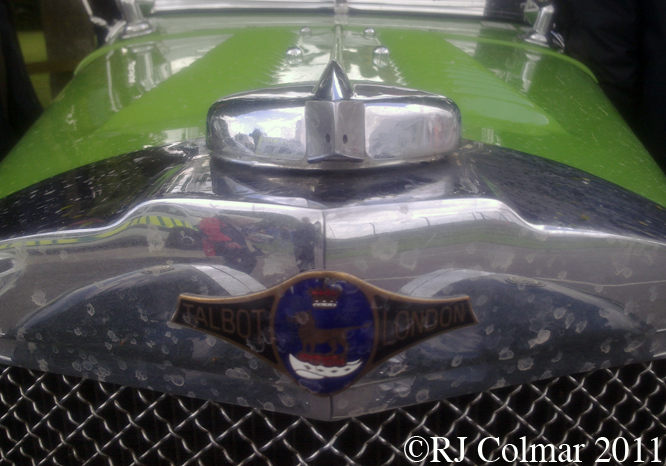
On Saturday Tour Britannia a similarly organised event for historic, classic & modern vehicles based this year in Wales and South West England visited Castle Combe on Saturday morning, when the race track was used as a rally stage thanks to the addition of three temporary chicanes and in the afternoon as a more conventional race track.
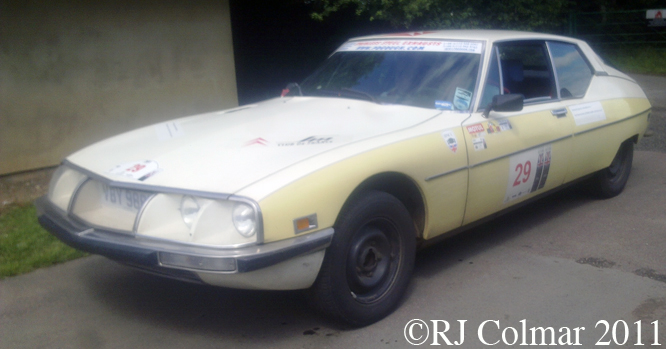
Headlining the racing fraternity on the inaugural event in 1973 were former two time Grand Prix World Champion Graham Hill in a Datsun Bluebird, regular Grand Prix participant Howden Ganley in a Citroen XM, similar to the #29 US spec vehicle of Andrew Brodie and Robert Lowdell above
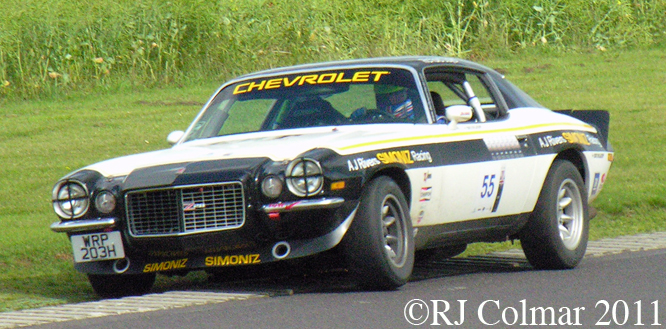
and future world champion in his rookie year making a big name for himself James Hunt in a Chevrolet Camaro belonging to the injured Richard Lloyd, similar to the vehicle of Stuart Scott and Steven Wood above which Richard Lloyd recreated in 2005 shortly before his untimely death. James in the Camaro was the winner of the inaugural event in 1973. Scott and Wood were awarded the Competitors Choice Concours award.
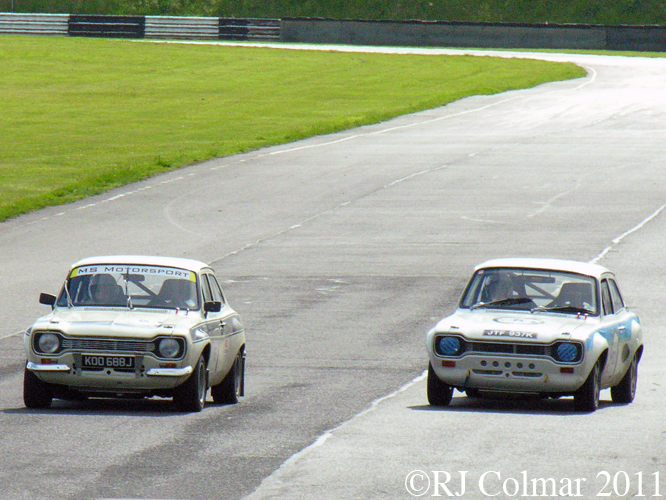
The following year the publicity generated by the event in 1973 galvanised Ford into preparing two Escort RS2000's for British UK Rally Champion Roger Clark and Saloon Car Racing Champion Gerry Marshall that were inseparable for most of the races with Roger pipping Gerry to the post in the final standings. Though in far higher states of tune than the original 1974 Escorts the vehicles of Phil & Mick Squires left and David Smithes & Eric Woolley right provided an evocative reminder of the epic battle in 1974. Phil & Mick won their class in this years event.
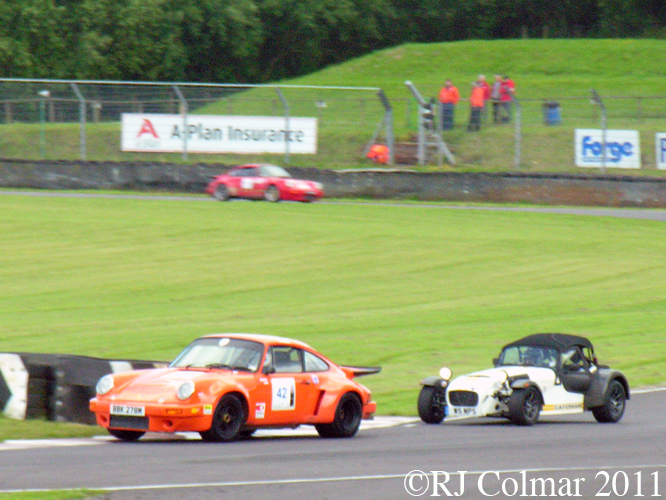
The highlight of the two races held on Saturday was the drive of former British Formula 5000 champion Ian Ashley in his Caterham R500 from the back of the grid to the lead in just two laps, above the ever on form Ashley is seen lining up the leading Porsche 911 RSR before the completion of the second lap.
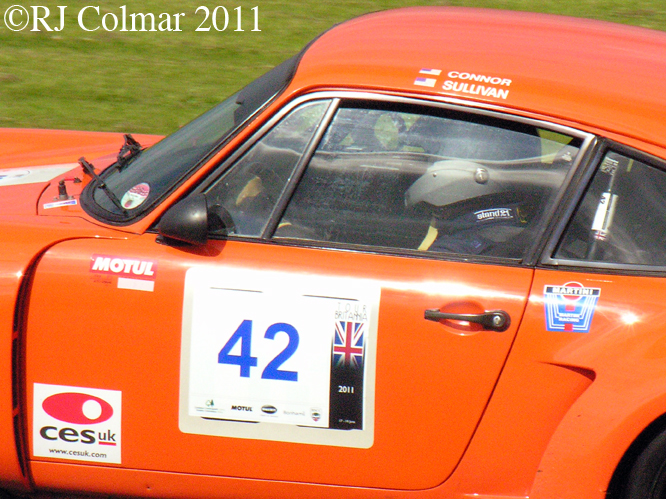
the #42 Porsche was driven by another name driver,
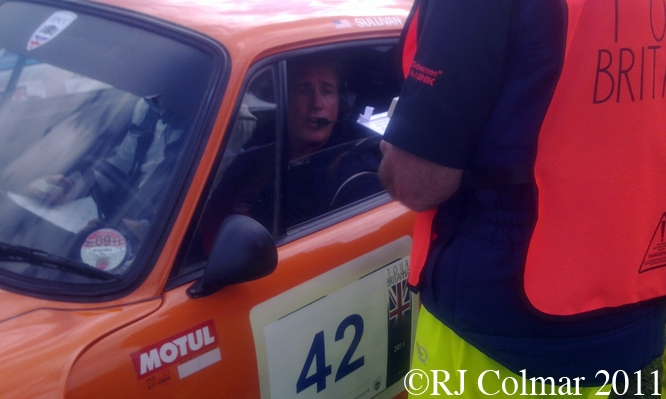
no less a name than former New York City cab driver, 1985 Indy 500 winner and 1988 Indycar Champion Daniel John 'Danny' Sullivan III from Louisville Kentucky ! Danny won his class in this years Tour Britannia which finished at Silverstone, yesterday afternoon.
My thanks to Simon Lewis who's heavily discounted ticket allowed me to visit this event.
Hope you have enjoyed today's Tour Britannia edition of 'Gettin' a lil' psycho on tyres' and that you will join me again tomorrow for a look at a classic Plymouth with a push button shift. Don't forget to come back now !
On Saturday Tour Britannia a similarly organised event for historic, classic & modern vehicles based this year in Wales and South West England visited Castle Combe on Saturday morning, when the race track was used as a rally stage thanks to the addition of three temporary chicanes and in the afternoon as a more conventional race track.
Headlining the racing fraternity on the inaugural event in 1973 were former two time Grand Prix World Champion Graham Hill in a Datsun Bluebird, regular Grand Prix participant Howden Ganley in a Citroen XM, similar to the #29 US spec vehicle of Andrew Brodie and Robert Lowdell above


and future world champion in his rookie year making a big name for himself James Hunt in a Chevrolet Camaro belonging to the injured Richard Lloyd, similar to the vehicle of Stuart Scott and Steven Wood above which Richard Lloyd recreated in 2005 shortly before his untimely death. James in the Camaro was the winner of the inaugural event in 1973. Scott and Wood were awarded the Competitors Choice Concours award.

The following year the publicity generated by the event in 1973 galvanised Ford into preparing two Escort RS2000's for British UK Rally Champion Roger Clark and Saloon Car Racing Champion Gerry Marshall that were inseparable for most of the races with Roger pipping Gerry to the post in the final standings. Though in far higher states of tune than the original 1974 Escorts the vehicles of Phil & Mick Squires left and David Smithes & Eric Woolley right provided an evocative reminder of the epic battle in 1974. Phil & Mick won their class in this years event.

The highlight of the two races held on Saturday was the drive of former British Formula 5000 champion Ian Ashley in his Caterham R500 from the back of the grid to the lead in just two laps, above the ever on form Ashley is seen lining up the leading Porsche 911 RSR before the completion of the second lap.
the #42 Porsche was driven by another name driver,
no less a name than former New York City cab driver, 1985 Indy 500 winner and 1988 Indycar Champion Daniel John 'Danny' Sullivan III from Louisville Kentucky ! Danny won his class in this years Tour Britannia which finished at Silverstone, yesterday afternoon.
My thanks to Simon Lewis who's heavily discounted ticket allowed me to visit this event.
Hope you have enjoyed today's Tour Britannia edition of 'Gettin' a lil' psycho on tyres' and that you will join me again tomorrow for a look at a classic Plymouth with a push button shift. Don't forget to come back now !
Saturday, 30 April 2011
Brushed Steel Roof - Maserati Bora

The Maserati Bora was developed in 1968 to go up against the mid engine De Tomaso Mangusta, Lambourghini Muira and later Ferrari 365 GT4 BB. 524 examples of the model were built from 1971 to 1978.

Under the direction of Citroen owners of the Maserati marque at the time, the Bora featured a steel monocoque with the longitudinal engine mounted on a subframe at the back and for the first time on a Maserati independent suspension on all four wheels.

Giorgetto Giugiaro of Ital Design was responsible for the steel bodywork which featured an unusual for the time brushed steel roof.

289 Bora's including this 1972 model were powered by a 310 hp 4719 cc / 288 cui V8 with a further 235 built from 1973 to 1978 being fitted with a larger 320 hp US emissions spec 4930cc / 301 cui motors giving the vehicle a 160 - 170 mph capability. The engine compartment featured double glazing to separate it from the cabin and a carpeted aluminium cover to keep the noise down.
By the time production of the Bora had ceased Maserati was in the ownership of De Tomaso.
Hope you have enjoyed today's brushed steel roof edition of 'Gettin' a lil' psycho on tyres' and that you will join me again tomorrow. Don't forget to come back now !
Thursday, 16 December 2010
The Mini Challenger - Citroen DS3

The Citroen DS 3 launched in 2009 is the first of the 'Different Spirit' range and replaces the C2 models.

It competes in the market place against the Alfa Romeo MiTo, Audi A1 and MINi.


Top of the range DS 3's have 150 hp capable of 0-62.5 in 7.3 seconds with a top speed of 133 mph and 155 g/km CO 2 emissions.

It is award time of the year and this applies as much to motor vehicles as any other field of endeavour, in an act of unparalleled hubris Europe's top motoring magazine writers have managed to vote a vehicle called a 'Leaf' that is not yet for sale or on the roads as European Car Of the Year. For once, and this happens very rarely I am in agreement with Top Gear magazine which has handed it's gong for 2010 to the DS3 describing the car as 'The peoples champion'.

The DS 3 was launched to an unsuspecting British public with the first product placement in a video by a British recording artist. You can see this same view at 2 mins 31 secs in Pixie Lott's 'Broken Arrow' video.

For those like me who believe competition on or off the track is the best place to prove a vehicles worth, Citoren have kindly built seven, consecutive, time World Rally Champion Sebastian Loeb from Alsace in France a 202 hp DS Racing version with which to defend his title, I expect the DS will remain in the public eye for a while yet.

Thanks for joining me, hope you'll join me tomorrow for Ferrari Friday, don't forget to come back now !
Wednesday, 27 October 2010
The Spirit that never breaks down - Rolls Royce Silver Spirit.

The radiator grill design and tragic Spirit of Ecstasy mascot makes Rolls Royce one of the few instantly recognisable brands no matter what age or model. The mascot on this model instantly retracts if dislodged allegedly preventing injury to pedestrians and making the item much harder to collect by even the most determined fans of the Beasty Boys.

The Silver Spirit was a development of the Silver Shadow with a new body and suspension that brought RR into the 1980's.

Sufficiently powered by a 6750cc / 411 cui V8 the Silver Spirit and slightly longer Silver Spur no longer featured the Citroen licensed self levelling suspension of the Silver Shadow but one using a Girling automatic hydraulic ride height control system riding on gas charged shock absorbers.

The Registration of this vehicle suggests that this might be a 1984 model but the alloy wheels to my not so well trained eye look to be of a more recent vintage. The Silver Spirit/Spur series is the twin of the Bentley Mulsanne / Eight series.

The Silver Spirit is the only Rolls Royce model that has ever come in to my hands, albeit briefly in my capacity as quality controller at a Volvo Garage, it certainly is an impressive machine to be seen driven around in, the ride quality is superb but the feel of the car with its spindly steering wheel and column shift left me feeling I was driving a very well appointed 1972 Volvo 144.
It should always be remembered that a Rolls Royce never 'breaks down', but if not looked after properly it might 'fail to proceed'.
Erratum: in response to a question about the Citroen SM suspension on October 20th I stated that 'Rolls Royce / Bentley took out licenses to use similar (Citroen hydropneumatic self levelling) systems on the Silver Shadow/T, Silver Spur/Mulsanne' in fact as I have written above the Silver Spirit/Spur have a Girling self levelling systems. Apologies for any confusion that arose.
Hope you have enjoyed your stay, don't forget to come back now !
Wednesday, 20 October 2010
Sa Majesté conduit par technologie ! - Citroen SM
If ever there was an automobile manufacturer that highlighted how conservative the automobile industry is, it would be Citroen, who during their years of ownership by Michelin really pushed the envelope with some out of the box thinking in terms of approach, technical innovation and design to their automotive solutions.

Top of the list of Citroens innovative vehicles I would put the UFO like Citroen SM launched in 1970. This GT car was born in part out of Citroens ownership of the Maserati brand. Note the inner pair of headlights turned with the steering wheel to help drivers see around corners, an innovation carried over from the Citroen DS.

Powered by a 178hp 2.7 litre / 164.7 cui (US 180 hp 3 litre / 183 cui) 90 degree V6 as used in the Maserati Merak, the SM was the most powerful front wheel drive vehicle of its time. The car featured not only self levelling suspension capable of running on just three wheels but also innovative variable assist power steering with just one turn from lock to lock, that was also self centering.

Just as the DS became known as 'La déesse' - 'The Goddess' the SM became known as 'Sa Majesté' - 'Her Majesty', though the S probably stems from 'Project S' which started the SM ball rolling and M unsurprisingly probably comes from Maserati.

Styling by Robert Opron reflected his American influenced tastes including these stainless steel fins in the rear bumper design.

The SM had an exceptionally low drag co efficient of 0.26, does anyone remember the fuss Audi made in 1982 when their C3 100, 200, 5000 series came out with a drag co efficient of 0.30 ?

Amazingly when Citroen decided to prove the SM's prowess in motor sport they chose to debut the car not on the race track but on the hard core African 1971 Rallye du Maroc which it promptly won. Later a 'bread van' version was also used in rally events.
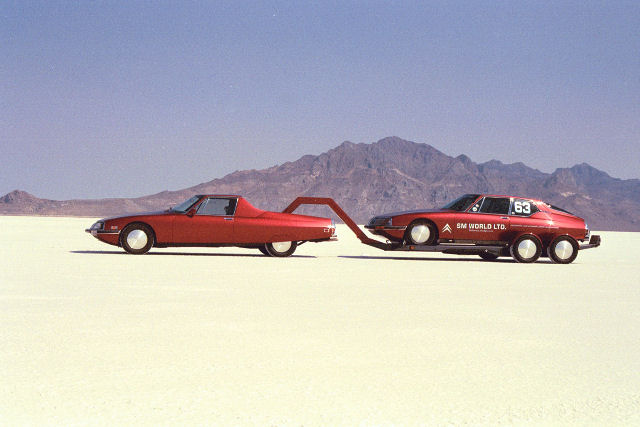
In 1987 Jerry Hathaway turbocharged an SM and his wife Sylvia took a production class land speed record at 202 mph at Bonneville that still stands. Jerry also built a cool matching SM tow truck and trailer rig on which to transport the LSR SM.
Hope you enjoyed today's edition of Gettin' a lil' psycho on tyres, don't forget to come back now !

Top of the list of Citroens innovative vehicles I would put the UFO like Citroen SM launched in 1970. This GT car was born in part out of Citroens ownership of the Maserati brand. Note the inner pair of headlights turned with the steering wheel to help drivers see around corners, an innovation carried over from the Citroen DS.

Powered by a 178hp 2.7 litre / 164.7 cui (US 180 hp 3 litre / 183 cui) 90 degree V6 as used in the Maserati Merak, the SM was the most powerful front wheel drive vehicle of its time. The car featured not only self levelling suspension capable of running on just three wheels but also innovative variable assist power steering with just one turn from lock to lock, that was also self centering.

Just as the DS became known as 'La déesse' - 'The Goddess' the SM became known as 'Sa Majesté' - 'Her Majesty', though the S probably stems from 'Project S' which started the SM ball rolling and M unsurprisingly probably comes from Maserati.

Styling by Robert Opron reflected his American influenced tastes including these stainless steel fins in the rear bumper design.

The SM had an exceptionally low drag co efficient of 0.26, does anyone remember the fuss Audi made in 1982 when their C3 100, 200, 5000 series came out with a drag co efficient of 0.30 ?

Amazingly when Citroen decided to prove the SM's prowess in motor sport they chose to debut the car not on the race track but on the hard core African 1971 Rallye du Maroc which it promptly won. Later a 'bread van' version was also used in rally events.


In 1987 Jerry Hathaway turbocharged an SM and his wife Sylvia took a production class land speed record at 202 mph at Bonneville that still stands. Jerry also built a cool matching SM tow truck and trailer rig on which to transport the LSR SM.
Hope you enjoyed today's edition of Gettin' a lil' psycho on tyres, don't forget to come back now !
Saturday, 25 September 2010
Perfect car for a wedding #1 - Citroen Traction Avant
I don't propose to post photos of cars used at Weddings every Saturday but I thought I'd give today's blog a topical theme, though I suspect the summer wedding season is probably already over.

Most of the photo's I have taken of cars used at weddings are not even taken on a Saturday, this is because just down the row of buildings from my city centre bank is an old court house that has been rebranded as a Registry Office. The City centre location is of course used for weddings 6 days a week though as can be seen from these photo's the location is not without a few 'parking issues'.

The Citroen Traction Avant is probably most famous as being the car that the cartoon detective Tintin used in the, now deemed less than politically correct, series of stories by Belgian artist Georges Rémi who published his work under the nom de plume Hergé.
The Citroen Traction Avant Garde was a revolutionary vehicle for it's time, which spanned 1934 -1957, it was the worlds first front wheel drive steel monocoque production car, setting a trend that is almost ubiquitous for passenger vehicles 76 years later.

The construction without the hitherto universal separate chassis was available with a variety of 4 and 6 cylinder engines from 1.3 litres / 79.5 CUI up to 2.9 litres / 176 CUI which sit behind the gearbox driving the front wheels, optimising the weight distribution on the independently sprung wheels.
There were plans to build a 3.8 litre / 231 CUI V8 version of the Traction Avant featuring an automatic transmission with a torque converter, similar to that later employed in the GM Dynaflow transmission, however after 20 prototypes had been built Citroen had gone bankrupt and Michelin who bought the company to primarily test its tyre and other rubber products cancelled the project.

In 1954 a Traction Avant was used to test the self levelling hydropneumatic suspension of the later equally revolutionary Citroen DS which would eventually replace the Traction Avant series in 1955. 759,111 of these vehicles were built in Paris (France), Forest (Belgium), Cologne (Germany) and Slough (England)
Best wishes to anyone who is getting married to day, hope you have enjoyed my first week as a blogger as much as I have, I look forward to to hearing from you all, 'y'all come back now ! Hear !.'
Subscribe to:
Posts (Atom)