Showing posts with label Dick. Show all posts

Thursday, 8 September 2011

La Machine - #17 Vollstedt - Offenhauser 77 (14)

As I have blogged elsewhere in 1978 the USAC Championship came to England and I was lucky enough to see the one of the two championship races at Silverstone and meet some of those involved at a meet and greet at Jubilee Gardens on the banks of the Thames in Central London.

78 09 26 #17 Vollstedt 14 01sc

One of the enduring memories of those two events was seeing the striking lines of Rolla Vollstedts #17 La Machine - Vollstedt - Offenhauser 77 [14], to my mind one of the most visually arresting open wheelers ever built, one that has a place of special veneration reserved at the top table in Art Tidesco's Automotive Temple of Speed.

78 10 01 #17 Volstedt 01sc

1960 US Olympic Team Skiing alternate Dick Simon was the driver of the immaculately turned out Vollstedt. Simon's best finish in 1978 was 4th at Phoenix he also scored three further top tens finishing the season 18th in the Champ Car Series standings.

78 09 26 #17 Vollstedt 14 02sc

The master mind behind the car was Rolla Vollstedt, a man with more stories to tell than I'll ever have hot dinners. Rolla has been devoting his life to racing since 1937 when he took part in unsanctioned Oregon street races with a Buick Coupé in 1937.

Working with modest budgets among Rolla's many achievements since starting his team in 1947 are building the first rear engined Offenhauser powered Indycar complete with rear wing to improve traction and counting the legendary Jim Clark, in 1967, along with Janet Guthrie, the first woman to compete in the Indy 500 among the drivers of his Championship cars. Rolla was also the last owner to attempt to qualify an Offenhauser powered for the Indy 500 in 1983.

I would like take this opportunity to wish Rolla a happy 93rd Birthday Day and thank him for building one of the most alluring automobiles it has ever been my privilege to see.

Thanks for joining me on Rolla Vollstedt's Birthday edition of 'Gettin' a lil psycho on tyres', I hope you'll join me again tomorrow for Ferrari Friday. Don't forget to come back now !

Wednesday, 6 July 2011

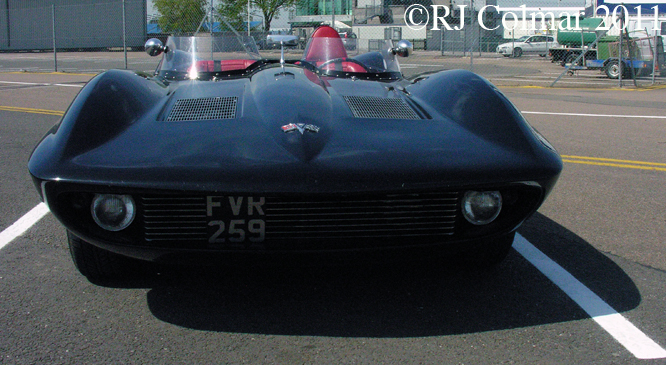
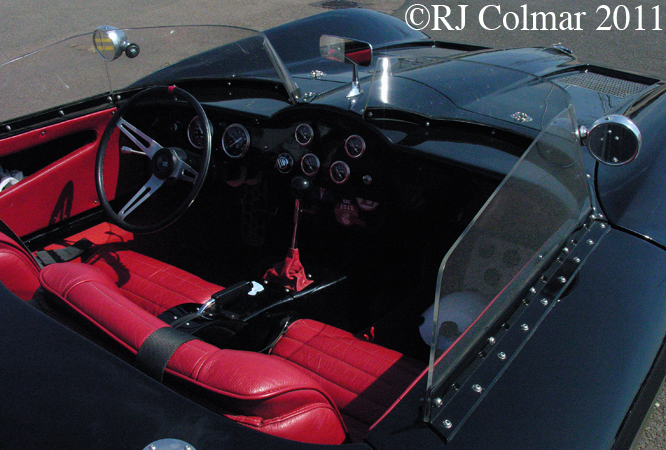
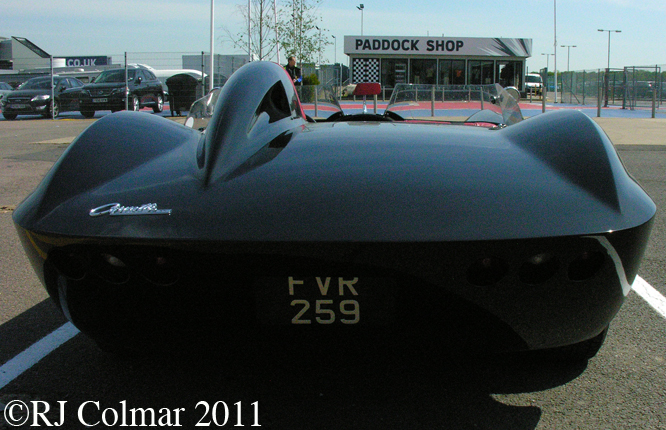
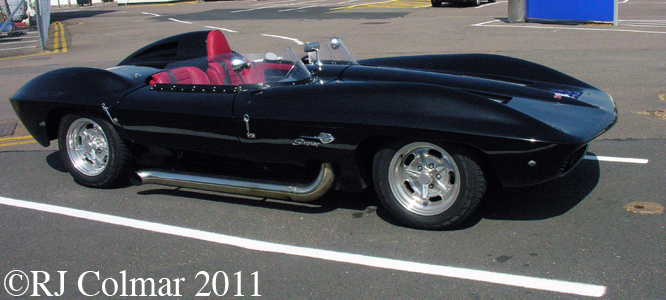
Exploring The Limits Of Handling and Performance - Chevrolet Corvette Stingray Concept Car (Replica)

Chevrolet Corvette Stingray Concept Car (Replica)

The 1959 Chevrolet Corvette Stingray concept car was based on the tubular steel chassis 1957 Corvette SS racing car that was abandoned after the 1957 Sebring 12 hours as a result of an agreement between members of the Automobile Manufacturers Association (AMA) not to build factory developed racing cars.

Chevrolet Corvette Stingray Concept Car (Replica)

Vice President of GM Styling William (Bill) L Mitchell is credited with designing and building the Stingray Concept Car featuring a fibreglass body which weighed in at 2,200 lbs around 1,000 lbs lighter than a contemporary production Corvette.

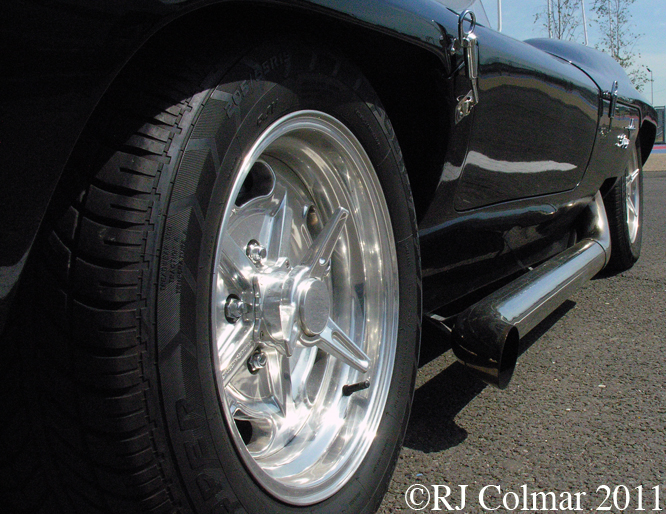
Chevrolet Corvette Stingray Concept Car (Replica)

The one off concept was entered by Bill in numerous races from at least April 1959 to at least October 1960 mostly for Dick Thompson and a couple of races for John Fitch, by early 1960 Dick had clocked up several class BM wins.

Chevrolet Corvette Stingray Concept Car (Replica)

Powered originally by a fuel injected 4.6 litre / 283 cui which was good for 315 hp at 6,200 rpm the car was used as a test bed for a four speed manual transmission once it's racing days were over. Today the car which resides General Motors Design Center has a 375 hp 5.5 litre / 327 cui motor fitted.

Chevrolet Corvette Stingray Concept Car (Replica)

Styling of the Stingray Concept Car heavily influenced the styling of 1963 Chevrolet Corvette Stingray production car. The strong line around the mid rift would become a feature on many vehicles of the 1960's the Chevrolet Corvair, Alfa Romeo GTV 2000, almost the entire 1960's BMW range, the Hillman Imp / Singer Chamoise and NSU Prinz to name but a few.

Chevrolet Corvette Stingray Concept Car (Replica)

This particular replica which I have seen at Silverstone many times over the years appears to be based on a 1977 Chevrolet (Corvette ?) chassis and is powered by a 5.4 litre 283 cui engine.

Hope you have enjoyed today's Concept edition of 'Gettin' a lil' psycho on tyres' and that you will join me again tomorrow. Don't forget to come back now !

Tuesday, 10 May 2011

Trading Places - 1960 Watson Roadsters

Thanks to Ed Arnadin's photos today we will be continuing our 100th anniversary of the first running of the Indianapolis 500 by having a behind the scenes look at Indianapolis in 1960.

70s

Our story begins with an invitation from a mutual friend of Ed Arnaudin and the Indy car owner Jim Robbins to visit the garage of the #97 Jim Robbins Special, where a Watson Roadster powered by an upright 4178 cc / 255 cui twin overhead cam Offenhauser is being prepared.

AJ Watson shares the record for building the most cars that won the 'Indy 500's', seven, with Roger S Penske. Watson built his first car 'City of Glendale' in 1950, Dick Rathmann qualified 18th on the grid driving the 'City of Glendale and retired from the race with a stalled motor after 25 laps. After working on aircraft assembly lines for Lockheed Watson was hired as Chief Mechanic by John Zink in 1954.

Watson modified Zinks Kurtis KK500C roadster and Bob Swiekert duly won the 1955 Indy 500 with it, in 1956 AJ built the first of 23 Watson Roadsters for John Zink, these iconic vehicles were to win a further six Indy 500's in 9 years.

The Watson chassis was narrower than the Kurtis, featured extensive use of 4130 chromoly tubing in place of the steel used by Kurtis, innovative use of magnesium in the drive line and body panels saved further weight. The Offenhauser engine was mounted upright on the left side of the chassis to increase weight bias on the corners of the car closest to the inside of the track rather than tilting the engine at 36 degrees as Kurtis had done and later Eperly / Salih would do with engines 18 degrees off horizontal.

With a 220 lb weight saving the 1,640 lb Watson Roadster design remained fundamentally unchanged from 1956 until 1963, AJ Foyt drove a Watson into Victory Lane at Indianapolis for the last time in 1964.

The car, seen being worked on above was one of three entered in the race owned by Safety Belt manufacturer Jim Robbin's, the #97 was driven by the man who first put a Watson on the grid of the Indy 500 in '53, Dick Rathmann. In 1960 Dick qualified for fourth spot on the grid and retired from the race in 31st place after 42 laps with defective brakes.

Dick Rathmann had a varied career spanning 1949 - 1964 encompassing the AAA Championship, NASCAR (13 wins, all in Hudsons, from 128 starts) and latterly the USAC Championship. He started from the Indy pole in 1958 but was collected in an accident on the opening lap by fellow front row starter Ed Elisan, the ensuing 15 car pile up cost Pat O'Conner his life.

As a result of that fatal accident Dick Rathmann became the first man to start from pole not to complete a lap of the race, a stat that has since been emulated by Roberto Guerrero and Scott Sharp. Rathmann's best Indy 500 finish was 4th in 1956.

Now this story enters the racing twighlight zone, ever since races were organised teams and drivers have made it there business to pull the wool over organisers eye's. 'Dick' Rathmann was actually born James. James had a brother, younger by four years, called Richard and when underage Richard wanted to go racing in 1946 James and Richard simply swapped names, James became 'Dick' and Richard became 'Jim' a change that ended up sticking for life.

76s

In 1960 Jim Rathmann was the driver of the #4 Ken Paul Special a Watson Offenhauser Roadster MK2, Jim qualified 2nd and can be seen in the blue car in the middle of the front row as the cars cross the 100 yards of bricks at the start of the 1960 Indy 500 above, his brother 'Dick' in the #97 is on the inside of the second row.

78s

Jim seen here battling with Eddie Sachs went on to win the 1960 Indy 500, a race memorable because the lead changed a record 29 times. Last year (2010) Jim became the sixth Indy 500 winner to celebrate their 50th Anniversary of the Indy 500 win, Ray Harroun, Jules Goux, Rene Thomas, Peter DePaolo and Louis Meyer were the others.

Three time Indy winner Johnny Rutherford presented Jim with a trophy to commemorate the 50th anniversary of his win, Rutherford who was present at Indy as a spectator for the first time in 1960 remembered the race thus " We had seats in the North grandstands of the infield on the backstretch. The duel between Jim and Rodger [Ward winner of the 1959 Indy 500] was one for the record books. Little did we know that some 50 years later [the 29 lead changes] would still be an Indy 500 record.”

Jim said of the 1960 Indy 500 "That was a great duel with Rodger. Ward was one of the toughest drivers out there and beating him meant a lot to me, and winning the Indy 500 changed my entire life. Winning the ‘500’ was and still is the all-time highlight of my racing career. To win that day, in that race against Ward means so much to me.”

Slightly off topic after retirement Jim became a Cadillac dealer in Melbourne, Florida and is credited with convincing GM president Ed Cole that GM should set up a deal to supply his friends the astronauts on the NASA space programmes with a pair of new cars each year.

My thanks to Steve Arnaudin for the scans of his Dad's slides, to B² and Indycar Nation for additional information.

Hope you have enjoyed today's 1960 edition of 'Gettin' a lil psycho on tyres' and that you will join me again for a celebration of the 50th anniversary of the first running of the Indianapolis 500. Don't forget to come back now !

Tuesday, 25 January 2011

Moby DIck - Porsche 935/78 #006

DSCN9920sc

The Porsche 935/78 was a one off vehicle built to win the 1978 Le Mans 24 hours and was the ultimate works development of the, then 15 year old, 911 which would not be topped until the advent of the 911 GT1 built in the late 1990's. Notice that in preparation for Le Mans the drivers seat was placed on the right hand side optimising weight distribution for a race run on a clockwise track.


Thanks to a rule made at the request of arch enemy BMW the body was lowered 10cm 3.9 inches over the standard 911 by cutting out the standard floor plan with the engine like wise now lowered the gearbox was inverted to raise the drive shafts closer to their original height. Apart of from the front windscreen almost every body panel was optimised to maximise the top speed on the 4 mile Mulsanne straight where 235 mph was eventually achieved.


The 935/78 was equipped with a 750 hp 3.2 litre 195 cui flat 6 with 4 valves per cylinder in water cooled cylinder heads, a first for Porsche who had always raced air/oil cooled motors up until this time.


The car seen here driven Jacky Ickx and Jochen Mass at the 1978 Silverstone 6 hour race, a warm up for the Le Mans 24 hours, romped away from the opposition, mostly private Porsche's with a single works BMW driven by Ronnie Peterson and Hans Joachim Stuck, finished a ridiculous 7 laps ahead of the rest of the field.


Stommelen/Schurti qualified 'Moby Dick', as the 935/78 was known, third on the grid at Le Mans however a silly stunt in which the car was driven on the road from Porsches garage outside the circuit to the circuit on race day went horribly wrong when predictably the car got caught in race day traffic causing the engine to over heat which created an oil leak. The subsequent loss of performance meant the car could only finish 8th.

935/78 #006 appeared twice more in 1978 but disgraced itself with two retirements and has since been consigned to the Porsche Museum. Joest Racing built two further 935/78's from factory drawings in 1981.

Hope you have enjoyed today's 235 mph edition of 'Gettin' a lil' psycho on tyres' and that you will join me again for another turbo charged blog tomorrow. Don't forget to come back now !
Monday, 3 January 2011

Choking on a clothes peg - Austin 10


The Austin 10 produced from 1932 to 1947 was a mid range car fitting between the Austin 7 and Austin 12.


Austin kept the chassis low by dipping the chassis frames 2 3/4 inches between the front and rear axles.


Capable of 55 mph and 34 imperial mpg this pre 1934 version, originally registered in Derbyshire, would have cost £168 when new. The clothes peg operating the choke is a not a factory fitted item.


In 1939 the Austin 10 was restyled by Argenrtine Ricardo "Dick" Burzi and 53,000 '10s' were produced during the course of WW2 for use by the UK armed forces. After the war almost all Austin 10s were exported the first exported to the USA in July '45, in September '45 the first cars to be imported into Switzerland after the war were a pair of Austin 10s.

Hope you have enjoyed today's open top edition of 'Gettin' a lil psycho on tyres' and that you'll be up for getting down and dirty with me for some grass track fun tomorrow. Don't forget to come back now !