
Showing posts with label Wagon. Show all posts
Showing posts with label Wagon. Show all posts
Wednesday, 10 February 2016


Wednesday, 31 August 2011
Multi Purpose Vehicle - Volvo 240 Tørslanda
The Volvo 200 series launched in 1974 was a significant update of the 140 series which is outwardly easily identifiable by federal spec of railway sleeper like low impact bumpers that gave the vehicle all the style, despite the best efforts of Jan Wilsgard, of a house brick.

From 1974 - 1993 the 200 series came with a variety of straight 4 engines, some with turbo chargers, Peugeot Renault Volvo, PRV, aluminium V6's and straight 5 cylinder or 6 cylinder diesels sourced from the Volkswagen.

Over the 19 year production run there were numerous stylistic updates which softened the more extreme features of the early 200 series, it was never considered a particularly good looking car but it's robustness and average 19 year longevity did lend the 200 series a certain status cache somewhere between a Range Rover and a Mini Van, the latter which first appeared as the 200 series production was being wound up.

The 1993 Tørslanda special edition, named after the Swedish factory that built them, was a back to basics estate station wagon model, allegedly designed to cope with harsh Scandinavian winters.

It featured, by then already retro, manual mirrors, door locks and windows front & rear, plastic trim in place of chrome which fairs badly in snow, heated seats, power steering, full length body stripes and BBS style alloy wheels.

The 200 series estates / station wagons, which accounted for a third of the 2.8 million units produced in Sweden, Australia, Belgium, Canada, Italy and Malasia, were particularly popular with those needing a large cargo area, the 41 cubic feet cargo area could carry large pieces of furniture, cookers, fridges, washing machines or hay bales and was often supplied with a dealer fitted rear facing seats that could accommodate two small children. These cars are still popular with trades people in Europe today.

Whilst outright performance was rarely top of the list of a typical 200 series customers desires, Volvo did support the development of a turbocharged two door model that allowed Gianfranco Brancatelli and Thomas Lindström driving for the Eggenberger Motorsport team to share the 1985 European Touring Car Championship.
Thanks for joining me on this Tørslanda special edition of 'Gettin' a lil' psycho on tyres', I hope you will join me again tomorrow. Don't forget to come back now !
From 1974 - 1993 the 200 series came with a variety of straight 4 engines, some with turbo chargers, Peugeot Renault Volvo, PRV, aluminium V6's and straight 5 cylinder or 6 cylinder diesels sourced from the Volkswagen.
Over the 19 year production run there were numerous stylistic updates which softened the more extreme features of the early 200 series, it was never considered a particularly good looking car but it's robustness and average 19 year longevity did lend the 200 series a certain status cache somewhere between a Range Rover and a Mini Van, the latter which first appeared as the 200 series production was being wound up.
The 1993 Tørslanda special edition, named after the Swedish factory that built them, was a back to basics estate station wagon model, allegedly designed to cope with harsh Scandinavian winters.
It featured, by then already retro, manual mirrors, door locks and windows front & rear, plastic trim in place of chrome which fairs badly in snow, heated seats, power steering, full length body stripes and BBS style alloy wheels.
The 200 series estates / station wagons, which accounted for a third of the 2.8 million units produced in Sweden, Australia, Belgium, Canada, Italy and Malasia, were particularly popular with those needing a large cargo area, the 41 cubic feet cargo area could carry large pieces of furniture, cookers, fridges, washing machines or hay bales and was often supplied with a dealer fitted rear facing seats that could accommodate two small children. These cars are still popular with trades people in Europe today.
Whilst outright performance was rarely top of the list of a typical 200 series customers desires, Volvo did support the development of a turbocharged two door model that allowed Gianfranco Brancatelli and Thomas Lindström driving for the Eggenberger Motorsport team to share the 1985 European Touring Car Championship.

Thanks for joining me on this Tørslanda special edition of 'Gettin' a lil' psycho on tyres', I hope you will join me again tomorrow. Don't forget to come back now !
Wednesday, 3 August 2011
Bi- Parting Tailgate - Volvo Amazon Estate / Station Wagon
Last week I looked at the Volvo Amazon, no sooner had I written the blog than I came across this Estate / Station Wagon version with Dutch plates.
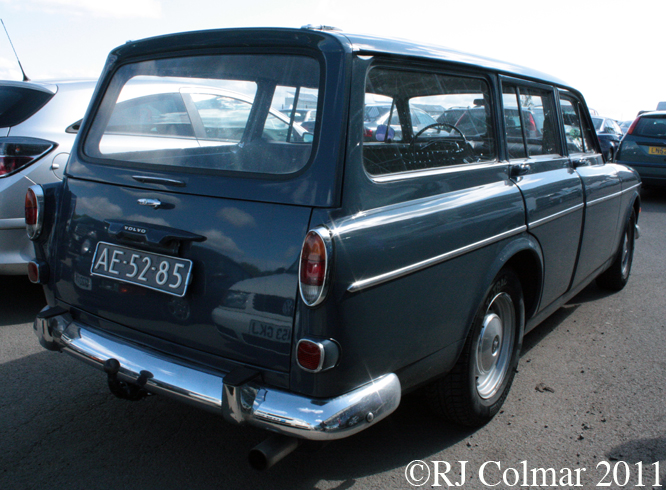
Unlike most modern vehicles of this type the Amazon had a two piece tailgate, the bottom half opens down to form a loading platform while the top half opens up a feature common to many US Estate Station wagons. Like the Mini introduced in 1959 the rear licence plate is conveniently hinged at the top so that one can carry longer loads with the tailgate down without attracting the ire of traffic law enforcement agencies.
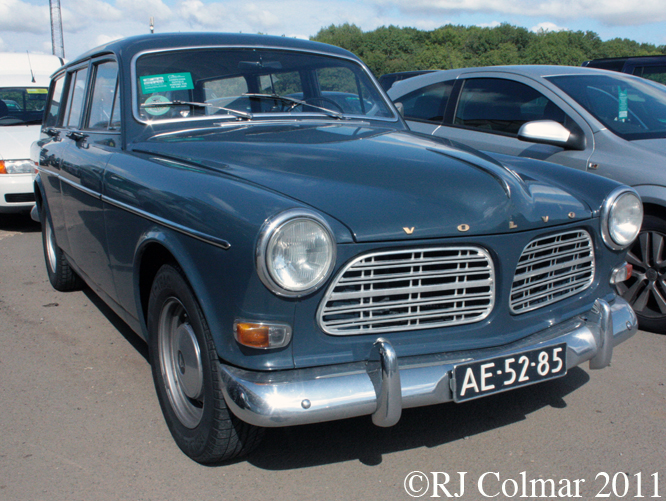
The Amazon Estate / Station wagon was launched in 1962 seven years after the original Amazon Saloon / Sedan, and shared with it's 3 box sibling body work made of phosphate treated steel to improve paint adhesion and heavy use of undercoat and anti corrosive oil treatment.
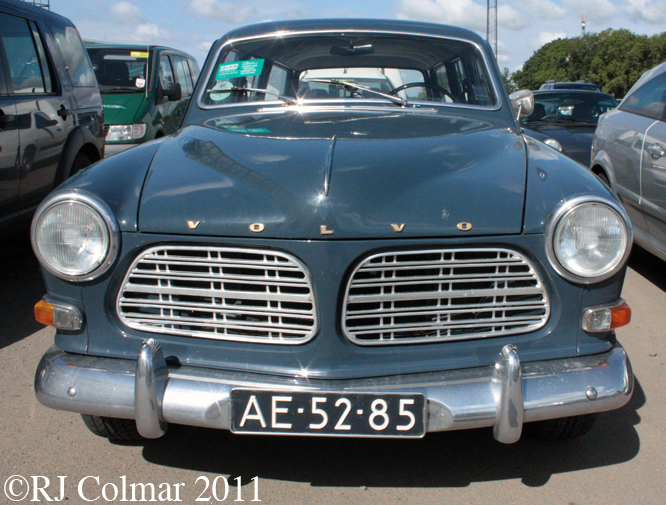
Between 1962 and 1969 Volvo manufactured 73,000 Amazon Estate / Station wagons.
Thanks for joining me on this bi-parting tailgate edition of 'Gettin' a lil' psycho on tyres' I hope you will join me again tomorrow. Don't forget to come back now !
Unlike most modern vehicles of this type the Amazon had a two piece tailgate, the bottom half opens down to form a loading platform while the top half opens up a feature common to many US Estate Station wagons. Like the Mini introduced in 1959 the rear licence plate is conveniently hinged at the top so that one can carry longer loads with the tailgate down without attracting the ire of traffic law enforcement agencies.
The Amazon Estate / Station wagon was launched in 1962 seven years after the original Amazon Saloon / Sedan, and shared with it's 3 box sibling body work made of phosphate treated steel to improve paint adhesion and heavy use of undercoat and anti corrosive oil treatment.
Between 1962 and 1969 Volvo manufactured 73,000 Amazon Estate / Station wagons.
Thanks for joining me on this bi-parting tailgate edition of 'Gettin' a lil' psycho on tyres' I hope you will join me again tomorrow. Don't forget to come back now !
Subscribe to:
Posts (Atom)