
Showing posts with label British. Show all posts
Showing posts with label British. Show all posts
Thursday, 31 March 2016


Thursday, 17 March 2016

Tuesday, 13 September 2011
1977 ECotY - Rover Vitesse
There were not many four door executive vehicles that would look comfortable parked along side a Ferrari or Maserati in the 1970's but the Rover SD1 powered by the familiar alloy Buick derived V8 and designed by David Bache is certainly one that could keep such company in any car park and not look out of place.

Thanks in part to a painfully slow process of rationalisation that was occurring at British Leyland during the early 1970's involving many duplicitous departments and management within the nationalised organisation it took 54 months for the SD1 to move from drawing board to production.

David Bache was not in the least shy about his design influences incorporated into the SD1 including these indicator lights which are almost identical to those found on a Ferrari Daytona.

Built in a new purpose built £31 million factory in Solihull the SD1 was marketed as the Rover 3500 and launched in July 1976 to an ecstatic reception regarding the styling and performance, though the quality of some of the materials used and build were short of the market leaders particularly the emerging BMW brand. The deep front spoiler and BBS pattern wheels on this model signifies a later model in this case built in 1986.

The Vitesse badge hitherto associated with Triumph models belies the fact that the SD1 had technical and marketing input from the still separate and competing Triumph design and management offices. In late 1980 the Rover Vitesse, seen here at the Atwell Wilson Motor Museum, was introduced as the performance version of the Rover 3500 and the Vanden Plas the Luxury version that included leather seats.

While the styling of the SD1 was ahead of it's time the rear suspension was actually a technological step back from the de Dion suspension used on the previous Rover P6 to a live rear axle, though this made the cars easier and cheaper to build the move did not compromise the handling, much praised in the contemporary press, in anyway.

Since British Leyland had so many competing brands in its range the 1977 European Car of the Year award winner was not the money spinner that it should have been because it was priced so as not to compete directly with the Jaguar XJ6 against which it was seen in an extremely favourable light.
Thanks for joining me on the 1977 European Car of the Year edition of 'Gettin' a lil psycho on tyres', I hope you'll join me again tomorrow when I'll be looking at a fully loaded turbocharged competitor of the Rover SD1. Don't forget to come back now !
Thanks in part to a painfully slow process of rationalisation that was occurring at British Leyland during the early 1970's involving many duplicitous departments and management within the nationalised organisation it took 54 months for the SD1 to move from drawing board to production.
David Bache was not in the least shy about his design influences incorporated into the SD1 including these indicator lights which are almost identical to those found on a Ferrari Daytona.
Built in a new purpose built £31 million factory in Solihull the SD1 was marketed as the Rover 3500 and launched in July 1976 to an ecstatic reception regarding the styling and performance, though the quality of some of the materials used and build were short of the market leaders particularly the emerging BMW brand. The deep front spoiler and BBS pattern wheels on this model signifies a later model in this case built in 1986.
The Vitesse badge hitherto associated with Triumph models belies the fact that the SD1 had technical and marketing input from the still separate and competing Triumph design and management offices. In late 1980 the Rover Vitesse, seen here at the Atwell Wilson Motor Museum, was introduced as the performance version of the Rover 3500 and the Vanden Plas the Luxury version that included leather seats.
While the styling of the SD1 was ahead of it's time the rear suspension was actually a technological step back from the de Dion suspension used on the previous Rover P6 to a live rear axle, though this made the cars easier and cheaper to build the move did not compromise the handling, much praised in the contemporary press, in anyway.
Since British Leyland had so many competing brands in its range the 1977 European Car of the Year award winner was not the money spinner that it should have been because it was priced so as not to compete directly with the Jaguar XJ6 against which it was seen in an extremely favourable light.
Thanks for joining me on the 1977 European Car of the Year edition of 'Gettin' a lil psycho on tyres', I hope you'll join me again tomorrow when I'll be looking at a fully loaded turbocharged competitor of the Rover SD1. Don't forget to come back now !
Tuesday, 30 August 2011
Royal Tragedy - Rover P6 Series II 2200 SC
Some of you may remember I found a cut'n'shut Rover Series I P6 Cabriolet behind a hedge last year, today I am looking at the Series II P6 introduced in October 1970.

Initially the P6 Series II comprised exterior changes to the grill, plastic replacing alloy, rear lights and the instrumentation and switches of the two more expensive Twin Carburettor and 3500 versions.

From 1973 the Series II P'6s came in three flavours the 98 hp 2200SC, Single Carburettor, 115hp 2200, Twin Carburettor and 3500.

Production of the P6 ceased in March 1977 with 32, 270 units produced over four years. Allegedly the last 2200 model was a Left Hand Drive export model that was converted to Right Hand Drive by the Tourist Trophy Garage in Farnham.

British Leyland, the nationalised merger of large swathes of the British motor industry was entering it's worst period of industrial relations during the production of the P6 and this was reflected in abominable reliability issues, one driving organisation reporting that their 3500 P6 had required three engines, two gearboxes, two clutch housings and a wiring loom in 6000 miles motoring over 6 months and was off the road for 114 days out of the 165 days that it was tested over !

An attempt was made to export a high spec P6 to the USA but with less than 1500 units sold many of the cars built for the USA were eventually sold in Left Hand Drive European markets instead.

While driving her daughter Stéphanie home on September 13th, 1982, Princess Grace of Monaco, nee Grace Kelly, suffered a stroke which caused her to drive her P6 off the road. She never regained consciousness and died from her injuries the next day, while Stéphanie who fractured her neck in the accident, made a full recovery.
Thanks for joining me on this edition of 'Gettin' a lil' psycho on tyres', I hope you will join me again tomorrow. Don't forget to come back now !
Initially the P6 Series II comprised exterior changes to the grill, plastic replacing alloy, rear lights and the instrumentation and switches of the two more expensive Twin Carburettor and 3500 versions.
From 1973 the Series II P'6s came in three flavours the 98 hp 2200SC, Single Carburettor, 115hp 2200, Twin Carburettor and 3500.
Production of the P6 ceased in March 1977 with 32, 270 units produced over four years. Allegedly the last 2200 model was a Left Hand Drive export model that was converted to Right Hand Drive by the Tourist Trophy Garage in Farnham.
British Leyland, the nationalised merger of large swathes of the British motor industry was entering it's worst period of industrial relations during the production of the P6 and this was reflected in abominable reliability issues, one driving organisation reporting that their 3500 P6 had required three engines, two gearboxes, two clutch housings and a wiring loom in 6000 miles motoring over 6 months and was off the road for 114 days out of the 165 days that it was tested over !
An attempt was made to export a high spec P6 to the USA but with less than 1500 units sold many of the cars built for the USA were eventually sold in Left Hand Drive European markets instead.
While driving her daughter Stéphanie home on September 13th, 1982, Princess Grace of Monaco, nee Grace Kelly, suffered a stroke which caused her to drive her P6 off the road. She never regained consciousness and died from her injuries the next day, while Stéphanie who fractured her neck in the accident, made a full recovery.
Thanks for joining me on this edition of 'Gettin' a lil' psycho on tyres', I hope you will join me again tomorrow. Don't forget to come back now !
Tuesday, 19 July 2011
Arrested Development - McLaren M26/1
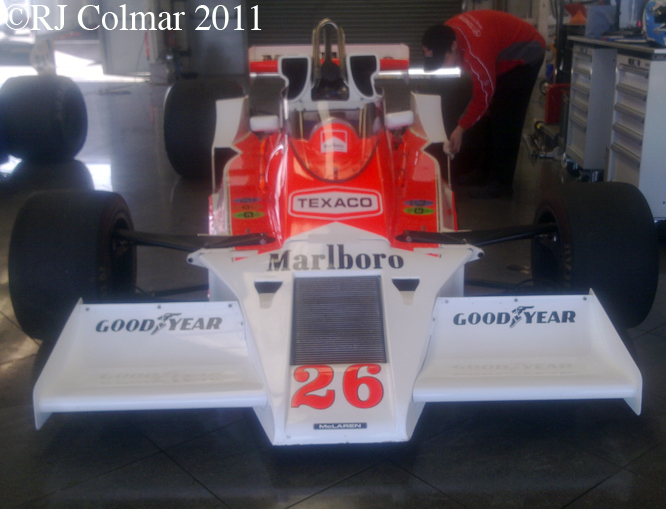
The McLaren M23 was already a four year old design when Gordon Coppucks successor the lower and lighter McLaren M26 was launched in the summer of 1976.
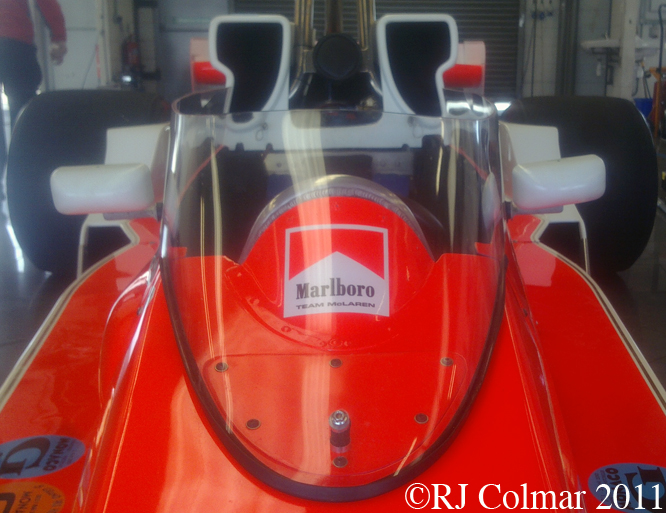
Unfortunately the development of the M26 was almost immediately stifled as James Hunt in his M23 and the team were waging one of the fiercest championship battles in the history of the World Divers Championship to that point in time.
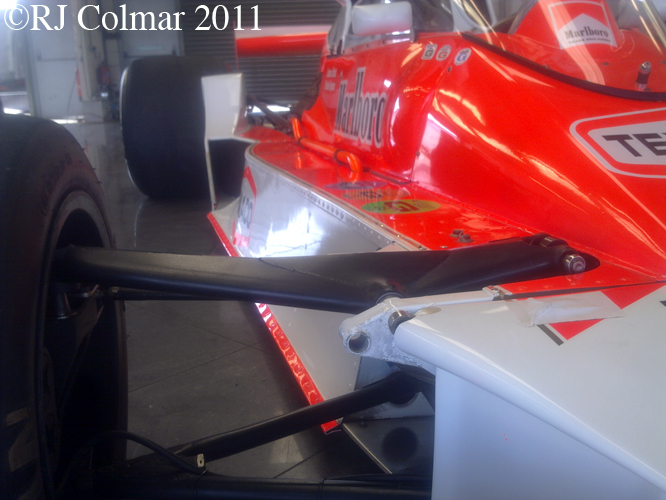
The M26 did race at the Dutch Grand Prix driven by Jochen Mass in 1976 but it was quickly decided that the design needed serious development that was best postponed until the end of the season.
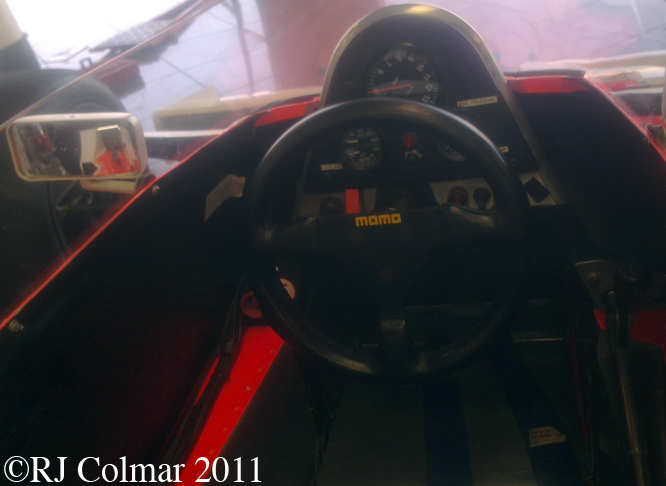
James subsequently won the 1976 World Drivers Championship. I am not sure why the M26 was not ready for the start of the 1977 championship but the older M23 was pressed into a fifth season of competition and it was not until the 10th round of the 17 race Grand Prix schedule that both front line McLaren drivers James Hunt and Jochen Mass had the M26 available to race.
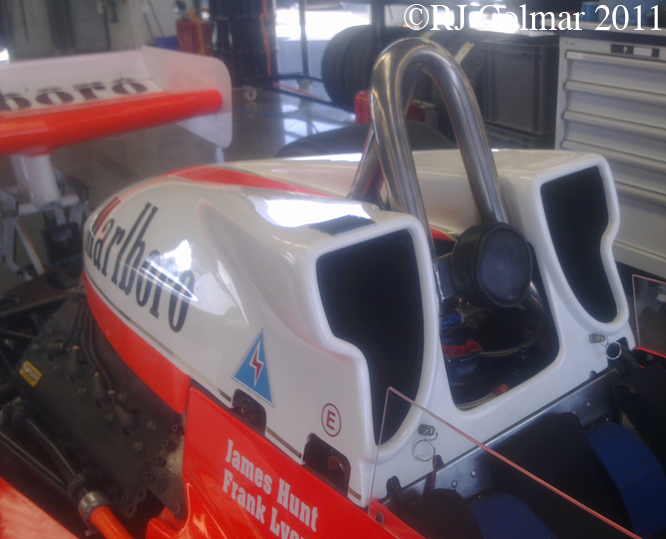
Nearly a year after it was launched, now featuring a radiator mounted in the nose, the car was competitive and at the British Grand Prix in 1977 James recorded the first of three victories driving the M26 model, not enough to defend his World Drivers championship but a respectable achievement none the less.
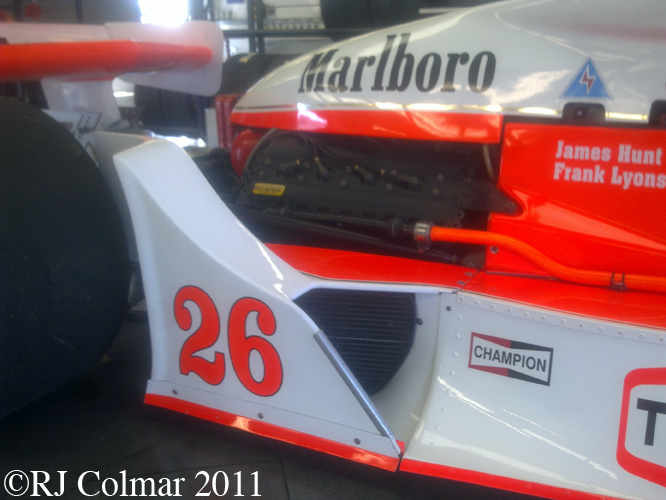
James was not known for his testing skills in the same way as the much vaunted Niki Lauda and so it is perhaps no surprise that for the following 1978 season the development of the M26 did not significantly improve performance.
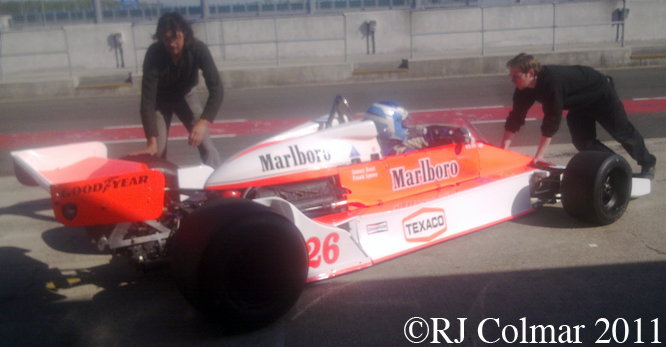
In 1978 the M26 was, like most of the opposition, simply outclassed by the dominant Lotus 79 design which introduced hitherto unimaginably superior handling to Grand Prix racing thanks to the venturi in it's side pods. Hunt left the McLaren Team to rejoin former Hesketh designer Dr Harvey Postlethwaite at Wolf Racing for the 1979 season.
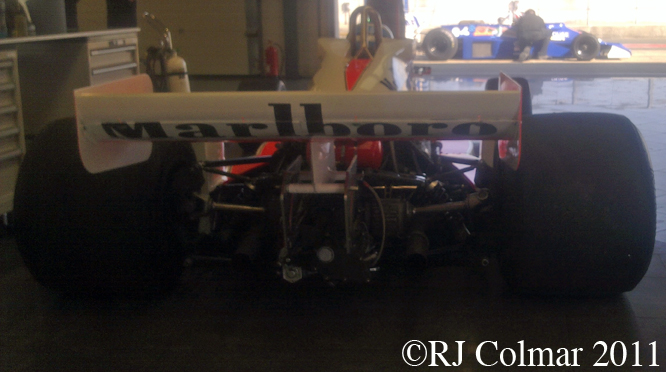
The car featured in these photographs is thought to be chassis M26/1 which was first raced by Jochen Mass in Holland in 1976. The best result for M26/1 was fourth place scored by Jochen Mass behind winner James Hunts similar model at the 1977 British Grand Prix.
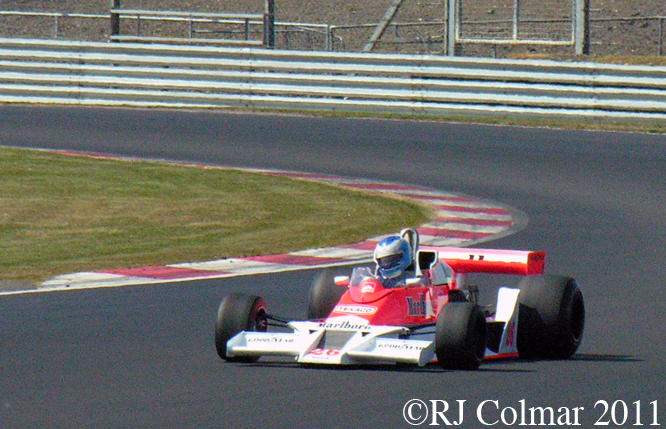
The vehicle is seen here being driven by owner Frank Lyons is expected to take part in this weekends Silverstone Classic race for Formula One cars on Sunday.
My thanks to NZALPA, VINCE H, David Lawson, Tim, Murray, Tony Gallagher, Alan Cox, Pink Snail, David Lawson, hipperson and Geoff Butcher at The Nostalgia Forum for their help identifying the chassis number and driver.
Hope you have enjoyed the Arrested Development edition of 'Gettin' a lil psycho on tyres' and that you'll join me again for a look at a Fittipaldi in Wolf clothing tomorrow. Don't forget to come back now !§
Sunday, 10 July 2011
From Metal Bashing to Autoclave - McLaren MP4/1 #MP4/1-02
Thirty years ago I was extremely lucky to find my self working for six months in an accounts department of a double glazing manufacturer during the one of two industrial experience segments of my degree course. This meant I had the time and funds not only to spend a week at Le Mans but I also had the time and funds to spend a weekend at the British Grand Prix at Silverstone.
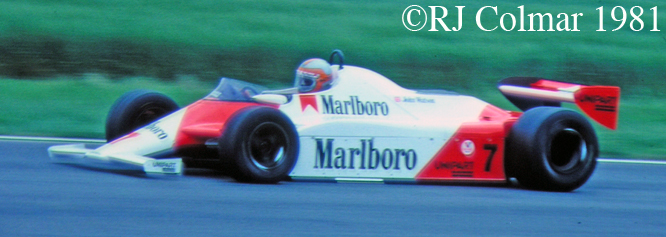
During the 1980 / 1981 off season McLaren's long time sponsor Philip Morris, disappointed with three years of under achievement coerced team principle Teddy Meyer into a merger with Project Four a lower tier Formula 2 team run by Ron Dennis which coincidentally was also sponsored by Philip Morris.
Ron Dennis had hired the designer, of the Chaparral 2K Indy Car, John Barnard to design a new car for McLaren which became known as the MP4/1. Outwardly the car was a conventional 'kit car' using a Cosworth DFV engine that had been the motor of choice since 1966.
However beneath the paint work John Barnhard's chassis was the first to be wholly manufactured with carbon composite materials, which until 1981 had been primarily used in the aerospace industry. Carbon composite materials when pressure and heat treated in an autoclave, a process developed by the Royal Aircraft Establishment in 1963, can be used produce objects that have high flexibility, tensile strength and temperature tolerance while at the same time have low thermal expansion and low weight compared to similar metal objects.
By the end of the 1980's all Formula One chassis were being manufactured from carbon composites along with brake discs and suspension components.
John Watson, seen during practice for the British Grand Prix here, qualified fifth for the 1981 British Grand Prix, at the start of the race the two turbo charged Renaults and Ferrari's made the best get away but on lap 3 Gilles Villeneuve clipped a curb and spun,see clip 1m 20secs, an incident which took out Alan Jones on the spot.
Somehow John Watson who was right behind Jones managed to avoid the melee almost coming to a stop as he did so, which in turn caused his team mate Andrea de Cesaris behind him to take evasive action and spin off into the catch fencing.
After loosing a lot of time Watson set off in sixth place behind Piquet, Reutemann, Pironi, Arnoux and Prost. Piquet crashed out with a puncture, Watson then over took first Reutemann and then Pironi who's engine exploded on the next lap. Prost retired with distributor trouble which put John in 2nd place behind Arnoux who had a comfortable lead.
On lap 53 Arnoux started experiencing the same problems as Prost and 8 laps later a huge roar went round the circuit as Belfast born John took the lead of his home Grand Prix which he held until the end of the race.
This was John's second Grand Prix victory his first was in the Penske PC4 in 1976 and the first victory for McLaren under the guidance of Ron Dennis. McLarens last victory had been with James Hunt in 1977.
John drove this same chassis #MP4/1-02 to victory in the 1982 Belgian Grand Prix.
Hope you have enjoyed today's British GP edition of 'Gettin' a lil' psycho on tyres' and that you will join me again tomorrow. Don't forget to come back now !
PS It is with great sorrow that I learned of the passing of William 'Bill' Boddy MBE known to many as 'WB' who edited Motor Sport magazine from 1936 to 1991, an organ which played no small part in my addiction to motoring and motor sport in the 1970's and ultimately to this blog.
He famously ran Motor Sport magazine through the war years during his spare time while working on important Air Publications.
Bill was a vociferous opponent to the 70 mph speed limits introduced to Britain as a temporary measure by Tom Fraser in 1965 after a spate of accidents in fog and the alleged testing of an AC Cobra at speeds up to 180 mph on the M1 motorway.
WB was aged 98, sincerest condolences to his family and many friends. RIP 'WB'.
During the 1980 / 1981 off season McLaren's long time sponsor Philip Morris, disappointed with three years of under achievement coerced team principle Teddy Meyer into a merger with Project Four a lower tier Formula 2 team run by Ron Dennis which coincidentally was also sponsored by Philip Morris.
Ron Dennis had hired the designer, of the Chaparral 2K Indy Car, John Barnard to design a new car for McLaren which became known as the MP4/1. Outwardly the car was a conventional 'kit car' using a Cosworth DFV engine that had been the motor of choice since 1966.
However beneath the paint work John Barnhard's chassis was the first to be wholly manufactured with carbon composite materials, which until 1981 had been primarily used in the aerospace industry. Carbon composite materials when pressure and heat treated in an autoclave, a process developed by the Royal Aircraft Establishment in 1963, can be used produce objects that have high flexibility, tensile strength and temperature tolerance while at the same time have low thermal expansion and low weight compared to similar metal objects.
By the end of the 1980's all Formula One chassis were being manufactured from carbon composites along with brake discs and suspension components.
John Watson, seen during practice for the British Grand Prix here, qualified fifth for the 1981 British Grand Prix, at the start of the race the two turbo charged Renaults and Ferrari's made the best get away but on lap 3 Gilles Villeneuve clipped a curb and spun,see clip 1m 20secs, an incident which took out Alan Jones on the spot.
Somehow John Watson who was right behind Jones managed to avoid the melee almost coming to a stop as he did so, which in turn caused his team mate Andrea de Cesaris behind him to take evasive action and spin off into the catch fencing.
After loosing a lot of time Watson set off in sixth place behind Piquet, Reutemann, Pironi, Arnoux and Prost. Piquet crashed out with a puncture, Watson then over took first Reutemann and then Pironi who's engine exploded on the next lap. Prost retired with distributor trouble which put John in 2nd place behind Arnoux who had a comfortable lead.
On lap 53 Arnoux started experiencing the same problems as Prost and 8 laps later a huge roar went round the circuit as Belfast born John took the lead of his home Grand Prix which he held until the end of the race.
This was John's second Grand Prix victory his first was in the Penske PC4 in 1976 and the first victory for McLaren under the guidance of Ron Dennis. McLarens last victory had been with James Hunt in 1977.
John drove this same chassis #MP4/1-02 to victory in the 1982 Belgian Grand Prix.
Hope you have enjoyed today's British GP edition of 'Gettin' a lil' psycho on tyres' and that you will join me again tomorrow. Don't forget to come back now !
PS It is with great sorrow that I learned of the passing of William 'Bill' Boddy MBE known to many as 'WB' who edited Motor Sport magazine from 1936 to 1991, an organ which played no small part in my addiction to motoring and motor sport in the 1970's and ultimately to this blog.
He famously ran Motor Sport magazine through the war years during his spare time while working on important Air Publications.
Bill was a vociferous opponent to the 70 mph speed limits introduced to Britain as a temporary measure by Tom Fraser in 1965 after a spate of accidents in fog and the alleged testing of an AC Cobra at speeds up to 180 mph on the M1 motorway.
WB was aged 98, sincerest condolences to his family and many friends. RIP 'WB'.
Tuesday, 15 March 2011
Replica Rallysprint - Triumph TR7

The Triumph TR7 was manufactured from 1974 to 1981.

Works competition versions of the TR7 run by British Leyland from 1976 to 1978 were initially powered by the Dolomite Sprint 16 valve engine and later switched to the ubiquitous (in the UK) aluminium Buick derived Rover V8.

This is vehicle has replica paintwork of a Triumph works rally car registered OOM512M was used in the single stage 1978 Texaco Rally Sprint a staged for TV event run at at Esgair Dafydd, in Wales, won by Per Eklund in a later Triumph TR7 with Tony Pond coming second in the #6.

If the registration plates on this particular are original then this TR7 was first registered in Birmingham in 1976 and it is fitted with the later Rover V8 engine according to the records made available to me.
My thanks to Tim Murray and RS2000 at The Nostalgia Forum for their help identifying the event in which OOM512M ran.
Hope you have enjoyed todays Rallysprint edition of 'Gettin' a lil' psycho on tyres' and that you will join me again tomorrow. Don't forget to come back now !
Wednesday, 29 September 2010
On the Origins of Brands - Riley & Wolseley
Today I am looking at two storied brands Riley & Wolseley born out of industrial diversification which were woven into that DNA of the nationalised merger British Motor Corporation in 1952.
From 1961 - 1969 they marketed top end 3 box versions, featuring wood veneer dashboards, of the Mini known as the Elf and Hornet respectively.

In 1896 William Riley jr purchased the Bonnick Cycle Company of Coventry which was born out of the cycling craze that swept England in 1890 and renamed it Riley Cycle Company.
Williams son Percy secretly built his first car, featuring an engine with the the worlds first mechanically operated inlet valve, in 1898 aged just 16.
Percy who also patented the detachable wheel went into business with his brothers forming the Riley Engine Company in 1903 supplying motorcycle engines and in 1905 they built their first car.
During restructuring in 1918 Riley car manufacture was transferred to Riley Motor Manufacturing which went into receivership in 1938 and was absorbed into the Nuffield Organisation along with Morris and MG, which in 1952 would merge with Herbert Austin's companies into the nationalised BMC.
By 1947 Riley had ceased manufacturing it's own designs and became a top end brand for shared designs in the Nuffield and later BMC organisations.
The Riley brand is easily identified by its blue diamond badge originally designed by Harry Rush with the strap line 'As old as the industry, as modern as the hour', was discontinued in 1969 and currently belongs to BMW.
Between 1961 and 1969 30,912 Riley Elfs were built.

In 1896 Herbert Austin working for the Wolseley Sheep Shearing Company made a copy of a Leon Bollee vehicle that he had seen in Paris. By 1899 he had built a Voiturette that went into production in 1901 with Herbert Austin in charge of the Wolseley car division that had by now been spun off as an independent concern.
In 1905 Herbert Austin left to set up his own Austin Motor Company.
After several mergers and changes of ownership the Wolseley Motor Company came into existence in 1914 in the hands of Armstrong Siddeley. At this time operations were started in Toronto and Montreal which became British and American Motors after WW1.
In 1918 Wolseley started a joint venture with Ishikawajiama Ship Building and Engineering for the production of Wolseley models under license, in 1947 this venture became Isuzu.
In 1927 William Morris (Lord Nuffield) purchased Wolseley outbidding his rival Herbert Austin and General Motors using his own money.
Woseley became another top end brand for shared designs after WW2 and would become part of the merged BMC a combination of the assets of William Morris and Herbert Austin who between them had been responsible for the rise of much of the British motor industry.
The brand disappeared in 1975 the last model being a wedge shape forerunner of the Austin Princess which was in production for just 7 months.
Today the brand is owned by Nanjing Automobile Group along with the assets of the MG Rover Group. The Wolseley Sheep Shearing Company is today known as Wolseley plc.
28,455 Wolseley Hornets pictured above were built between 1961 and 1969.
Hope you have enjoyed today's post, don't forget to come back now !
From 1961 - 1969 they marketed top end 3 box versions, featuring wood veneer dashboards, of the Mini known as the Elf and Hornet respectively.

In 1896 William Riley jr purchased the Bonnick Cycle Company of Coventry which was born out of the cycling craze that swept England in 1890 and renamed it Riley Cycle Company.
Williams son Percy secretly built his first car, featuring an engine with the the worlds first mechanically operated inlet valve, in 1898 aged just 16.
Percy who also patented the detachable wheel went into business with his brothers forming the Riley Engine Company in 1903 supplying motorcycle engines and in 1905 they built their first car.
During restructuring in 1918 Riley car manufacture was transferred to Riley Motor Manufacturing which went into receivership in 1938 and was absorbed into the Nuffield Organisation along with Morris and MG, which in 1952 would merge with Herbert Austin's companies into the nationalised BMC.
By 1947 Riley had ceased manufacturing it's own designs and became a top end brand for shared designs in the Nuffield and later BMC organisations.
The Riley brand is easily identified by its blue diamond badge originally designed by Harry Rush with the strap line 'As old as the industry, as modern as the hour', was discontinued in 1969 and currently belongs to BMW.
Between 1961 and 1969 30,912 Riley Elfs were built.

In 1896 Herbert Austin working for the Wolseley Sheep Shearing Company made a copy of a Leon Bollee vehicle that he had seen in Paris. By 1899 he had built a Voiturette that went into production in 1901 with Herbert Austin in charge of the Wolseley car division that had by now been spun off as an independent concern.
In 1905 Herbert Austin left to set up his own Austin Motor Company.
After several mergers and changes of ownership the Wolseley Motor Company came into existence in 1914 in the hands of Armstrong Siddeley. At this time operations were started in Toronto and Montreal which became British and American Motors after WW1.
In 1918 Wolseley started a joint venture with Ishikawajiama Ship Building and Engineering for the production of Wolseley models under license, in 1947 this venture became Isuzu.
In 1927 William Morris (Lord Nuffield) purchased Wolseley outbidding his rival Herbert Austin and General Motors using his own money.
Woseley became another top end brand for shared designs after WW2 and would become part of the merged BMC a combination of the assets of William Morris and Herbert Austin who between them had been responsible for the rise of much of the British motor industry.
The brand disappeared in 1975 the last model being a wedge shape forerunner of the Austin Princess which was in production for just 7 months.
Today the brand is owned by Nanjing Automobile Group along with the assets of the MG Rover Group. The Wolseley Sheep Shearing Company is today known as Wolseley plc.
28,455 Wolseley Hornets pictured above were built between 1961 and 1969.
Hope you have enjoyed today's post, don't forget to come back now !
Monday, 20 September 2010
Happy 100th Birthday British and Colonial Aeroplane Company, Ltd !
What better way to celebrate the start of my blogging career, than with a centenary celebration in honour of the company that started my local exclusive vehicle manufacturer, The Bristol Car Company.
Unfortunately I missed the celebrations at Filton this weekend where 200 odd Bristol's, nearly 5% of all Bristol's ever made, were on display but have already made arrangements to be at the 101st birthday party.

Above is a photo taken at the Prescott VSCC meeting back in August of what I believe to be one of the 487 Bristol 400's made between 1947 and 1958.
The Bristol 400 featured a 1971 cc ohv straight 6 which, along with the chassis and bodywork, was based on the pre war BMW 327.
Some great snaps, by my friend Tim Murray, from the centenary celebrations can be seen at The Nostalgia Forum here.
Hope you enjoyed my first blog and as they used to say on one of my favourite TV show's 'y'all come back now ! Hear !'
Unfortunately I missed the celebrations at Filton this weekend where 200 odd Bristol's, nearly 5% of all Bristol's ever made, were on display but have already made arrangements to be at the 101st birthday party.

Above is a photo taken at the Prescott VSCC meeting back in August of what I believe to be one of the 487 Bristol 400's made between 1947 and 1958.
The Bristol 400 featured a 1971 cc ohv straight 6 which, along with the chassis and bodywork, was based on the pre war BMW 327.
Some great snaps, by my friend Tim Murray, from the centenary celebrations can be seen at The Nostalgia Forum here.
Hope you enjoyed my first blog and as they used to say on one of my favourite TV show's 'y'all come back now ! Hear !'
Subscribe to:
Posts (Atom)