
Showing posts with label Prix. Show all posts
Showing posts with label Prix. Show all posts
Tuesday, 19 January 2016


Monday, 11 January 2016

Saturday, 12 December 2015

Sunday, 29 November 2015

Tuesday, 19 July 2011
Arrested Development - McLaren M26/1
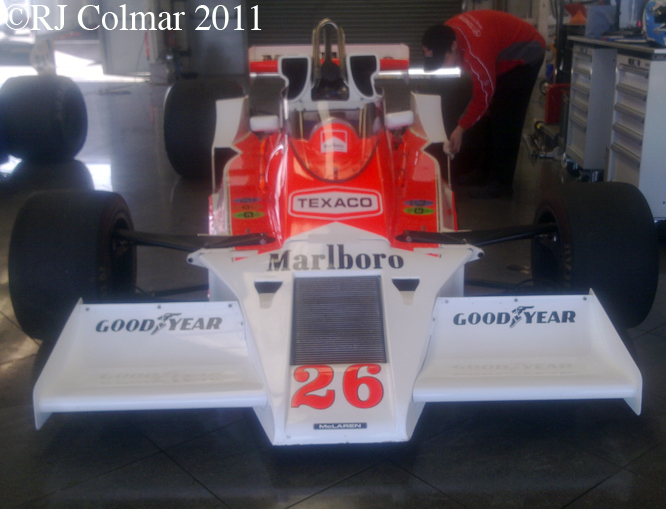
The McLaren M23 was already a four year old design when Gordon Coppucks successor the lower and lighter McLaren M26 was launched in the summer of 1976.
Unfortunately the development of the M26 was almost immediately stifled as James Hunt in his M23 and the team were waging one of the fiercest championship battles in the history of the World Divers Championship to that point in time.
The M26 did race at the Dutch Grand Prix driven by Jochen Mass in 1976 but it was quickly decided that the design needed serious development that was best postponed until the end of the season.
James subsequently won the 1976 World Drivers Championship. I am not sure why the M26 was not ready for the start of the 1977 championship but the older M23 was pressed into a fifth season of competition and it was not until the 10th round of the 17 race Grand Prix schedule that both front line McLaren drivers James Hunt and Jochen Mass had the M26 available to race.
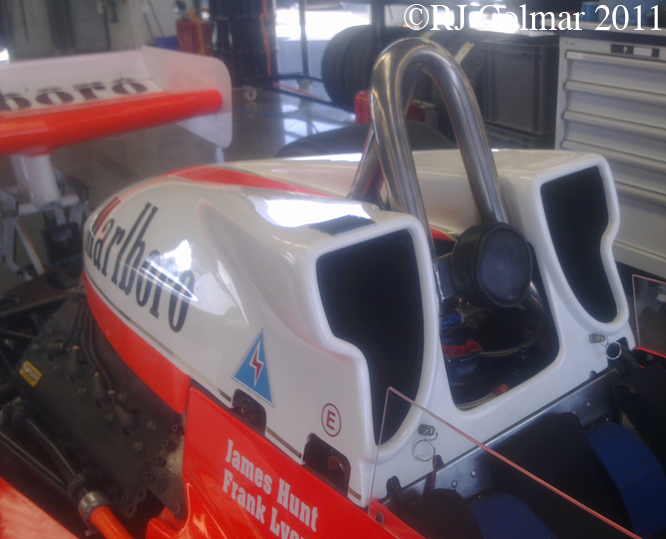
Nearly a year after it was launched, now featuring a radiator mounted in the nose, the car was competitive and at the British Grand Prix in 1977 James recorded the first of three victories driving the M26 model, not enough to defend his World Drivers championship but a respectable achievement none the less.
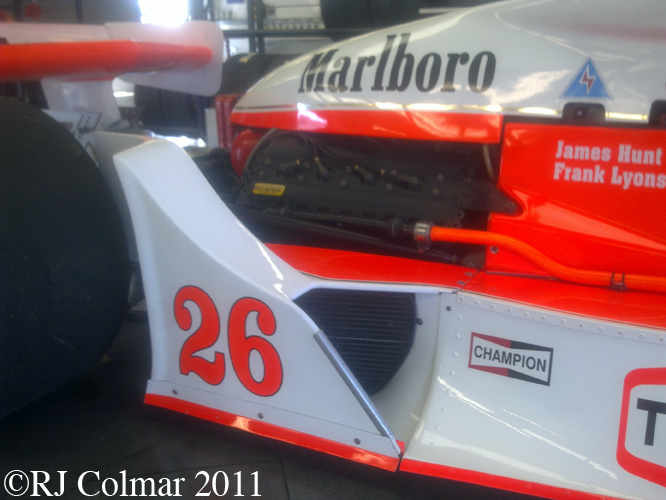
James was not known for his testing skills in the same way as the much vaunted Niki Lauda and so it is perhaps no surprise that for the following 1978 season the development of the M26 did not significantly improve performance.
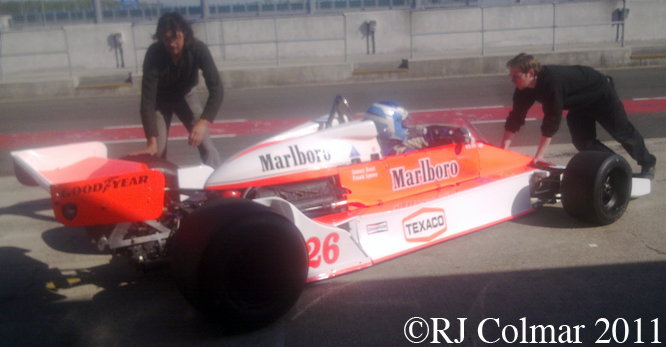
In 1978 the M26 was, like most of the opposition, simply outclassed by the dominant Lotus 79 design which introduced hitherto unimaginably superior handling to Grand Prix racing thanks to the venturi in it's side pods. Hunt left the McLaren Team to rejoin former Hesketh designer Dr Harvey Postlethwaite at Wolf Racing for the 1979 season.
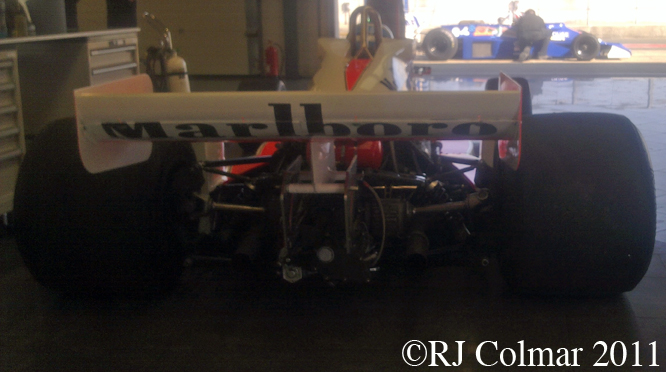
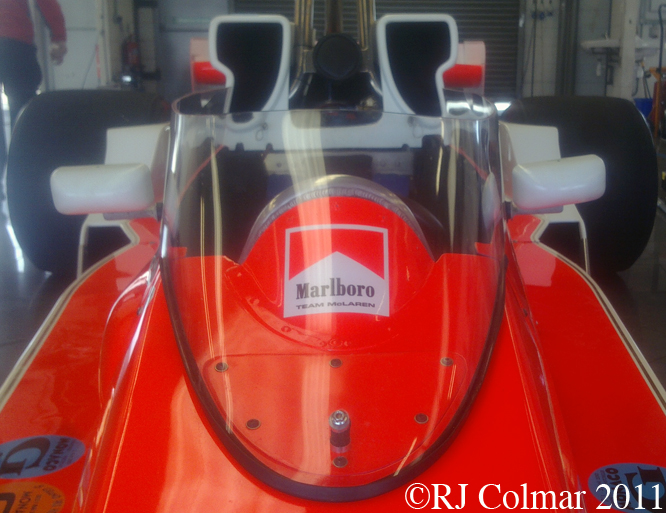
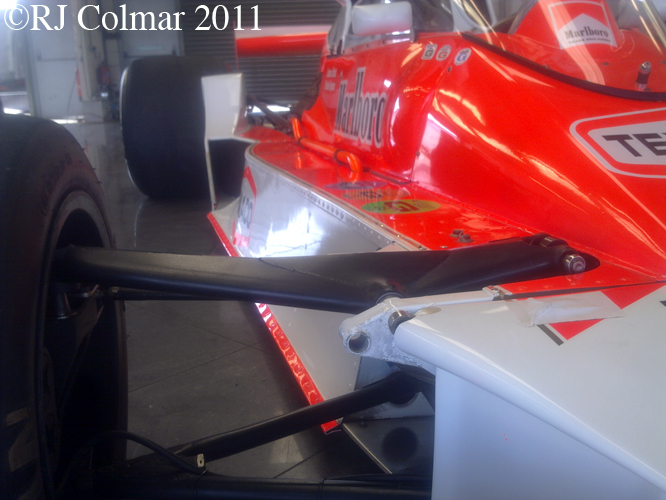
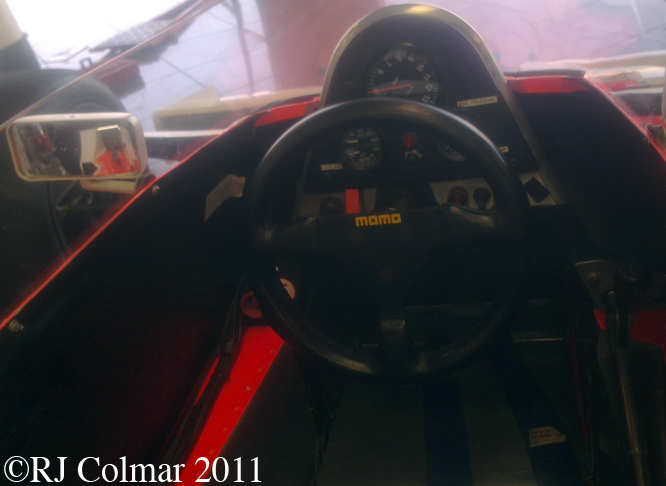
The car featured in these photographs is thought to be chassis M26/1 which was first raced by Jochen Mass in Holland in 1976. The best result for M26/1 was fourth place scored by Jochen Mass behind winner James Hunts similar model at the 1977 British Grand Prix.
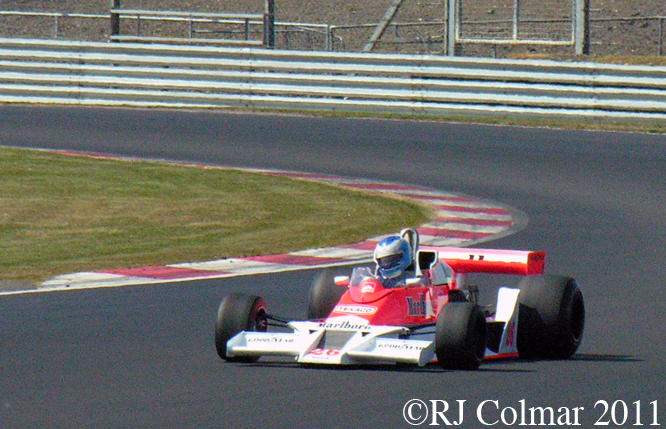
The vehicle is seen here being driven by owner Frank Lyons is expected to take part in this weekends Silverstone Classic race for Formula One cars on Sunday.
My thanks to NZALPA, VINCE H, David Lawson, Tim, Murray, Tony Gallagher, Alan Cox, Pink Snail, David Lawson, hipperson and Geoff Butcher at The Nostalgia Forum for their help identifying the chassis number and driver.
Hope you have enjoyed the Arrested Development edition of 'Gettin' a lil psycho on tyres' and that you'll join me again for a look at a Fittipaldi in Wolf clothing tomorrow. Don't forget to come back now !§
Sunday, 17 July 2011
A Noble Effort - Hesketh Ford 308B # 308-2
Mid way through 1972 James 'Hunt The Shunt' got fired by the STP March Formula 3 team for taking over a vacant seat with a rival team at Monaco after his own car had broken down and been hit by another car.
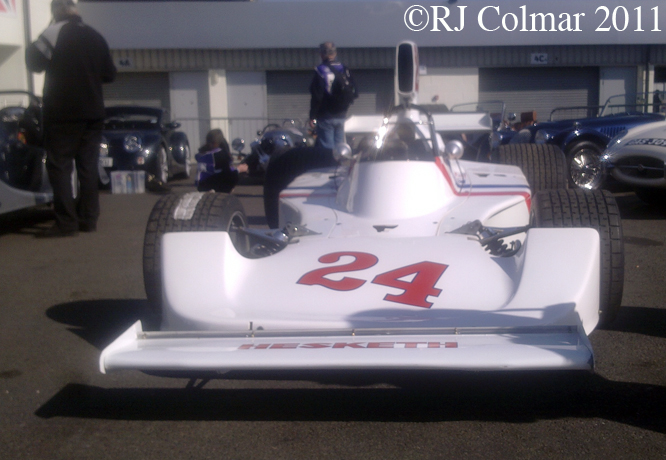
James found himself another ride with the ambitious Hesketh Team founded by Thomas 'Alexander' Fermor-Hesketh, 3rd Baron Hesketh, who inherited his title aged just four.
The Hesketh team were not experiencing much joy in the 2nd tier European Formula 2 championship and in a double or quits move Lord Hesketh decided that he may as well be loosing his fortune in the top tier Grand Prix Championship for the 1973 Season.
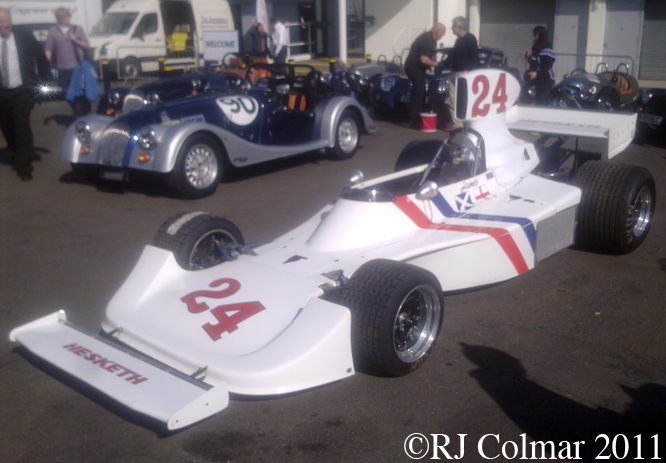
Things picked up rapidly as James quicky found his feet in Grand Prix racing, notably finishing second in the season ending US Grand Prix running Hesketh's March 731 engineered through the season by Dr Harvey Postlethwaite. The Hesketh team also brought a legendary ' joie de vivre' to the Grand Prix paddock.
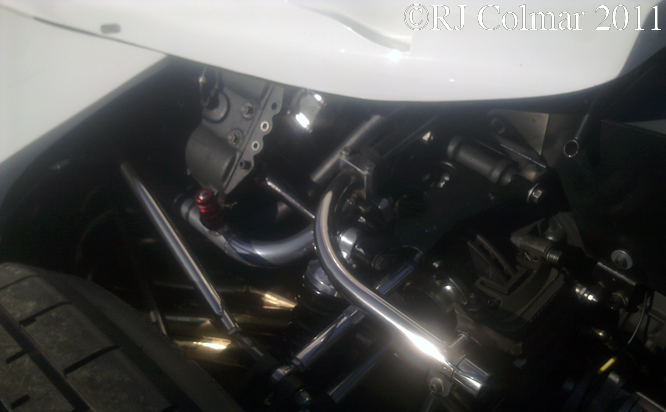
In 1974 Dr. Postlethwaite designed a new car based heavily on the March 731 from the year before. James in the new Hesketh 308 scored a debut pole position at the non championship 1974 Race of Champions ahead of the Ferrari's of Clay Regazzoni and Niki Lauda, and then came home first from pole in the non championship International Trophy at Silverstone.
For the rest of the 1974 season the teams effort suffered from poor reliability mixed with a couple of podium finishes enough for Hesketh to finish a credible 6th in the manufacturers championship and James 8th in the drivers championship.
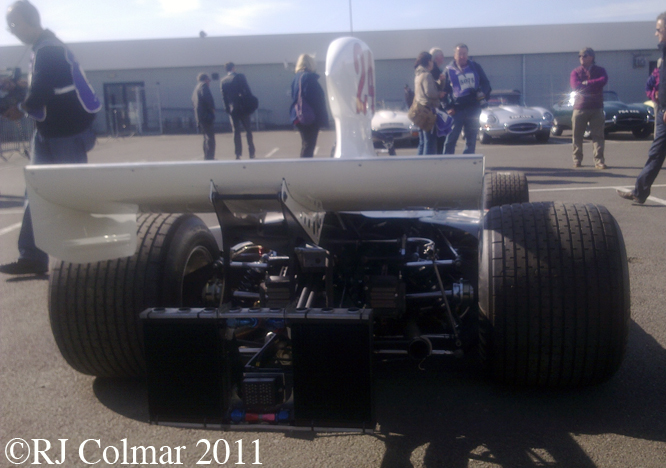
Lord Hesketh was adamant about not accepting sponsorship for his team and the cars were upgraded to 'B' spec for 1975, the front radiator was replaced by radiators mounted beneath the rear wing. The cars reliability was still less than stellar but when he could get across the finish line James always scored points and often podiums.
On the 22nd of June 1975 the team finally came good at the Dutch Grand Prix held on the drying Zandvoort circuit, after making an early pit stop for dry tyres James was able to leap frog leader Niki Lauda when he made his pit stop and held on to take the Hesketh teams only victory, the last ever by an unsponsored team.
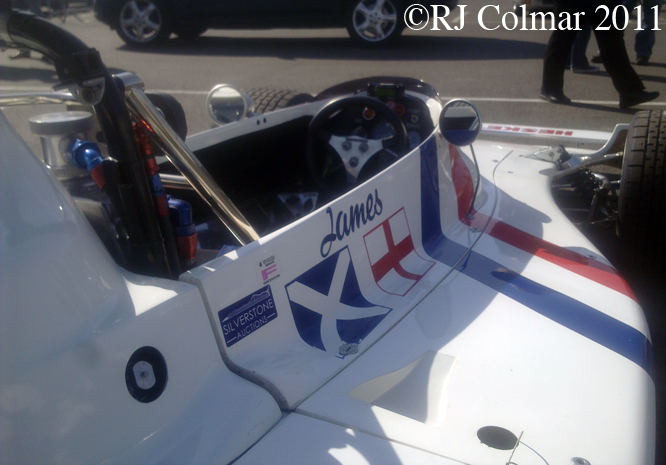
James finished an impressive 4th in the 1975 drivers championship and Hesketh 4th in the constructors championship. Alas the good Lord had to call time on his Grand Prix party for lack of funds and sold up at the end of the season Dr. Postlethwaite and his last Hesketh design 308C joined a partnership between Walter Wolf and Frank Williams, while James Hunt went and drove for McLaren and the remains of the Hesketh team using revised 308B chassis upgraded to 'D' spec continued to participate in the 1976 season under the direction of Bubbles Horsely the team manager.
US readers might remember the Hesketh team going out with a front page bang, in qualifying for the the 1975 James team mate Brett Lunger was launched into flight by a chicane kerbstone and a photo of the Hesketh crashing back to earth made the front pages around the world. Brett and the car recovered to make the start of the race but retired soon after.
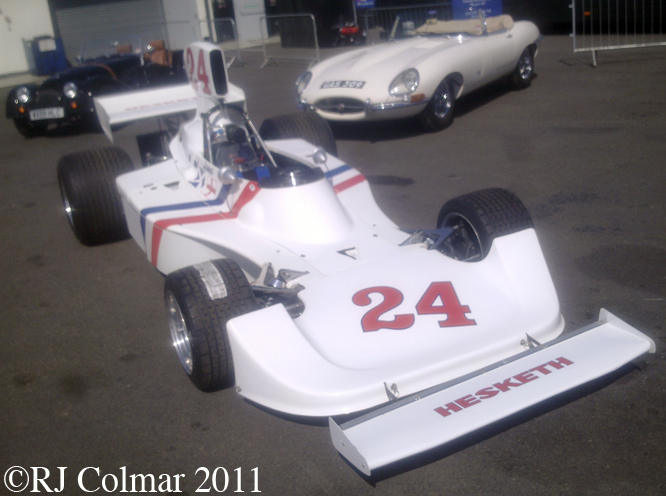
The car featured in today's blog is the #308-2 chassis which James drove to victory in the Dutch GP. It was owned by Lord Hesketh until 2007 and was to be auctioned at the Silverstone Classic Auction next week however it has already been snapped up and sold by private treaty.
Hope you have enjoyed today's Nobel edition of 'Gettin' a lil' psycho on tyres' and that you will join me again tomorrow when I'll be taking a look at James Hunt's world championship winning car. Don't forget to come back now !
James found himself another ride with the ambitious Hesketh Team founded by Thomas 'Alexander' Fermor-Hesketh, 3rd Baron Hesketh, who inherited his title aged just four.
The Hesketh team were not experiencing much joy in the 2nd tier European Formula 2 championship and in a double or quits move Lord Hesketh decided that he may as well be loosing his fortune in the top tier Grand Prix Championship for the 1973 Season.
Things picked up rapidly as James quicky found his feet in Grand Prix racing, notably finishing second in the season ending US Grand Prix running Hesketh's March 731 engineered through the season by Dr Harvey Postlethwaite. The Hesketh team also brought a legendary ' joie de vivre' to the Grand Prix paddock.
In 1974 Dr. Postlethwaite designed a new car based heavily on the March 731 from the year before. James in the new Hesketh 308 scored a debut pole position at the non championship 1974 Race of Champions ahead of the Ferrari's of Clay Regazzoni and Niki Lauda, and then came home first from pole in the non championship International Trophy at Silverstone.
For the rest of the 1974 season the teams effort suffered from poor reliability mixed with a couple of podium finishes enough for Hesketh to finish a credible 6th in the manufacturers championship and James 8th in the drivers championship.
Lord Hesketh was adamant about not accepting sponsorship for his team and the cars were upgraded to 'B' spec for 1975, the front radiator was replaced by radiators mounted beneath the rear wing. The cars reliability was still less than stellar but when he could get across the finish line James always scored points and often podiums.
On the 22nd of June 1975 the team finally came good at the Dutch Grand Prix held on the drying Zandvoort circuit, after making an early pit stop for dry tyres James was able to leap frog leader Niki Lauda when he made his pit stop and held on to take the Hesketh teams only victory, the last ever by an unsponsored team.

James finished an impressive 4th in the 1975 drivers championship and Hesketh 4th in the constructors championship. Alas the good Lord had to call time on his Grand Prix party for lack of funds and sold up at the end of the season Dr. Postlethwaite and his last Hesketh design 308C joined a partnership between Walter Wolf and Frank Williams, while James Hunt went and drove for McLaren and the remains of the Hesketh team using revised 308B chassis upgraded to 'D' spec continued to participate in the 1976 season under the direction of Bubbles Horsely the team manager.
US readers might remember the Hesketh team going out with a front page bang, in qualifying for the the 1975 James team mate Brett Lunger was launched into flight by a chicane kerbstone and a photo of the Hesketh crashing back to earth made the front pages around the world. Brett and the car recovered to make the start of the race but retired soon after.

The car featured in today's blog is the #308-2 chassis which James drove to victory in the Dutch GP. It was owned by Lord Hesketh until 2007 and was to be auctioned at the Silverstone Classic Auction next week however it has already been snapped up and sold by private treaty.
Hope you have enjoyed today's Nobel edition of 'Gettin' a lil' psycho on tyres' and that you will join me again tomorrow when I'll be taking a look at James Hunt's world championship winning car. Don't forget to come back now !
Sunday, 10 July 2011
From Metal Bashing to Autoclave - McLaren MP4/1 #MP4/1-02
Thirty years ago I was extremely lucky to find my self working for six months in an accounts department of a double glazing manufacturer during the one of two industrial experience segments of my degree course. This meant I had the time and funds not only to spend a week at Le Mans but I also had the time and funds to spend a weekend at the British Grand Prix at Silverstone.
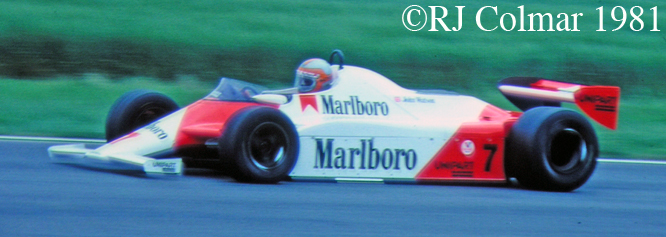
During the 1980 / 1981 off season McLaren's long time sponsor Philip Morris, disappointed with three years of under achievement coerced team principle Teddy Meyer into a merger with Project Four a lower tier Formula 2 team run by Ron Dennis which coincidentally was also sponsored by Philip Morris.
Ron Dennis had hired the designer, of the Chaparral 2K Indy Car, John Barnard to design a new car for McLaren which became known as the MP4/1. Outwardly the car was a conventional 'kit car' using a Cosworth DFV engine that had been the motor of choice since 1966.
However beneath the paint work John Barnhard's chassis was the first to be wholly manufactured with carbon composite materials, which until 1981 had been primarily used in the aerospace industry. Carbon composite materials when pressure and heat treated in an autoclave, a process developed by the Royal Aircraft Establishment in 1963, can be used produce objects that have high flexibility, tensile strength and temperature tolerance while at the same time have low thermal expansion and low weight compared to similar metal objects.
By the end of the 1980's all Formula One chassis were being manufactured from carbon composites along with brake discs and suspension components.
John Watson, seen during practice for the British Grand Prix here, qualified fifth for the 1981 British Grand Prix, at the start of the race the two turbo charged Renaults and Ferrari's made the best get away but on lap 3 Gilles Villeneuve clipped a curb and spun,see clip 1m 20secs, an incident which took out Alan Jones on the spot.
Somehow John Watson who was right behind Jones managed to avoid the melee almost coming to a stop as he did so, which in turn caused his team mate Andrea de Cesaris behind him to take evasive action and spin off into the catch fencing.
After loosing a lot of time Watson set off in sixth place behind Piquet, Reutemann, Pironi, Arnoux and Prost. Piquet crashed out with a puncture, Watson then over took first Reutemann and then Pironi who's engine exploded on the next lap. Prost retired with distributor trouble which put John in 2nd place behind Arnoux who had a comfortable lead.
On lap 53 Arnoux started experiencing the same problems as Prost and 8 laps later a huge roar went round the circuit as Belfast born John took the lead of his home Grand Prix which he held until the end of the race.
This was John's second Grand Prix victory his first was in the Penske PC4 in 1976 and the first victory for McLaren under the guidance of Ron Dennis. McLarens last victory had been with James Hunt in 1977.
John drove this same chassis #MP4/1-02 to victory in the 1982 Belgian Grand Prix.
Hope you have enjoyed today's British GP edition of 'Gettin' a lil' psycho on tyres' and that you will join me again tomorrow. Don't forget to come back now !
PS It is with great sorrow that I learned of the passing of William 'Bill' Boddy MBE known to many as 'WB' who edited Motor Sport magazine from 1936 to 1991, an organ which played no small part in my addiction to motoring and motor sport in the 1970's and ultimately to this blog.
He famously ran Motor Sport magazine through the war years during his spare time while working on important Air Publications.
Bill was a vociferous opponent to the 70 mph speed limits introduced to Britain as a temporary measure by Tom Fraser in 1965 after a spate of accidents in fog and the alleged testing of an AC Cobra at speeds up to 180 mph on the M1 motorway.
WB was aged 98, sincerest condolences to his family and many friends. RIP 'WB'.
During the 1980 / 1981 off season McLaren's long time sponsor Philip Morris, disappointed with three years of under achievement coerced team principle Teddy Meyer into a merger with Project Four a lower tier Formula 2 team run by Ron Dennis which coincidentally was also sponsored by Philip Morris.
Ron Dennis had hired the designer, of the Chaparral 2K Indy Car, John Barnard to design a new car for McLaren which became known as the MP4/1. Outwardly the car was a conventional 'kit car' using a Cosworth DFV engine that had been the motor of choice since 1966.
However beneath the paint work John Barnhard's chassis was the first to be wholly manufactured with carbon composite materials, which until 1981 had been primarily used in the aerospace industry. Carbon composite materials when pressure and heat treated in an autoclave, a process developed by the Royal Aircraft Establishment in 1963, can be used produce objects that have high flexibility, tensile strength and temperature tolerance while at the same time have low thermal expansion and low weight compared to similar metal objects.
By the end of the 1980's all Formula One chassis were being manufactured from carbon composites along with brake discs and suspension components.
John Watson, seen during practice for the British Grand Prix here, qualified fifth for the 1981 British Grand Prix, at the start of the race the two turbo charged Renaults and Ferrari's made the best get away but on lap 3 Gilles Villeneuve clipped a curb and spun,see clip 1m 20secs, an incident which took out Alan Jones on the spot.
Somehow John Watson who was right behind Jones managed to avoid the melee almost coming to a stop as he did so, which in turn caused his team mate Andrea de Cesaris behind him to take evasive action and spin off into the catch fencing.
After loosing a lot of time Watson set off in sixth place behind Piquet, Reutemann, Pironi, Arnoux and Prost. Piquet crashed out with a puncture, Watson then over took first Reutemann and then Pironi who's engine exploded on the next lap. Prost retired with distributor trouble which put John in 2nd place behind Arnoux who had a comfortable lead.
On lap 53 Arnoux started experiencing the same problems as Prost and 8 laps later a huge roar went round the circuit as Belfast born John took the lead of his home Grand Prix which he held until the end of the race.
This was John's second Grand Prix victory his first was in the Penske PC4 in 1976 and the first victory for McLaren under the guidance of Ron Dennis. McLarens last victory had been with James Hunt in 1977.
John drove this same chassis #MP4/1-02 to victory in the 1982 Belgian Grand Prix.
Hope you have enjoyed today's British GP edition of 'Gettin' a lil' psycho on tyres' and that you will join me again tomorrow. Don't forget to come back now !
PS It is with great sorrow that I learned of the passing of William 'Bill' Boddy MBE known to many as 'WB' who edited Motor Sport magazine from 1936 to 1991, an organ which played no small part in my addiction to motoring and motor sport in the 1970's and ultimately to this blog.
He famously ran Motor Sport magazine through the war years during his spare time while working on important Air Publications.
Bill was a vociferous opponent to the 70 mph speed limits introduced to Britain as a temporary measure by Tom Fraser in 1965 after a spate of accidents in fog and the alleged testing of an AC Cobra at speeds up to 180 mph on the M1 motorway.
WB was aged 98, sincerest condolences to his family and many friends. RIP 'WB'.
Thursday, 9 June 2011
Sweet dreams are made of this #2 - Connew PC1 02
Continuing the improbable but never the less true story of the Connew Grand Prix team that I started on Boxing day today I am looking at some of the trials and tribulations the team had preparing for the French Grand Prix in 1972.
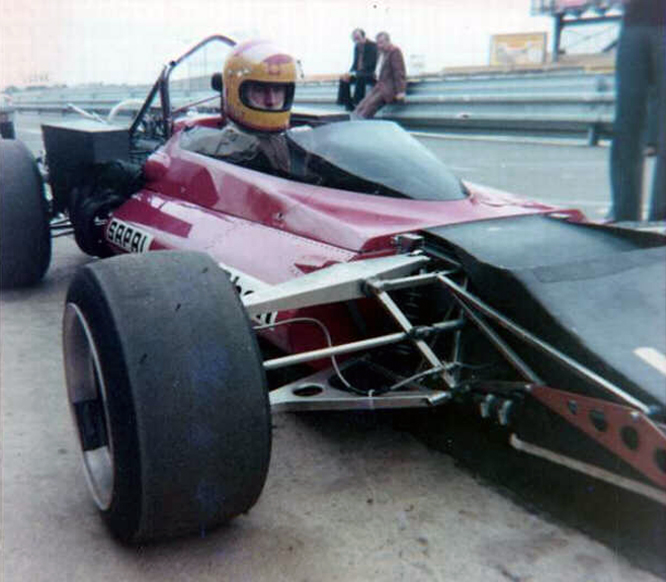
Having built thier car with a dummy engine as seen in the previous Connew blog, Peter managed to secure funding from a French consortium lead by Vincent Mausset to run Francois Migault in 5 races.
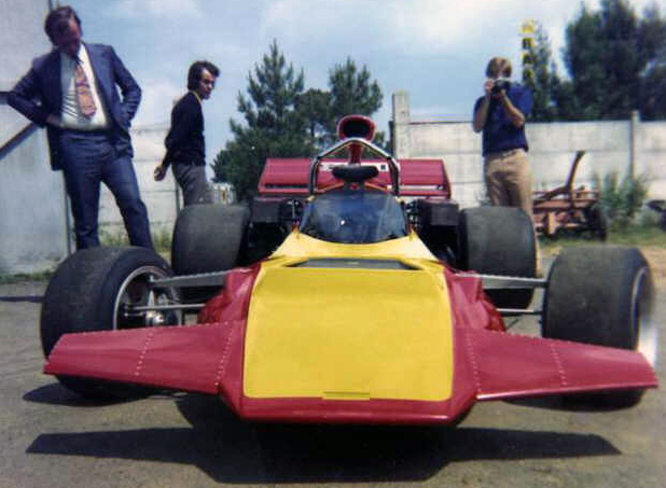
The funding took the form of a 'wad' of French Francs which Peter, his cousin Barry and chief mechanic Roger Doran could only exchange to Pounds Sterling at £30 a time, thanks to foreign currency exchange restrictions in operation at the time.
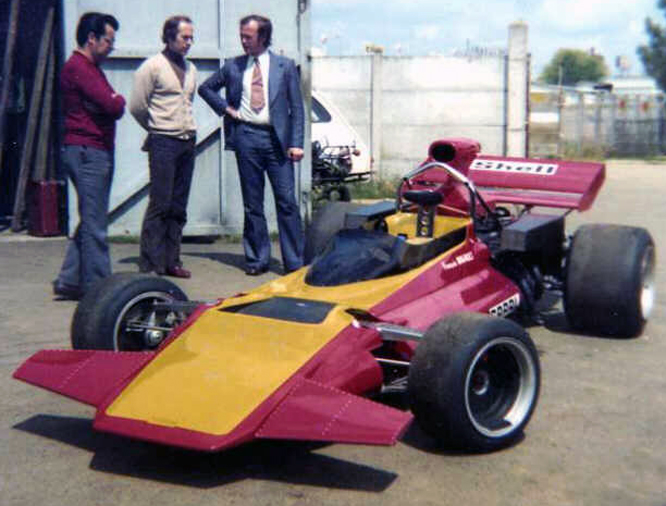
Peter managed to put a deposit down on a second hand Ford Cosworth DFV engine, in need of a rebuild, from Phil Kerr at McLaren, and purchased a brand new gearbox.
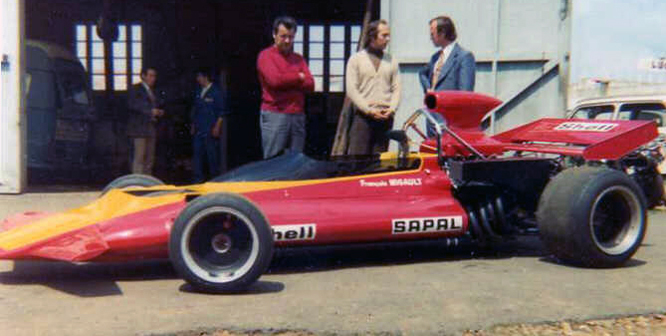
Francois borrowed a truck from his brother who was in the furniture manufacturing business with a company called SAPAL, in return for the truck which was used as the teams transporter SAPAL stickers appeared on the Connew.
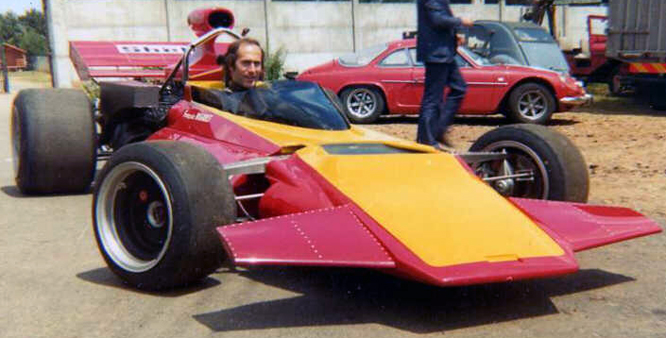
While final preparations of the car were made for it's first Grand Prix and the truck was fitted out for racing car transporter duties, Barry got married, heroically spending just 24 hours with his bride before returning to help the team at it's lockup in Chadwell Heath. FInally the team was ready to go with a truckie named 'Mansell' at the wheel of the SAPAL transporter, in Portsmouth customs officials were reluctant to let the truck leave the country because it was on French registration plates but the driver 'Mansell' was English.
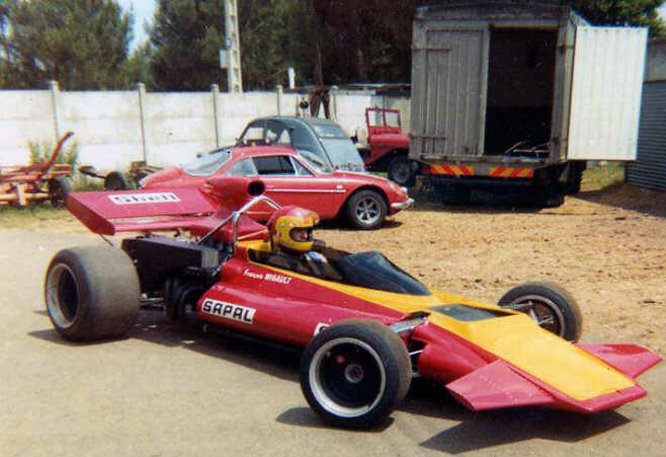
Once in France just outside Le Mans the trucks engine blew up. The truck was towed to Le Mans, Francois home town and the team used the Le Mans Bugatti Circuit, where these photos were taken, to do some testing while the truck was repaired.
On the first day of testing it became apparent that the cars suspension had been damaged in transit and with that the teams plans to go to the French Grand Prix had to be abandoned while repairs to the car were made.
To be continued....
With thanks to Peters cousin Barry Boor for the photographs if you'd like to read the whole story of how the Connew team came together over a period of two years and it's trials and tribulations the year after please read Barry's account of his part in this 'Boys Own' adventure here.
Hope you have enjoyed the second part of the Connew story and that you will join me again tomorrow for Ferrari Friday. Don't for get to come back now !
Having built thier car with a dummy engine as seen in the previous Connew blog, Peter managed to secure funding from a French consortium lead by Vincent Mausset to run Francois Migault in 5 races.
The funding took the form of a 'wad' of French Francs which Peter, his cousin Barry and chief mechanic Roger Doran could only exchange to Pounds Sterling at £30 a time, thanks to foreign currency exchange restrictions in operation at the time.
Peter managed to put a deposit down on a second hand Ford Cosworth DFV engine, in need of a rebuild, from Phil Kerr at McLaren, and purchased a brand new gearbox.
Francois borrowed a truck from his brother who was in the furniture manufacturing business with a company called SAPAL, in return for the truck which was used as the teams transporter SAPAL stickers appeared on the Connew.
While final preparations of the car were made for it's first Grand Prix and the truck was fitted out for racing car transporter duties, Barry got married, heroically spending just 24 hours with his bride before returning to help the team at it's lockup in Chadwell Heath. FInally the team was ready to go with a truckie named 'Mansell' at the wheel of the SAPAL transporter, in Portsmouth customs officials were reluctant to let the truck leave the country because it was on French registration plates but the driver 'Mansell' was English.
Once in France just outside Le Mans the trucks engine blew up. The truck was towed to Le Mans, Francois home town and the team used the Le Mans Bugatti Circuit, where these photos were taken, to do some testing while the truck was repaired.
On the first day of testing it became apparent that the cars suspension had been damaged in transit and with that the teams plans to go to the French Grand Prix had to be abandoned while repairs to the car were made.
To be continued....
With thanks to Peters cousin Barry Boor for the photographs if you'd like to read the whole story of how the Connew team came together over a period of two years and it's trials and tribulations the year after please read Barry's account of his part in this 'Boys Own' adventure here.

Hope you have enjoyed the second part of the Connew story and that you will join me again tomorrow for Ferrari Friday. Don't for get to come back now !
Monday, 6 June 2011
Sundance Winner - Senna
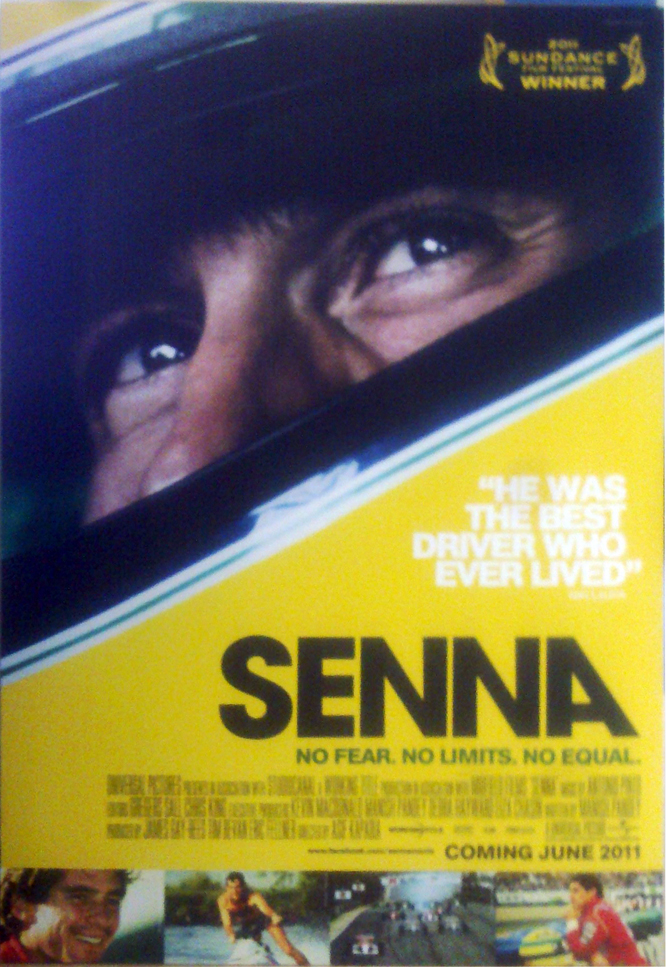
Last night I was taken to the cinema at Watershed in Bristol by a non racing fan Fiona with a professional interest in documentary films to go and see 'Senna' a 90 min documentary about three time Formula 1 World Champion Ayrton Senna.
Directed by Asif Kapadia the film is apparently unusual in being the first such documentary which is made entirely of archive footage for its visuals, with a handful of contemporary voiceovers by persons who knew and were involved with Ayrton during his 34 year life.
The film focuses on Senna's Formula One career from 1984 to 1994 using some excellent TV highlights of his driving prowess mixed with interviews, many of the best conducted in his native Portuguese language, along with drivers meetings which took place before crucial races in Ayrton's career.
I have to confess, perhaps as a result of having become aware of Grand Prix racing at a time when racing drivers were killed at an alarming rate, I was never the biggest of Senna fans. I always respected his achievements but found the aggression, which I saw him display racing wheel to wheel first hand, in the lower formula before he reached Formula One just a little too foolhardy for my tastes.
However this documentary did leave me with a useful reminder and insight into just how exciting Brazilian Ayrton Senna was to watch at the wheel and just how focused he was with the job at hand.
I loved the relatively low fi 80's TV picture quality on the giant cinema screen, and could have easily enjoyed this film if it had been an hour longer in the same vane. Much to my surprise Fiona and her partner Caroline both announced they had also enjoyed it !
This cross gender appeal of the drama of Senna's life no doubt contributed to 'Senna' wining the World Cinema Audience Award at the Sundance Film Festival earlier this year.
No matter how little you know or even like Formula One racing this is a seriously engaging documentary, definitely one not to miss.
My thanks to Fiona for taking me out last night.
Thanks for joining me on today's 'Sundance award winning' edition of 'Gettin' a lil' psycho on tyres', I hope you'll join me again tomorrow. Don't forget to come back now !
Friday, 13 May 2011
A Big Red Cadillac - Ferrari 126 CK
Taking a one day break from GALPOT's Indy 500 celebrations, for Ferrari Friday today we are celebrating the life of Gilles Villeneuve, father of 1995 Indy 500 winner and 1998 World Champion Jaques Villeneuve, and Gilles Ferrari 126 CK seen here during practice for the 1981 British GP at Silverstone.

The Ferrari 128 CK was a development of Ferrari's first turbocharged Grand Prix car which was launched in 1980. Featuring a fire breathing 600 hp 1,496 cc / 91 cui 120º V6 twin turbo charged motor and six speed gearbox Villeneuve described this car as a 'big red Cadillac' because the chronic turbo lag, ferocious power curve combined with ground effect aerodynamics made this car a real handful to keep under control.
Despite it's wayward characteristics Gilles pulled off two of the most entertaining victories this writer has ever seen on TV, the first at Monaco (apologies commentary in German) came after Champion elect Nelson Piquet spun off after leading for 51 laps and reigning Champion Alan Jones experienced a fuel feed problem which allowed Gilles to steal a late victory on the one circuit least suited to his cars few strengths.
Two weeks later Gilles pulled off an even more unlikely victory at the equally tight and unsuited Jarama Circuit this time Villeneuve took the lead after 14 laps when reigning Champion Jones spun off. Gilles kept a four car train behind him for the rest of this exciting race by using the Ferrari's brutal power on the straights to pull away out of the corners, going round the corners his pursuers bunched up time after time but did not have the brute strength to get an edge on the straights.
The finish of the 1981 Spanish Grand Prix was one of the closest in history with the first five cars being separated by 1.24 seconds. Sadly this would be the last time Gilles would take the checkered flag.
By the time Ferrari had arrived in Britain they were developing a to minimise turbo lag by injecting fuel into the red hot turbo exhaust pipe when the throttle was off, as the fuel ignited in the turbo exhaust pipe a vacuum was created between the burning fuel and turbo outlet which caused the turbo to spin faster so that when the throttle was depressed turbo boost was more readily available. When ever the 126 CK was off throttle a flame would appear licking out of the exhausts.
At some point this system was banned, it being successfully argued by teams using naturally aspirated motors that the turbo afterburner constituted a second engine, when the rules clearly stated only one motor was allowed.
At the British Grand Prix, apologies Austrian commnetary, Gilles qualified 8th and made up five places on the opening lap before loosing it on the apex of the last corner of the first lap. Notice in the clip that despite his totalled car Gilles somehow manages to squeeze another 1/4 lap out of the car before retiring, this guy just did not know how to stop when the chips were down.
Another memorable performance that emphasised Gilles never say die attitude came at the 1981 Canadian Grand Prix where despite his damaged front wing obscuring his vision and adversely affecting the already poor handing of his Ferrari for numerous laps, Gilles kept his car on the black stuff to record an amazing third place finish.
Gilles was killed in an accident during practice for the Belgian Grand Prix, May 8th 1982
Salute Gilles RIP.
Hope you will join me for another edition of 'Gettin' a lil' psycho on tyres' tomorrow. Don't forget to come back now !
The Ferrari 128 CK was a development of Ferrari's first turbocharged Grand Prix car which was launched in 1980. Featuring a fire breathing 600 hp 1,496 cc / 91 cui 120º V6 twin turbo charged motor and six speed gearbox Villeneuve described this car as a 'big red Cadillac' because the chronic turbo lag, ferocious power curve combined with ground effect aerodynamics made this car a real handful to keep under control.
Despite it's wayward characteristics Gilles pulled off two of the most entertaining victories this writer has ever seen on TV, the first at Monaco (apologies commentary in German) came after Champion elect Nelson Piquet spun off after leading for 51 laps and reigning Champion Alan Jones experienced a fuel feed problem which allowed Gilles to steal a late victory on the one circuit least suited to his cars few strengths.
Two weeks later Gilles pulled off an even more unlikely victory at the equally tight and unsuited Jarama Circuit this time Villeneuve took the lead after 14 laps when reigning Champion Jones spun off. Gilles kept a four car train behind him for the rest of this exciting race by using the Ferrari's brutal power on the straights to pull away out of the corners, going round the corners his pursuers bunched up time after time but did not have the brute strength to get an edge on the straights.
The finish of the 1981 Spanish Grand Prix was one of the closest in history with the first five cars being separated by 1.24 seconds. Sadly this would be the last time Gilles would take the checkered flag.
By the time Ferrari had arrived in Britain they were developing a to minimise turbo lag by injecting fuel into the red hot turbo exhaust pipe when the throttle was off, as the fuel ignited in the turbo exhaust pipe a vacuum was created between the burning fuel and turbo outlet which caused the turbo to spin faster so that when the throttle was depressed turbo boost was more readily available. When ever the 126 CK was off throttle a flame would appear licking out of the exhausts.
At some point this system was banned, it being successfully argued by teams using naturally aspirated motors that the turbo afterburner constituted a second engine, when the rules clearly stated only one motor was allowed.
At the British Grand Prix, apologies Austrian commnetary, Gilles qualified 8th and made up five places on the opening lap before loosing it on the apex of the last corner of the first lap. Notice in the clip that despite his totalled car Gilles somehow manages to squeeze another 1/4 lap out of the car before retiring, this guy just did not know how to stop when the chips were down.
Another memorable performance that emphasised Gilles never say die attitude came at the 1981 Canadian Grand Prix where despite his damaged front wing obscuring his vision and adversely affecting the already poor handing of his Ferrari for numerous laps, Gilles kept his car on the black stuff to record an amazing third place finish.
Gilles was killed in an accident during practice for the Belgian Grand Prix, May 8th 1982
Salute Gilles RIP.
Hope you will join me for another edition of 'Gettin' a lil' psycho on tyres' tomorrow. Don't forget to come back now !
Sunday, 26 December 2010
Sweet dreams are made of this - Connew PC1 02

Imagine a recently graduated 24 year old industrial designer, who knows nothing about motor sport, but with a passing interest in large American chromed land yachts sitting in an office designing record players in East London, i pods if your not sure of what a record player is, and the phone rings. His friends are calling to see if he would like to join them on holiday with the intention of taking in the 1969 Italian Grand Prix.


When his boss tells our hero that it is not okay to take the time of work to go on holiday our hero offers his resignation, and joins his friends anyway.

At the Italian GP our hero falls in love with the sound of V12 engines as they accelerate between the corners of the Monza track.


Upon returning to England he finds out about a vacancy in the drawing office of a newly established Grand Prix team owned by a former multiple World Motor Cycle champion and one time World Grand Prix champion.

Our hero's attitude 'that there was no problem in this world that common sense and application with half an ounce of intelligence can not overcome' wins him the job, starting out knowing absolutely zero about the design of racing cars within months he is working on the design of a Grand Prix car.

When our hero sees the red car his new design is going to replace wheeled out into the sunshine for the first time, in that very instant he decides he is going to build a Grand Prix vehicle of his very own.

Our hero starts working from home, his parents home that is, on his own Grand Prix challenger, a friend tells our hero he may use a spare bedroom and lock up to start building his car, other friends chip in with time, suppliers 'lend' him various bits and pieces to be getting on with. As the design our hero then takes a job with an engineering company where he uses his and colleagues lunch hours to fabricate parts he cannot otherwise afford for his own Grand Prix challenger.


12 months after deciding to build his very own Grand Prix car our hero completes his chassis and he shows it to his cousin, a wood work teacher, who agrees to to join the team to make the bodywork using materials he has never used before.

Using only our heros own wages, friends time, goodwill and what can be scrounged including a dummy engine, once used by Jochen Rindt to win the 1969 US Grand Prix, gearbox and wheels our heros team push their improbably completed Grand Prix car one Sunday night out of it's lock up, down the London Rd in Chadwell Heath to the only place with enough light to take a photo of their pride and joy, the forecourt of their local petrol station.


If this story sounds incredible then I'd like to welcome you to the incredible story of Peter Connew who in 36 months made the transition from record player designer to Formula One designer and constructor of the Connew PC1 02 Grand Prix car seen here in late 1971. To be continued....
With thanks to Peters cousin Barry Boor for the photographs if you'd like to read the whole story of how the Connew team came together over a period of two years and it's trials and tribulations the year after please read Barry's account of his part in this 'Boys Own' adventure here.

Hope you enjoyed part one of my all time favourate Formula One story which will be continued at some future date, and that you'll join me tomorrow for a look at some teutonic efficiency at 'Gettin' a lil' psycho on tyres'. Don't forget to come back now !
Sunday, 3 October 2010
Keep turning right - 2010 Somerset Grand Prix

Yesterday I took a couple of hours off to visit Oak Tree Arena home of Somerset Raceway. Finding it was none to easy as the track, which opened in 2008 has yet to be photographed for Google Earth, however it's off Junction 22 of the M5 on the A38 heading for Bridgewater, a tad south of Burnham Without.

I didn't spot the signage first time but a local resident kindly pointed me in the right direction.

Above Dan Lewis Class 5 Mini.
This weekends event was billed as the Somerset Grand Prix, a round of the 2010 National Autograss Championship, hosted by the South Somerset Auto Grass Club under the National Autograss Sport Associations governance.

Above Otis Williams, Class 1 (Junior), Mini.
NASA promotes Autograss as a family sport catering for Juniors aged 12

Above, Paul, Fackerells, Class 10, Special.
with Seniors starting at 16 and allegedly running up to and over 70 !

Above, John Gays Class 7 Suzuki SC100.
Cars run in 10 classes which split into bodied

Above open wheel Specials.
and space frame open wheel specials.

Above Peugeot 205 & Vauxhall Nova.
NASA Autograss racing is a non contact sport run professionally for amateurs, the racing is close, and atmosphere friendly. I look forward to watching how the the Oak Tree Arena develops as a venue in the future. One things for sure I'll certainly be going back.
Further NASA fixtures can be seen here. Information about the South Somerset Autograss Club can be found here.
Don't forget to come back now ! Hear ?
Subscribe to:
Posts (Atom)