
Showing posts with label Kraft. Show all posts
Showing posts with label Kraft. Show all posts
Wednesday, 22 July 2015


Sunday, 8 May 2011
Winning in the rain - Wynn's Friction Proofing Special
To accommodate Ferrari Friday I got a little out of sequence with my posts celebrating the Centenary of the first running of the Indianapolis 500, today we are looking at the 1950 Wynn's Friction Proofing Special, thanks to a photograph taken by Ed Arnaudin in 1980.

Frank Kurtis the designer of extremely successful midget, 1/4 midget, sports and sprint cars also designed and built some 120 Champ cars for the Indianapolis 500, marketed and manufactured under the Kurtis Kraft name.
His creations took five victories between 1950 to 1955, so it is no stretch to say Kurtis dominated at Indianapolis in the first half of the 1950's.
The first Indy 500 winner Kurtis Kraft built was the Wynn's Friction Proofing Special seen in today's photograph, the car was powered with a ubiquitous, for the period, 4,424 cui / 270 cui 4 cylinder twin overhead cam Offenhauser motor.
Driving the Wynn's Friction Special in 1950 was Johnnie Parsons who won the rain shortened 'Indy 500' on just his second attempt. Due to an engravers error, Johnnie's name was spelt incorrectly on the Borg Warner trophy, an error that was not corrected until the trophy was refurbished in 1991. Until then I am sure Johnnie's son Johnny probably enjoyed having his name on the trophy even though it was next to his Dad's face.
Johnnie took part in 10 Indy 500's from 1949 - 1958, his best finishes beside the win were 2nd in 1949 and 4th in 1956. Parsons also won the Turkey Night Grand Prix for midgets in 1955, a race won more recently by NASCAR drivers Jason Lefler in 1999 and Tony Stewart in 2000.
My thanks to Steve Arnaudin for scanning his Dads photograph.
Hope you have enjoyed today's rained out edition of 'Gettin' a lil' psycho on tyres' and that you will join me again tomorrow. Don't forget to come back now !
29 05 11 Errata, thanks to evidence provided by Tim Murray it turns out that as of 2005 the Johnny Parsons spelling error had not been corrected. Apologies for any confusion caused.
Frank Kurtis the designer of extremely successful midget, 1/4 midget, sports and sprint cars also designed and built some 120 Champ cars for the Indianapolis 500, marketed and manufactured under the Kurtis Kraft name.
His creations took five victories between 1950 to 1955, so it is no stretch to say Kurtis dominated at Indianapolis in the first half of the 1950's.
The first Indy 500 winner Kurtis Kraft built was the Wynn's Friction Proofing Special seen in today's photograph, the car was powered with a ubiquitous, for the period, 4,424 cui / 270 cui 4 cylinder twin overhead cam Offenhauser motor.
Driving the Wynn's Friction Special in 1950 was Johnnie Parsons who won the rain shortened 'Indy 500' on just his second attempt. Due to an engravers error, Johnnie's name was spelt incorrectly on the Borg Warner trophy, an error that was not corrected until the trophy was refurbished in 1991. Until then I am sure Johnnie's son Johnny probably enjoyed having his name on the trophy even though it was next to his Dad's face.
Johnnie took part in 10 Indy 500's from 1949 - 1958, his best finishes beside the win were 2nd in 1949 and 4th in 1956. Parsons also won the Turkey Night Grand Prix for midgets in 1955, a race won more recently by NASCAR drivers Jason Lefler in 1999 and Tony Stewart in 2000.
My thanks to Steve Arnaudin for scanning his Dads photograph.
Hope you have enjoyed today's rained out edition of 'Gettin' a lil' psycho on tyres' and that you will join me again tomorrow. Don't forget to come back now !
29 05 11 Errata, thanks to evidence provided by Tim Murray it turns out that as of 2005 the Johnny Parsons spelling error had not been corrected. Apologies for any confusion caused.
Saturday, 7 May 2011
Fearless Freddy and the Cummins Diesel Special
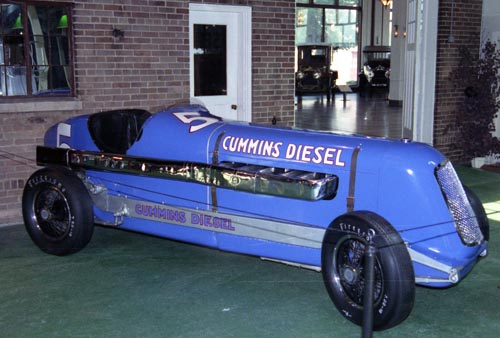
Staying with the 1952 Indy 500 which I started to look at yesterday today we are looking at the Cummins Diesel Special, thanks to a photograph taken by Ed Arnaudin in 1982.

The history of Cummins the diesel engine manufacturer dates back to 1919 Clessie Cummins set out to exploit the hitherto unrealised commercial potential of Rudolf Diesels high compression thermal engine which takes it's name from it's inventor the diesel engine.
Based in Colombus Indiana Cummins a self taught engineer was also quick to spot opportunities to promote his products through events like the Indy 500 and in 1931 entered a car built around a Duesenberg road car chassis fitted with an 85 hp Cummins deisel marine engine which started last but thanks to it's fuel economy came home 13th and in the process became the first car ever to complete the Indy 500 without making a pitstop.
This car was subsequently prepared for use on the road and used by Cummins and his marketing manager WG Irwin on a promotional tour of Europe.
In 1934 Cummins returned with a two car entry the #5 powered by a two stroke diesel which went the distance coming in 12th and the #6 by a 4 stroke diesel which retired with transmission failure.
In 1950 Cummins returned to the Brickyard with the #61 Cummins Deisel 'Green Hornet' a 340 hp supercharged diesel sitting in a Kurtis Kraft chassis driven by Jimmy Jackson who started 32nd and retired after 50 laps of the rain shortened race. The Green Hornet would take the diesel land speed record at Bonneville after it was timed at 165 mph on the famous salt flats.
For 1952 Cummins held nothing back from their Indy 500 programme working again with Kurtis Kraft the chassis now accommodated a 380 hp 6.6 litre / 401 cui six cylinder turbocharged engine, mandated at twice the size of the gasoline powered vehicles in the race.
The motor featured an aluminium block and head with a magnesium crank case, this unit was lain 5 degrees off flat which gave the #28 three advantages, reduced centre of gravity, reduce the frontal area and thanks to the offset engine some of it's weight could be distributed so that the car was heavier on the left (inside) wheels.
Fearless Fred Agabashian was hired to drive the Cummins Diesel Special on the recommendation of Kurtis. After the car was tested for the first time the team, comprising almost entirely regular Cummins employees who worked as engineers and mechanics apart from the driver, knew they had a veritable 'Rocketship' on their hands.
Fred sandbagged for much of the month of May until Pole day by lifting off on the back straight one lap cruising through a turn on another never completing a whole lap under full power so as not to draw attention to the 'Rocketship' capability of the car and risk having the rules changed.
Come 5:45 pm on pole day Fred and the heavy, 3,100 lb, Cummins Diesel Special fitted with a fresh engine made their mark on the world of motor sport by setting an individual lap record of 139 mph and a record 4 lap average of 138 mph.
Qualifying over 1 mph faster than the next nearest competitor in one of the most famous races in the world with a vehicle powered by what was in essence a truck engine subsequently repaid Cummins investment many times over in the volume of publicity this feat generated.
Having shredded their tyres in qualifying the Cummins team needed a different strategy in the race and planned to run a half a tank of diesel and make one pit stop for fuel and tyres. The heavy Cummins Diesel Special was in good company with Ascari and his heavy Ferrari, both cars bogged down at the start but climbed through the field.
Agabashain in the Cummins was running as high as fifth when the car probably claimed a world first, retirement due to.... turbo failure after 71 laps, the air intake for the turbocharger, placed low in the nose, had sucked up debris into the turbine housing damaging the blades.
Cummins however were not in the least disappointed they remain the only manufacturer of truck engines to have recorded an Indy 500 pole. An achievement possibly only eclipsed recently by the 4 victories Audi Diesels in the Le Mans 24 hours since 2006, interrupted by a Peugeot Diesel victory in 2009.
A small post script allegedly in 1953 a spark plug manufacturer was advertising its wares, in the 1953 Indy 500 programe, with a picture of the 1952 Cummins Diesel Special, the only car in the 1952 field without need of them.
My thanks to Steve Arnaudin for scanning and forwarding his Dad's photograph.
Hope you have enjoyed today's TD edition of 'Gettin' a lil, psycho on tyres' and that you will join me again tomorrow. Don't forget to come back now !
The history of Cummins the diesel engine manufacturer dates back to 1919 Clessie Cummins set out to exploit the hitherto unrealised commercial potential of Rudolf Diesels high compression thermal engine which takes it's name from it's inventor the diesel engine.
Based in Colombus Indiana Cummins a self taught engineer was also quick to spot opportunities to promote his products through events like the Indy 500 and in 1931 entered a car built around a Duesenberg road car chassis fitted with an 85 hp Cummins deisel marine engine which started last but thanks to it's fuel economy came home 13th and in the process became the first car ever to complete the Indy 500 without making a pitstop.

This car was subsequently prepared for use on the road and used by Cummins and his marketing manager WG Irwin on a promotional tour of Europe.

In 1934 Cummins returned with a two car entry the #5 powered by a two stroke diesel which went the distance coming in 12th and the #6 by a 4 stroke diesel which retired with transmission failure.

In 1950 Cummins returned to the Brickyard with the #61 Cummins Deisel 'Green Hornet' a 340 hp supercharged diesel sitting in a Kurtis Kraft chassis driven by Jimmy Jackson who started 32nd and retired after 50 laps of the rain shortened race. The Green Hornet would take the diesel land speed record at Bonneville after it was timed at 165 mph on the famous salt flats.

For 1952 Cummins held nothing back from their Indy 500 programme working again with Kurtis Kraft the chassis now accommodated a 380 hp 6.6 litre / 401 cui six cylinder turbocharged engine, mandated at twice the size of the gasoline powered vehicles in the race.
The motor featured an aluminium block and head with a magnesium crank case, this unit was lain 5 degrees off flat which gave the #28 three advantages, reduced centre of gravity, reduce the frontal area and thanks to the offset engine some of it's weight could be distributed so that the car was heavier on the left (inside) wheels.
Fearless Fred Agabashian was hired to drive the Cummins Diesel Special on the recommendation of Kurtis. After the car was tested for the first time the team, comprising almost entirely regular Cummins employees who worked as engineers and mechanics apart from the driver, knew they had a veritable 'Rocketship' on their hands.
Fred sandbagged for much of the month of May until Pole day by lifting off on the back straight one lap cruising through a turn on another never completing a whole lap under full power so as not to draw attention to the 'Rocketship' capability of the car and risk having the rules changed.
Come 5:45 pm on pole day Fred and the heavy, 3,100 lb, Cummins Diesel Special fitted with a fresh engine made their mark on the world of motor sport by setting an individual lap record of 139 mph and a record 4 lap average of 138 mph.
Qualifying over 1 mph faster than the next nearest competitor in one of the most famous races in the world with a vehicle powered by what was in essence a truck engine subsequently repaid Cummins investment many times over in the volume of publicity this feat generated.
Having shredded their tyres in qualifying the Cummins team needed a different strategy in the race and planned to run a half a tank of diesel and make one pit stop for fuel and tyres. The heavy Cummins Diesel Special was in good company with Ascari and his heavy Ferrari, both cars bogged down at the start but climbed through the field.
Agabashain in the Cummins was running as high as fifth when the car probably claimed a world first, retirement due to.... turbo failure after 71 laps, the air intake for the turbocharger, placed low in the nose, had sucked up debris into the turbine housing damaging the blades.
Cummins however were not in the least disappointed they remain the only manufacturer of truck engines to have recorded an Indy 500 pole. An achievement possibly only eclipsed recently by the 4 victories Audi Diesels in the Le Mans 24 hours since 2006, interrupted by a Peugeot Diesel victory in 2009.
A small post script allegedly in 1953 a spark plug manufacturer was advertising its wares, in the 1953 Indy 500 programe, with a picture of the 1952 Cummins Diesel Special, the only car in the 1952 field without need of them.
My thanks to Steve Arnaudin for scanning and forwarding his Dad's photograph.
Hope you have enjoyed today's TD edition of 'Gettin' a lil, psycho on tyres' and that you will join me again tomorrow. Don't forget to come back now !
Subscribe to:
Posts (Atom)