Tuesday, 11 January 2011

Two Cats in Hollywood - D-type XKD 531 & C -type XKC 007

Thanks again go to Steve & Ed Arnaudin for providing today's unusual photograph which Ed purchased somewhere around 1958/59.

Jaguar D and C types

Photo by Carlyle Blackwell, Publised Courtesy Blackwell Archive, for sales enquiry's please e-mail infoATpsychoontyres.co.uk and your contact details will be forwarded to the Blackwell Archive.

Extensive research on The Nostalgia Forum has revealed that not only the cars but also the lead driver AND the photograph itself all have stories to tell.

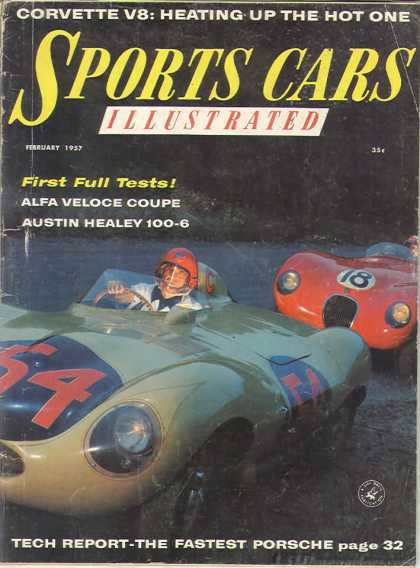
This photograph appears to have been taken in the studio by Carlyle Blackwell around 1956/57, when he was the owner of the red #18 C-Type XKC 007 which he raced between 1955 and 1957. The #54 D-type is thought to be XKD 531 owned and raced by J Douglas.

It should be noted that this blog is a research project in progress and the identification of the chassis numbers is still not definitive. I have tried to reach the copyright holders but so far in vain so it is possible I might have to withdraw this blog at some point.

The D-type Jaguar like the C-Type was a factory built racing car powered by a variation of the same XK engine design as the XK 120, XK 140 and C-type.

Like the late C-Type the D-Type was fitted with efficient disc brakes. It's debut at Le Mans in 1954 was thwarted by sand in the fuel, once it was removed Duncan Hamilton & Tony Rolt took their D-type back up the field to second place 1 lap down on the winning Ferrari of Jóse Frolián González and Maurice 'Racing Is Life' Trintignant.

The following year Mike Hawthorn and Ivor Beub driving a D-Type won a hollow Le Mans Victory after the Mercedes Benz team withdrew following the horrendous crash in which an estimated 83 spectators lost their lives and a further 120 were injured.

D-types entered by the private Ecurie Ecosse team took two further victories in '56 and '57.

The #54 XKD 531, which I believe we are looking at here, is one of 53 customer D-types, this one was raced from 1956 to 1957 by J Douglas and then from 1958 to at least 1959 by Ray Seher.

The red #18 C-type XKC 007 was originally owned by Charles H Hornburg Jnr who had future US World Champion Grand Prix driver Phil Hill drive it to two victories in 1952, Phil said of XKC 007 " It was the first car I ever drove that had a really precise feel about it – it really felt like a racing car.”

Carlyle Blackwell acquired the car in 1955 and raced it through to the end of 1957 before acquiring the D-type XKD 528.

Jaguar D Type

Photo by Carlyle Blackwell, Publised Courtesy Blackwell Archive, for sales enquiry's please e-mail infoATpsychoontyres.co.uk and your contact details will be forwarded to the Blackwell Archive.

The story of this photo does not stop with the cars however, look closely at the driver of the #54 and some of you might recognise the face as none other than that of Emmy winning writer Jack Douglas.

A detail of this photograph appeared on the cover of Sports Car Graphic in March 1963 the masthead reads "If the face on this month's cover looks familiar, it should be. It belongs to Jack Douglas, writer, author of among other things, "My brother was an only child", and sometime race driver. The photo was shot by his friend, Hollywood photographer Carlyle Blackwell."

Jaguar D Type

Photo by Carlyle Blackwell, Publised Courtesy Blackwell Archive, for sales enquiry's please e-mail infoATpsychoontyres.co.uk and your contact details will be forwarded to the Blackwell Archive.

The whole photograph as seen at the top of the blog first appeared on the cover of Sports Car Illustrated in February 1957 with a masthead that reads "Carlyle Blackwell shot this Ektachrome of a pair of competition Jaguars booming through the night."
As can be seen studio lights are used to illuminate both drivers and the front of the #18.

Note how the colour from Ed's purchased slide has darkened around an apparently ivory car, while the colour of the car as it appears on the cover of Sports Car Illustrated appears yellowish, the colour of Jacks car at the time has been described as 'mustard yellow' which only goes to show how unreliable photographs can be when trying to identify vehicles back in the day.

To date this is without doubt one of the most fascinating photographs I have ever come across. My thanks to Steve and particularly Ed Arnaudin who first purchased the photograph. Thanks also to everyone on the Auto Slides by Blackwell thread on The Nostalgia Forum for their invaluable contributions including, RA Historian Tom, Frank Barrett, Jean L, Jerry Entin, Frank Sheffield, Frank Hill, JB Miltonian, and raceanouncer 2003 Vince H.

I hope anyone believing they can improve on the accuracy of my hypothesis about this photo or with contacts leading to the Blackwell estate will chime in below.

Hope you have enjoyed this 'Carceology' edition of "Getting a lil' psycho on tyres' and that you will join me again tomorrow to see a 'mystery' vehicle with a Cat under the hood. Don't forget to come back now !

28 07 12 PS My thanks to Pamela Blackwell who has kindly retrospectively given me permission to post the photo's her father took.

Pamela tells me that her brother is seen at the wheel of the #18 Jaguar C-type in the photograph and that the photo was taken in Carlyle Blackwell's driveway.

Monday, 10 January 2011

Gordon MacKenzie's Cockpit - #52 C-type Jaguar XKC 030

It's a great pleasure to share another of Ed Arnaudin's photographs on 'Gettin' a lil pyscho on tyres' sticking with this weeks Jaguar theme today we have Gordon Mackenzie's C-type Jaguar in the paddock at Lime Rock in April 1959.


The C-type is the competition version of the XK 120 with a lightweight aerodynamic aluminium body built around a tubular frame. 52 C-types were built powered by a 205 hp version of the XK engine one of which driven by Peters Whitehead & Walker won Le Mans in 1951.

In 1953 with an engine tuned to 220 hp, thanks to a switch from triple SU carburettors to Webbers and a chassis fitted with disc brakes Duncan Hamilton & Tony Rolt drove their C-type to Jaguars second Le Mans win.

XKC 030 had been raced by amongst others by David Hirsch and both Virginia and Loyal Katsee, when after rolling his XK 120 in 1957 Gordon McKenzie acquired it and subsequently used it with varying degrees of success all the way through to 1962.

Gordon MacKenzie came home 5th behind the #25 Ferrari TRC of G Andrey and 2 spots ahead of Bob Grossman's 250 GT California on this particular day.

John Aibel informs me that Gordon McKenzie was a well known racing instructor in the North East States and is still active in Vintage SCCA events.

My thanks to Ed & Steve Arnaudin for the photograph, John Aibel and Terry O'Neil for background information.

Hope you have enjoyed to today's lightweight edition of 'Gettin' a lil' psycho on tyres' and that you'll join me again tomorrow for two cats in a Hollywood studio. Don't forget to come back now !

Sunday, 9 January 2011

Big Cat in Northern Rhodesia - Jaguar XK 140 FHC


The XK 140 was in production from 1954, 1955 model year, to 1957. Improvements over the XK 120 included substantial bumpers, modern flashing indicators mounted in the wings and a more powerful 190 hp engine. Despite the extra weight the XK 140 was still capable of 120 miles per hour.

Continuing on a Jaguar theme today's blog is a who? what ? where ? when ? to which I have only the following answers.

Who ?

What Jaguar XK 140 FHC

Where some where in Northern Rhodesia now Zambia.

When circa March 1957 (Cover Roan, Antelope, Magazine 03/57)

I hope someone out there might be able to fill in the missing information.

If you have or know of anyone else who has any information about or particularly photographs of any form of motor sport in Northern Rhodesia / Zambia be it rallying, sprints, hill climbs, racing cars or motor bikes, stock cars, bangers, (motorbike) speedway, karting, participants in any capacity, the tracks, particularly track locations, please leave a message below or e-mail me direct arttidesco@netscape.net.

By the end of the year I hope to start editing a no budget photo video on motorsport in Nothern Rhodesia / Zambia any help with information and or photographs would be much appreciated.

Thanking you in anticipation of your responses.

I shall be returning to this subject as the year progresses.

Back with another couple of cats in Hollywood tomorrow on 'Getting a lil' psycho on tyres', don't forget to come back now !

PS 15/01/11 Wow ! anyone who has any doubts about the power of the world wide web to connect folks check this out, yesterday I received an e-mail from Tim Fulcher who's dad used to race motor cycles in Zambia, he informed me that the driver above is one Ken Livingstone who played an active part in Nothern Rhodesian motorsport as both a driver and a committee member of Ndola Motor Sports Club. Thanks Tim :-)

Saturday, 8 January 2011

Cats with Grace & Pace - Jaguar XK 120


The post war success of the Jaguar Company was built around the twin overhead cam alloy head iron block XK engine which was in various guises from was in production from 1948 - 1992.


The motor was designed by William 'Bill' Heyes and Walter 'Wally' Hassan prior to the outbreak of WW2 hostilities, during the period of hostilities Jaguar staff realised the design in between duties as fire watchman over the heavily industrialised city of Coventry which was a major target of German bombing raids.


The XK 120 launched at the London Motor Show in 1948 was the first vehicle designed around a 160 hp 3442 cc / 210 cui version of the XK engine, at the time the XK 120 mph capability made it the worlds fastest production car.


The racing and rallying success of the XK 120 is incalculable including the Daily Express One Hour Race in 1949, Class win at Palm Beach Shores, class win in the Mille Miglia both in 1950 all three with Leslie Johnson at the wheel and a 1,2,3, victory in the 1950 Tourist Trophy. Ian Appleyard took overall wins in the Alpine Rallies of 1950 & '51 and the first Alpine Rally Gold cup in 1952. An XK 120 driven by Al Keller is also credited with being the only foreign 'built' car to win a NASCAR sanctioned event at New Jerseys Linden Airport in 1954 to name but a few.


Leslie Johnson started a three year record breaking spree in 1950 at the 1.58 mile L’autodrome de Linas-Montlhéry outside Paris which features 30 degree banking.

Sharing the driving in 3 hour stints with Stirling Moss for 24 hours they averaged 107.46 mph, covering 2579.16 miles in 1950.

The following year '51 Johnson drove 131.83 miles in one hour saying afterwards 'the car felt so good it could have gone on another week' sowing the seeds for the 1952 attack on the week speed record.

In 1952 a four man team comprising Johnson, Moss, Hadley and Fairman only managed 96 hours at their first attempt at the week record, because a spring broke after 85 hours, Johnson drove with the broken spring for a further 9 straight hours to spare his compatriots any additional risk setting 96 hour, 72 hour and 10,000 mile world and class records all at over 100 mph.

After the spring had been replaced the team then set a full seven day & night record of covering 16, 851.73 miles at an average speed of a staggering 100.31 miles and hour.


The first 242 roadsters, of which the 1949 #267 driven by Roderick Spollon is one, were hand built with aluminium bodies on ash frames, as demand picked up by 1950 pressed steel bodies were used with aluminium bonnet, doors and boot lid. Production of OTS roadsters (no roof) , DHC (convertible) and FHC (steel roof) XK120 variants came to an end in 1954 when the XK 140 was introduced.

Hope you have enjoyed todays 120 MPH edition of 'Getttin a lil' psycho on tyres' and will join me on a safari looking at some big cats in Africa as I continue my quest for new information about events that occurred long ago. Don't forget to come back now !

PS


In memory of former XK 120 owner Barbara Weaver wife of ARCA and founding SCCA member George Weaver who recently passed away I am posting this photo by Ed Arnaudin of the pits complex at Thompson CT during it's construction in July 1958.

Barbara, who's car carried the licence plate 'SCCA' and her husband located the Thompson CT site and with financial assistance from Briggs Cunningham the Weavers built and ran the road circuit until 1967, when land could no longer be acquired for the facility to expand.

She was an affirmed motor sport aficionado allegedly falling in love with the Maserati belonging to her husband to be before falling in love with it's lucky owner.

Amongst many roles in motor sport she played host to Fangio, Shelby, George Constantine, Jackie Cooper and Joan Fontaine, Bob Holbert, Bob Grossman, the entire Cunningham team, Chuck Daigh, Lance Reventlow, and Walter Cronkite.

A full and proper obituary of this wonderfully decidedly hands on character is linked here.

Sincere condolences to Barbara's family and friends.

Friday, 7 January 2011

Air bag exempt - Ferrari F 430


Last week on Ferrari Friday we looked at seven magnificent Ferrari F430 GT2 racing cars this week were looking at the road car that the racer was based on. The F430 was launched at the Paris Motor Show in 2004.


This USD $225,000 vehicle came loaded with electronics including limited slip active differential which varies the distribution of torque from the engine to the rear wheels based on information on steering angle and lateral acceleration, Electronic Stability Control which detects and minimises skids, Skyhook electronic suspension and is fitted with little knobs on the steering wheel to adjust all of the above to ones personal preference. Unusually US authorities granted the F430 exemption from US airbag requirements.


These brake discs / rotors are cast from an iron molybdenum alloy developed in collaboration with Brembo and are claimed to be good for over 300 laps of the Ferrari Fiorano test track with out fading.


196 mph capability is afforded courtesy of a 483hp 4300 cc / 262 cui V8 a shared Ferrari / Maserati design that is a complete departure of all previous Ferrari V8's that trace their ancestry and architecture back to the 1950's Dino V6 racing programme.

Hope you have enjoyed today's air bag exempt edition of 'Gettin' a lil psycho on tyres' and that you will join me tomorrow for a look at a fast cat from Coventry. Don't forget to come back now !

Thursday, 6 January 2011

200 mph Viscous Traction - Lamborghini Diablo VT 6.0


When the Diablo was launched in 1990 it was the first Lamborghini capable of over 200 mph and in the process it relieved the Ferrari F40 of 'the worlds fastest production road car' title. The design brief set by then Lamborghini owners the Swiss Mimram brothers for the Lamborghini Countach replacement back in the late eighties was relatively straight forward - Minimum speed capability 315 kph / 196 mph.


Marchello Gandini was responsible for the styling but when Chrysler took over Lamborghini in 1987 they were unimpressed and after the Chrsler Styling Centre in Detroit smoothed out the design Gandini was so unimpressed he took his original drawings which later were realised in the form of the Cizeta-Moroder V16T.


By the time this one of 251 penultimate VT 6.0 variants was built in 2000 Audi had become owners of Lamborghini and the Diablo had; acquired 4 wheel drive (Viscous Traction), an upgraded 547 hp 6 litre / 370 cui V12 and been fitted with made under licence Nissan 300 ZX Z32 head light clusters. The title of worlds fastest production car was short lived and handed on to the 213 mph Bugatti EB110 in 1991.

Hope you have enjoyed the Viscous Traction edition of 'Gettin' a lil' psycho on tyres' and that you will join me again tomorrow for Ferrari Friday, don't forget to come back now !

Wednesday, 5 January 2011

Eminently Fit For Purpose - AEC Routemaster RML 2583 ER

It used to be a right of passage for some lucky small boys and probably a few lucky small girls to receive a big red bus for Christmas some where between the ages of 2 and 4. It is an enormous thrill to share these photo's on which by far the most popular of these toys was based, namely the iconic red Routemaster more commonly known as a 'London Bus' on the 12th and final day of Christmas.


On my way home from a visit to the dentist last month I thought I must have been given a few extra doses of painkiller when this wholly familiar, from my time spent in London variously in the 60's, 70's and 80's, beautiful red bus came into view on a roundabout in Bristol.


The Routemaster was developed by A.A.M. Durrant, Colin Curtis and styled by Douglas Scott between 1947 and 1956 to replace London's fleet of 1,891 trolley buses which themselves had started to replace London Trams in 1931.


The first Routemaster was exhibited at Earls Court in 1954 and in 1956 four prototypes went into service prior to full production getting underway from 1958 to 1968.


Routemasters were constructed by the Associated Equipment Company, AEC, in Southall, and were completely overhauled every 5 years at the Aldenham Works near Elstree in Hertfordshire up until 1986.


Novel features of the Routemaster, for buses, included the first use independent front suspension, power steering, a fully automatic gearbox and power assisted - hydraulic braking. The construction took its queues from methods of aircraft construction, also similar to the D and E type Jaguar (!), featuring an aluminium (English pronunciation) body with two steel sub frames, one on the front for the engine/suspension and steering gear and one on the rear for the rear suspension and axle.


115 hp for the Routemaster was originally provided by either the 9,600 cc / 586 cui AEC AV590 or 9,800 cc / 598 cui Leyland O.600 6 cylinder diesel engines. After the Routemaster had been in service 15 years longer than originally anticipated from 1992 to 1994 many of the AEC and Leyland engines were swapped for Iveco or Cummins units.


Routemasters came in two flavours standard 27' 6" RM or 30' RML, designed to negotiate the narrow roads of London's metropolis they are all only 8' wide and 14' 4 1/2" high.


An example of how easy the RM / RML busses were to handle can be seen in this clip from a comedy film 'On The Buses' which includes stock footage from the London Transport driver training facility at Chiswick.


Longer wheel base RML's are distinguishable by a half size window between the 2nd and 4th window's of the bus.


While the official capacity for the long wheel base RML was 72 I have been on these buses when they were so packed getting one more sardine on board would have been impossible.


The bus conductor would signal his driver that it was safe to proceed with two rings of the bell operated by this button attached to an easily reached cord that runs the length of the lower deck of the bus. Passengers rang the bell 'once' to signal to the driver when they wished to alight at the next stop.


The beauty of having no doors to pass on entry and exit was that the bus would only need to be stationary for as long as it took for people to alight and board no time was wasted waiting for doors to open and close. The disadvantage of having no doors was that in could get a bit 'parky' riding on these buses with inclement weather.


On the 9th of December, 2005 after much trading of Routemasters back and forth between London and other regional operators, having outlasted its intended replacement the Daimler Fleetline by over 20 years these splendidly fit for purpose vehicles were finally withdrawn from service on all but a couple of 'Heritage' routes, not even the Mayor of London who said in 2001 that "only some sort of ghastly dehumanised moron would want to get rid of Routemasters" could save them.


Allegedly in October 2008 a Top Gear presenter destroyed a Routemaster in a publicity stunt, presumably to publicise what "ghastly dehumanised moron" he is.

Ding ! Ding ! Any more fares please !

Hope you have enjoyed my 12 vehicles of Christmas series concluding with todays ride on the Routemaster, and that you'll join me again tomorrow when I'll be upping the pace with a 200 mph vehicle named after a ferocious bull raised by the Duke of Veragua, famous for fighting an epic battle with 'El Chicorro' in Madrid. Don't forget to come back now !