Showing posts with label Company. Show all posts

Tuesday, 11 October 2011

English T Variations - Ford Model T

Ford Motor Company started manufacturing vehicles in 1903 and that same year three Model A's were exported to Great Britian, by 1909 the Ford Motor Company (England) was established and began working from an Office in London on March 8th 1911.

01 DSCN4072sc

Ford's first overseas assembly plant was opened in 1911 at Trafford Park in Manchester where Ford Model T's were assembled with imported chassis, mechanical parts and locally manufactured bodies. The 1911 Model T above has the distinction of being the first car to be driven up Ben Nevis.

22 year old Henry Alexander, on the instruction of his father the first Ford dealer in Scotland, spent six weeks preparing a route to the top Britains highest peak 4,409 ft / 1,344 m above sea level. It then took Mr Alexander 5 days to reach the summit along the precarious route he had prepared. Mr Alexander repeated the feat in 1928 and to mark Centenary of the Model T reaching the top of Ben Nevis, earlier this year a team of 71 volunteers carried a replica model T to the summit assembled it and then disassembled it and brought it back down again !

02 DSCN4075sc

Although the three pedal system for operating motor cars as used in most cars to this day was familiar when the first Model T's were built in 1908 the Model T relied on a hand throttle operated on the steering wheel a left pedal that when fully depressed engaged a low gear, when part depressed disengaged the gear box and when not depressed engaged a high gear. The centre pedal when depressed engaged reverse and the right pedal operated the brakes which were attached to the rear wheels only.

Above is a 1912 Landaulet offering minimal weather protection to the front seat occupants while giving the rear seat occupants a choice of protection thanks to a folding roof. The Landaulet body style was a hangover from the age of the horse drawn carriage and has largely disappeared only Maybach are known to offer a Landaulet option at the time of writing.

03 DSCN4098sc

When designing the Model T Henry Ford new that as well as a motor car he wanted his vehicle to be adaptable to the requirements of a great variety of users in agriculture and industry. Amongst the stranger applications of the Model T was the mobile aircraft starter version.

The long pole that extends beyond the front of this 1915 'Huck Starter' Model T can be aligned with the propellor shaft of an aeroplane and then engaged with it. The chain to the left of the operator connects the aeroplane starter shaft to the drive of the Model T which when engaged will rotate the aircraft engine until it fires under its own power.

04 DSCN4097sc

When production of the Model T started it took around 12 and half hours to assemble one. By the outbreak of the Great War in 1914 production time had been slashed to just 93 minutes , at one time nearly half of all the worlds motor vehicles were thought to be Fords, in the UK in 1919 41% of all new cars registered for the road were Fords.

The Model T was easily adapted into trucks and buses above is a 1923 fire engine that served on the estate of the Earl of Derbyshire from 1924 to 1948.

05 DSCN4069sc

One of the great myths about the Model T was that one could have a Model T any colour one wanted so long as it was black. In fact this was only true after 1914, up until then Model's T's were not available in black at all, from 1912 to 1914 Model T's were only available in Midnight Blue with black wings / fenders. After 1914 over 30 different black paints were developed to satisfy the various means of applying the paint to different parts of the cars.

The 1924 Model T above is little changed from the 1911 example seen at the top of the post.

06 Image4384sc

With over 15 million examples produced when production of the Model T ceased in 1927, the Model T held the title of the worlds most popular vehicle until 1972 when it was eclipsed by the VW Beetle, though it should be noted the Beetle had undergone many more changes in it's life time than the Model T.

The 1924 example above can be seen at the Attwell Wilson Museum.

Monday, 8 August 2011

Traffic Light King - GMC Syclone

Max Grabowsky established the Rapid Motor Vehicle Company on the 22nd December 1901 which built a truck powered by a single cylinder motor. In 1909 the company was taken over by General Motors to form the General Motors Truck Company from which the GMC Truck brand was born. In 1916 a GMC Truck was driven from Seattle to New York City in just 30 days, ten years later a 2 ton GMC Truck took five days and 30 mins to travel from New York to San Francisco.

GMC Syclone

In 1990 GMC identified a niche market for a 'performance' truck based on the GMC Sonoma complete with lowered suspension, four wheel drive, fog lights and under the bumper corner spoilers.

GMC Syclone

The Syclone model was powered by a 280 hp 4.3 litre / 262 cui turbocharged V6 motor that was coupled with a 4 speed automatic transmission. ABS brakes, to keep all those horses under control, were used for the first time on an all wheel drive truck application.

GMC Syclone

Volkswagen Golf / Rabbit GTi inspired, to European eyes, red detailing inside and out was rounded off with 16 inch alloy wheels carrying comparatively low profile tyres.

GMC Syclone

Car & Driver famously pitted the $26,000 Syclone against a $122,000 296 hp Ferrari 348ts and in all the acceleration tests up to and including the 1/4 mile drag the Syclone came out best only loosing out with a top speed of 126 mph against the Ferrari's 166 mph !

GMC Syclone

Built in Troy MI by Production Automotive Services, unlike the regular Sonoma which was built in Shreveport LA, the only downside of the Syclone was that it's lowered suspension limited the carrying capacity to just 500 lbs, still considerably more than a Ferrari, but considerably less than that 1700 lbs plus of a regular GMC Sonoma.

GMC Syclone

It is thought just 2998 Syclones were built between 1991 and '92, with just 3 made in 1992 ! 113 are thought to have been exported, with 31 returned, making today's vehicle seen in Bristol one of just 82 Syclones thought to be outside the USA.

Patrick Bedard of Car & Driver summed up the Syclone as the pick up that would 'do a Ferrari blur on the local scenery' and 'makes this capability seem like a perfectly wonderful idea.' Sounds good to me, a very good idea indeed.

Thanks for joining me on this `Traffic Light King' edition of 'Gettin' a lil' psycho on tyres', I hope you will join me again tomorrow. Don't forget to come back now !

Saturday, 30 July 2011

The Lil' Car That Scared The Fat Cat - Doretti #1196

The Doretti was designed by former Bristol Omnibus apprentice Frank Rainbow while he was working for the Tube Investment Group. In January 1953 Frank was given 9 months to design and build the first Doretti car by Eric Saunders, managing director of the Swallow Coachbuilding Company which became part of the TI Group in 1946 after spawning S.S. Cars in 1934 which became Jaguar in 1945.

Doretti, Castle Combe C&SCAD

In 1952 Eric met Arthur Andersen of the Rome Cable Corporation, who was interested in the production of a vehicle specifically designed for sale in the USA and discussion turned to the production of a car to be designed by Frank with bodies to be made in Wales.

Doretti, Castle Combe C&SCAD

Using his connection with Sir John Black at Standard Triumph, Eric Saunders secured a supply of Triumph TR2 running gear for the Swallow Doretti, a name derived from a marketing company operated by Arthur Andersens daughter Dorothy Deen and Paul Bernhart which was to market the car.

Doretti, Castle Combe C&SCAD

Frank completed the first car with a Reynolds 531 chrome-molydenum steel tube chassis on schedule and it was exhibited alongside a Triumph TR2, which Doretti parent Cal Specialities Company was also responsible for distributing.

Doretti, Castle Combe C&SCAD

From 1954 to 1955 around 280 Doretti's were built in a factory with a maximum of just 18 employees.

Doretti, Castle Combe C&SCAD

The success of the Doretti frightened Jaguar, which was by now a large customer of the same TI Group that facilitated the birth of the Doretti, into giving Tube Investments an ultimatum to disengage from the Doretti project or loose the Jaguar account. Doretti production halted overnight on the receipt of the ultimatum and thus the Doretti name lives on in around 180 of the cars that are thought to have survived.

Hope you have enjoyed today's Cal Specialities Company edition of 'Getting a 'lil psycho on tyres' and that you'll join me again tomorrow for a look at another European sports car that changed the image of it's manufacturer forever. Don't forget to come back now !

Wednesday, 4 May 2011

AAA Champion - Stutz White Squadron Racer

Moving forward a year from yesterdays post today we are looking at this well known 1915 Stutz White Squadron Racer thanks to another photograph by Ed Arnaudin.

Indy64 8s

The Ideal Motor Company was founded in 1911 by Harry Stutz who entered a vehicle called a Stutz powered with a Wisconsin Motor in the very first Indianapolis 500 in 1911.

Despite having under gone no testing of any sort in preparation for the race Norwegian Gil Anderson started in tenth, qualifying was decided by the order in which the entries were received (!), and completed the full 200 laps in a creditable 11th, the first finisher not to receive any prize money. The entrepreneurial Stutz claimed the result a victory with the strap line 'the car that made good in a day'.

In 1912 Charlie Merz brought his Wisconsin powered Stutz home in 4th and in 1913 went one better with a 3rd place finish. For 1914 Barney Oldfield brought his Stutz home 5th in the '500' again using a Wisconsin engine.

Harry Stutz developed an engine based on the classic 115hp 1914 Mecedes Grand Prix car complete with single overhead cam and 4 valves per cylinder in 1915 and it is this type of vehicle we see in Ed's photograph taken in 1964.

This car was driven and later owned by White Squadron driver Earl Cooper who's story is no less fascinating than his cars. Nebrasken Earl got into racing by borrowing a customers Maxwell in 1904 after the proprietor of the Maxwell dealership Earl was working for refused to sponsor him.

Cooper won first time out beating his boss in the same race which earned him a victory garland and unemployment in the process. Earl decided to pursue racing and by 1912 formed a successful partnership with Stutz securing his first of three eventual AAA National Championships winning 5 out of 8 road races in 1913.

Sidelined for most of the 1914 season and a good part of the early 1915 season for some, as yet unknown to me, medical condition Earl came back strongly with a forth place at Indianapolis going on to win one of two events held at Elgin, IL and a 500 mile speedway race at Snelling MN to take his second championship aboard this particular Stutz.

After winning the war interrupted 1917 Championship Earl retired from full time racing in 1919 only to return in 1922 taking five wins in 1923. Cooper led much of the 1924 Indy 500 only for two separate punctures to force him to settle for a second place finish.

In May 1925 Cooper became the first man to lap Indianapolis at over 110 mph he started that race 4th but finished 17th after leading 4 laps and eventually crashing. Despite starting on pole for his final race at Indianapolis in 1926 Earl's car suffered transmission failure and by 1928 he had retired for good aged 42.

Earl became a team manager building Cooper front wheel drive racing cars, one of which competed at Indianapolis into the the 1940's. He also reacquired the car seen in this photograph in 1938, restored it and then donated it to the Collection of the Natural History Museum of Los Angeles who appear to have loaned the car to the Petersen Museum in LA where it is mostly to be found on display.

My thanks to Steve Arnaudin for sending me the scan of his Dad's slide and to E.B. of The Nostalgia Forum for identifying this vehicle.

Hope you have enjoyed this AAA Champions edition of 'Getting a lil' psycho on tyres' and that you will join me again tomorrow for a look at the first of two very different Studebakers. Don't forget to come back now !

Monday, 13 December 2010

Bristol disambiguation - Bristol RE & Bristol 400.

I received an e-mail form Hans in Oldenburg asking if there is any connection between the Bristol Car Company and Bristol Commercial Vehicles to which the answer in German is 'jaein', yes and no.


In 1874 George White, born in Kingsdown, Bristol, round the corner from where yours truly lives, was working for a firm of solicitors responsible for the promotion of the Bristol Tramways Company and became involved with the Imperial Tramways Company operating across parts of England and London United Tramways operating in West London.


These horse drawn tram operators were merged in 1887 into the Bristol Tramways and Carriage Company of which George White was Managing Director. By 1900 he had been promoted to Chairman of the BT&CC. BT&CC started building vehicles, initially with chassis from Filton fitted with bodies from it's Brislington works in 1908 after the Thorneycrofts and FIATs it had been operating were found to be too unreliable.


Bristol Commercial Vehicles, based wholly in Brislington, was separated from the bus operating company Bristol Tramways and Carriage Company in 1955. This 1969/70 Bristol RE (Rear Engine), with bodywork by Eastern Coach Works of Lowestoft, was the most successful first generation rear engined bus, production started in 1962 and continued until 1982 though in it's last years it was only supplied to customers in Northern Ireland and New Zealand after being absorbed by British Leyland in 1972.


After witnessing a flight by Wilbur Wright in France in 1909 the now titled Sir George White Bt (Baronet, 6th division of aristocracy below Lords above all but two levels of Knights, a hereditary title issued to commoners of wealth originally but public service latterly) founded the Bristol Aeroplane Company in 1910 for commercial aircraft production.


The Bristol Car Company was born out of the Bristol Aeroplane Company in 1947 under the leadership of Sir George White Bt's grandson George Stanley Midelton White although the cars were marketed for several years as being made by the Bristol Aeroplane Company run by his father Sir George Stanley White, Bt.


So the two companies manufacturing vehicles bearing the 'Bristol' name are connected through the White family but not through any commercial or technical arrangements, of course the Bristol Car Company is the only one that survives. The blue car in the photo's is one of the 487 Bristol '400' models made between 1947 and 1950.

Thanks for joining me on today's commercial disambiguation edition of 'Gettin' a lil' psycho on tyres' I hope you'll join me for tomorrow's Bristol Blue, edition. Don't forget to come back now !

Sunday, 12 December 2010

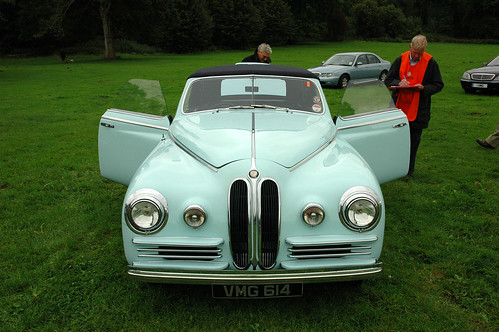
Special Drophead - Bristol 401 Cabriolet


Continuing the Centenary Celebration of the Bristol Aeroplane Company out of which Bristol Cars was born, today we are looking at another unique car a Bristol 401 Drophead.


Between 1948 and 1953 Bristol Cars built 611 401 coupes and 23 mechanically identical 402's cabriolets.


Sources close to the Bristol Owners Club assure me that this vehicle, seen at a VSCC meeting at Prescott, is a one off special 401 coupe converted into a cabriolet.

Hope you have enjoyed today's special drophead edition of 'Gettin' a lil' psycho on tyres' and will join me again tomorrow for some Bristol disambiguation. Don't forget to come back now !

Monday, 15 November 2010

How many are there - Bristol 400 Cabriolet ?

I have made a bit of a mess of my original idea of celebrating the Bristol Aeroplane Companies Centenary celebration by setting out to post a blog about each model in the order they were released with the most basic mistake of confusing a 401 with a 403, now that has been rectified I find there was a version of the Bristol 400 which I did not even know about until John Lomas kindly pointed out I had a photograph of it !


Uploaded with ImageShack.us

This Bristol 400 cabriolet appears to be one of two built that never entered full production. If I had known just how rare it was when I took the photograph I would have waited for an opportunity to take a photograph of the front of the car, but that as they say will now have to wait for another day.

It would appear that Pinin Farina also built a Bristol 400 convertible but director Tony Crook cancelled any plans for it to go into production allegedly because of the inferior quality of the bodywork. According to the Bristol Owners Club, despite this decision there may be as many as 10 Pinin Farina Bristol 400's. A quick search on Google images reveals one of the Pinin Farina 400 Cabrilolets to be a dark blue while another is eggshell blue.

Slightly off topic it was lovely to see Kevin Harvick keeping his composure after his pit crew dropped lug nut yesterday at Phoenix. Somehow Kevin managed to come back from 19th to 6th behind Jimmy Johnson and now sits 46 points behind Hamlin who after leading most of the race ran low on fuel at the end and wound up coming in just 12th.

Kevin is certainly the underdog going into Homestead Miami next weekend, but he certainly won't be the first underdog going into the final race of the season to lift the Cup. Go Harvick ! Go #29 ! Go Happy !

Finally a word to some visitors from Germany, schoen Gruss an alle Morgan Freunde von http://www.morgan-club.de die dem letztens 'Gettin' a lil psycho on tyres' besucht haben.

Thanks for popping by, looking forward to tomorrow's blog already, don't forget to come back now !

Monday, 8 November 2010

Standard of the World - 1978 Cadillac Coupe Deville


Rounding out a couple of days looking at Cadillac Coupe de Villes is this 1978 model which appears with number plates suggesting that it was registered before August 1976. Cadillac was born out of the Henry Ford Company on August 22nd, 1902, when mechanic & entrepreneur Henry M. Leland put forward to the investors in the company that continued manufacture was a more profitable than factory liquidation.


In 1977 the Coupe de Ville was downsized 9.8 inches saving 750 lbs in weight over its immediate ancestor, the new package was powered by a 7 litre 425 cui V8.


Leland named the new company Cadillac after his ancestor Antoine de la Mothe Cadillac the founder of Detroit. General Motors acquired Cadillac in 1909. Cadillac appears to have been responsible for setting the V8 as the standard configuration in the US Motor Industry.


This particular model can be identified as a 1978 version by the small vertical tail light insets a feature that would remain with the de Ville until 1999.


Cadillac was twice awarded the Dewar Trophy by the Royal Automobile Club (RAC) in England for advancement of the automobile industry first in 1909 for developing models with full parts interchangeability in 1908, and again in 1913 for developing the electric starter (thank heavens, that saved an a lot of sweat and probably a few broken arms) and electric lights (hallelujhah, imagine if we were all still driving around by naked flame candle light or propane powered lights ?). These successes led to Cadillac adopting the strap line "Standard of the World".

Slightly off topic, after an amazing Cup race in Texas, kudos to Dangerous Denny Hamlin, there are still three guys in with a chance to win it all, I am glad Happy Harvick managed to pull a 6th place out of the bag, before the last pit stops it looked like he would be lucky to finish in the top 20. It's looking like the only way to keep his championship hopes alive will be two straight win's. I hope Happy over turns the record books and pulls them off, should be a little easier after the #48 pit crew was benched mid race by the Evil Genius Knaus in favour of the #24 crew when they became available.

Hope you enjoyed your visit, thanks for dropping by, wishing every one a mellow Monday, don't forget to come back now !

Monday, 20 September 2010

Happy 100th Birthday British and Colonial Aeroplane Company, Ltd !

What better way to celebrate the start of my blogging career, than with a centenary celebration in honour of the company that started my local exclusive vehicle manufacturer, The Bristol Car Company.

Unfortunately I missed the celebrations at Filton this weekend where 200 odd Bristol's, nearly 5% of all Bristol's ever made, were on display but have already made arrangements to be at the 101st birthday party.


Above is a photo taken at the Prescott VSCC meeting back in August of what I believe to be one of the 487 Bristol 400's made between 1947 and 1958.

The Bristol 400 featured a 1971 cc ohv straight 6 which, along with the chassis and bodywork, was based on the pre war BMW 327.

Some great snaps, by my friend Tim Murray, from the centenary celebrations can be seen at The Nostalgia Forum here.

Hope you enjoyed my first blog and as they used to say on one of my favourite TV show's 'y'all come back now ! Hear !'