
Showing posts with label Fittipaldi. Show all posts
Showing posts with label Fittipaldi. Show all posts
Sunday, 30 November 2014


Saturday, 5 July 2014

Wednesday, 20 July 2011
Long Lost - Wolf 1979 Series
Wolf Racing was founded by Canadian Oil Magnet Walter Wolf in 1977 after an ill feted start made in partnership with Frank Williams in 1976.

The Wolf team with Dr Harvey Postlethwaite designing the cars came flying right out of the box in Argentina 1977 scoring a debut win with Jody Scheckter at the wheel of the Wolf WR1. Scheckter impressed further by driving to two more wins in 1977. The 1977 series Wolf design ran WR1 - WR3 same as the chassis numbers.
During the following season the second series Wolf WR4 - WR6, with ground effects side pods that were all the rage in 1978, was less impressive and Jody, who had been courted by Ferrari well before his Wolf contract was up, left to join the red team from Maranello.

The third series Wolf, which ran WR7 to WR9, apparently seen here at The Cotswold Motoring Museum, was designed by Dr Harvey Postlethwaite who had been reunited with former Hesketh driver James Hunt for the 1979 season.
As ironic luck would have it former Wolf driver Jody Scheckter would go on to win the 1979 World Drivers Championship in his first season with Ferrari while ex World Champion James Hunt quit the Wolf Team after the Monaco Grand Prix having struggled to qualify better than 10th in seven races and scored one 8th place finish and six retirements.

Keke Rosberg took over the driving duties for the rest of the year but with no improvement in the teams performance Walter Wolf sold his team onto the equally struggling Fittipaldi brothers at the end of 1979.
Walter Wolf kept one of the third series cars while Fittipaldi upgraded the remaining two cars into Fittipaldi F7 spec with a centre post rear wing and heavily revised side pods with out the rear flick ups and built a third F7 from scratch.

The Fittipaldi F7 cars all but disappeared from public view in the early 80's. According to the museum description provided by the cars owner Andrew Smith by 1982 the Fittipaldi Team was in administration and all of the teams assets were acquired by ADA Engineering.
Andrew a James Hunt fan, and former Mini racer, saw WR7 race, with Keke Rosberg driving, at Silverstone in 1979 and bought the car from ADA Engineering with a Cosworth DFV engine. Some of the third series Wolf style body work, and unique '79 Monaco spec twin element front wings have been refitted to this chassis which still has F7 running gear, a Fittipaldi in Wolf clothing.
At this moment there are inconsistencies in the accounts as to which third series Wolf chassis became which Fittipaldi F7 chassis. Not having seen which, if any, chassis plate this particular vehicle, seen at the Cotswold Motoring Museum, is carrying I cannot be sure exactly which, of the two Wolf chassis or three Fittipaldi chassis this is.
If you have evidence as to which of the Wolf third series chassis were transformed into the Fittipaldi F7 series chassis please chime in below or send me an e-mail to the address which appears at the very bottom of the blog page.
My thanks to Steve Holter, and Norman Jones from The Nostalgia Forum for their contributions to today's blog.
Hope you have enjoyed todays Wolf edition of 'Gettin' a lil' psycho on tyres' and that you will join me again tomorrow for a look at a world champions daily driver that is coming up for auction on Saturday. Don't forget to come back now !
The Wolf team with Dr Harvey Postlethwaite designing the cars came flying right out of the box in Argentina 1977 scoring a debut win with Jody Scheckter at the wheel of the Wolf WR1. Scheckter impressed further by driving to two more wins in 1977. The 1977 series Wolf design ran WR1 - WR3 same as the chassis numbers.
During the following season the second series Wolf WR4 - WR6, with ground effects side pods that were all the rage in 1978, was less impressive and Jody, who had been courted by Ferrari well before his Wolf contract was up, left to join the red team from Maranello.
The third series Wolf, which ran WR7 to WR9, apparently seen here at The Cotswold Motoring Museum, was designed by Dr Harvey Postlethwaite who had been reunited with former Hesketh driver James Hunt for the 1979 season.
As ironic luck would have it former Wolf driver Jody Scheckter would go on to win the 1979 World Drivers Championship in his first season with Ferrari while ex World Champion James Hunt quit the Wolf Team after the Monaco Grand Prix having struggled to qualify better than 10th in seven races and scored one 8th place finish and six retirements.
Keke Rosberg took over the driving duties for the rest of the year but with no improvement in the teams performance Walter Wolf sold his team onto the equally struggling Fittipaldi brothers at the end of 1979.
Walter Wolf kept one of the third series cars while Fittipaldi upgraded the remaining two cars into Fittipaldi F7 spec with a centre post rear wing and heavily revised side pods with out the rear flick ups and built a third F7 from scratch.
The Fittipaldi F7 cars all but disappeared from public view in the early 80's. According to the museum description provided by the cars owner Andrew Smith by 1982 the Fittipaldi Team was in administration and all of the teams assets were acquired by ADA Engineering.
Andrew a James Hunt fan, and former Mini racer, saw WR7 race, with Keke Rosberg driving, at Silverstone in 1979 and bought the car from ADA Engineering with a Cosworth DFV engine. Some of the third series Wolf style body work, and unique '79 Monaco spec twin element front wings have been refitted to this chassis which still has F7 running gear, a Fittipaldi in Wolf clothing.

At this moment there are inconsistencies in the accounts as to which third series Wolf chassis became which Fittipaldi F7 chassis. Not having seen which, if any, chassis plate this particular vehicle, seen at the Cotswold Motoring Museum, is carrying I cannot be sure exactly which, of the two Wolf chassis or three Fittipaldi chassis this is.
If you have evidence as to which of the Wolf third series chassis were transformed into the Fittipaldi F7 series chassis please chime in below or send me an e-mail to the address which appears at the very bottom of the blog page.
My thanks to Steve Holter, and Norman Jones from The Nostalgia Forum for their contributions to today's blog.
Hope you have enjoyed todays Wolf edition of 'Gettin' a lil' psycho on tyres' and that you will join me again tomorrow for a look at a world champions daily driver that is coming up for auction on Saturday. Don't forget to come back now !
Monday, 18 July 2011
Caution Wide Vehicle - McLaren M23 M23/6

The Ford Cosworth DFV powered McLaren M23 driven by Denny Hulme was designed by Gordon Cuppock, based on the lessons learned from the successful McLaren M16 Indy car. It burst onto the Grand Prix scene in 1973 with a pole position on its debut in South Africa. Denny scored the first win for the model in Sweden and Peter Revson followed that with wins in Great Britain and Canada in 1973.
For 1974 Denny who won his last race in an M23 in the season opening Argentinian GP was joined in the McLaren team by 1972 World Champion Emerson Fittipaldi who won in Brazil, Belgium, and Canada on his way to becoming the 1974 World Champion. McLaren also won the World Constructors title in 1974.
Jochen Mass joined Emerson in the McLaren team in 1975 winning the shortened Spanish GP while Emerson won in Argentina and Great Britain to finish 2nd in the World Drivers Championship.
1976 would prove to be the chassis most successful year in terms of wins with James Hunt, who replaced Emerson in the team crossing the line first in Spain, France, Great Britain, Germany, The Netherlands, Canada and the United States.
However 1976 was a year of high drama and comedy in Formula One first James was disqualified from the Spanish Grand Prix because his car was 1.8cm less than an inch too wide. In 1975 the McLaren had been used as a base model too set the dimensions for the 1976 Formula regulations.
McLaren successfully argued that when the tyres on the car were moving they were taller as a result of the centrifugal force taking up the slack on the side walls of the tyres and that this accounted for the discrepancy. The governing F.I.A. accepted this argument and the win was reinstated with a $3,000 fine, when the M23's next appeared they had a slightly narrower rear track.
On the first corner, Paddock Bend, of the opening lap of the British Grand Prix James Hunt was the innocent victim in a crash with Ferrari's Clay Reggazoni. The race was stopped and James who's car was severely damaged took a short cut to get back to the pits when the race was stopped.
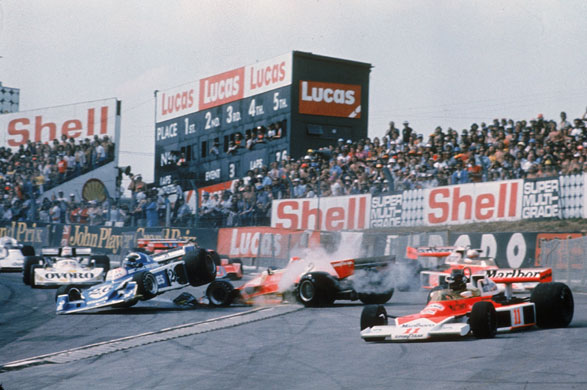
Come the restart the organisers initially refused to allow James to line up on the grid because the team had worked to repair his car while the mess was being cleared up. However people power intervened and fearing a riot from the partisan crowd the organisers relented, James took the win, he and the partisan crowd partied long and hard into the night and later the F.I.A. disqualified both Hunt and Clay Regazzoni from the event for having failed to complete the opening lap.
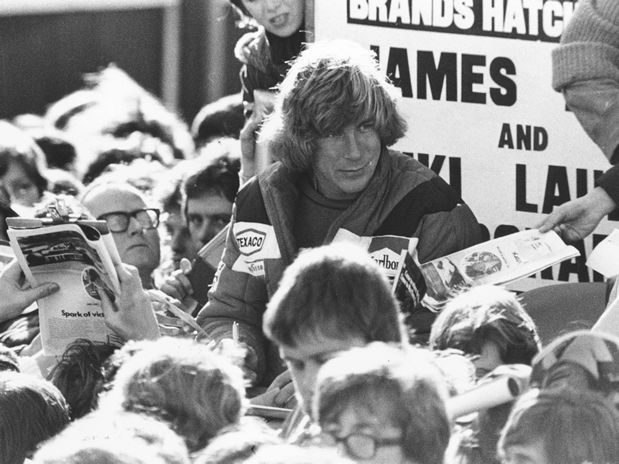
Up until this point reigning Champion Niki Lauda had dominated the 1976 Championship with four wins three seconds, the last of which became 1st after Hunt's disqualification from the British GP and a third. The next race was the ill feted German Grand Prix in which Niki was eliminated in an accident that triggered an inferno from which he was lucky to escape with his life.
James won the German Grand Prix and the Dutch GP while Niki recuperated and 39 days after the inferno at the Nurburgring Niki and James met again at the Italian GP. At the end of practice for the Italian GP James and Mclaren team mate Jochen Mass and John Watson at Penske were found to be running with a fuel octane rating that was too high and had their Saturday times disallowed.

Since it had been raining during the first practice sessions on the Friday Hunt, Mass and Watson had effectively failed to qualify, however the 13 second plus off pace Otto Stuppacher was already on his way home to Austria when the announcement and the Marlboro sponsored Art Mezario withdrew as did Englishman Guy Edwards allowing Hunt, Mass and Watson to start.
Hunt crashed trying to make time and was applauded for doing so by the Tifosi and Lauda came home a remarkable 4th in his first race back.
James won both the Canadian and US Grand Prix while the brave Niki could only amass a further three championship points. Going into he last race of the season the Japanese GP Niki had a 3 point lead over James.

For the race James qualified 2nd behind Andretti with Niki just one place further back. I remember getting up at some unholy hour to watch this race live on TV in the UK and remember the disappointment when I saw the monsoon that unfolded on the track.
After much debate amongst the driver the race started and Niki who had lost his eyelids in the German inferno and yet to have them replaced through plastic surgery had little choice but to retire in the near zero visibility conditions. James took an early lead in the race but as the rain stopped and the track started to dry Hunt started losing ground dropping to 5th after a pit stop to replace a punctured tyre with just a few laps to go.

James charged back into the race managing to regain two positions which left him in third position when the flag came out for Mario Andretti to win by just over a lap from Patrick Depailler, with James Hunt, who had no idea what his position was in the race, right on his tail.
Hunt only learned that he had become champion after he got out of the car and stopped shouting at team manager Teddy Meyer for a less than perfect pit stop.
Hunt won the 1976 World Drivers title by just one point and Great Britain had it's first World Champion since Jackie Stewart had won his last crown in 1973.
The McLaren M23 was pressed into service again in 1977 but its competitiveness was on the wane James winning a non championship race before committing fully to the M26 successor which had gone through a troublesome one year gestation period before coming on song.
The works M23 had a final swan song when it introduced Gilles Villeneuve to the world of Grand Prix racing in Great Britain and Bruno Jack'O'Malley in Italy towards the end of the 1977.
I have done my best to find out exactly which of the 13 M23 chassis this is, The Donington Museum blurb identified this car as McLaren M23/8 and said it was used to win the '76 Spanish and US GP's however M23/8 was destroyed in 1975. The car was then given a new tub with the chassis number M23/8-2 and the old tub was apparently eventually repaired to 1975 tall airbox spec and now resides in the United States.
M23/8-2 went on to become one of the stars of the 1976 season being used to win the controversial Spanish GP along with those in Canada and the US GP. M23/8-2 is said to belong to BCE the man responsible for running the the whole Formula Show since 1981.
It is said that the vehicle in my photograph appeared at the 60th Anniversary celebrations of the World Grand Prix Drivers Championship in Bahrain last year, it is also suggested that the M23 which appeared at Bahrain belongs to the brave octogenarian who started a modelling career with Hublot earlier this year however I have no firm evidence of the ownership of the vehicle in the photograph at the top of this post

at this time.
Most likely the vehicle above seen at the Donington Park Museum is M23/6 which seems to meet many of the criteria hinted at on various threads of The Nostalgia Forum and who's whereabouts is listed as unknown by the respected Old Racing Car site.
M23/6 was used by Denny Hulme to win the Agentine Grand Prix in 1974 then in 1976 James Hunt drove it to win the French Grand Prix, cross the line first in Great Britain only to be disqualified .
At the next race the German Grand Prix I saw James win in this chassis which became one of a rare set of vehicles that crossed the line first in three consecutive races, though it was disqualified from one of them.
In 1977 Emilio de Villota drove M23/6 with little success in Grand Prix events, 2 starts three DNQ's, but did win two rounds of a British series open to all single seat racing cars.

My thanks to Michael Ferner, Wouter Melissen, Steve Holter, Simon Hadfield, Slurp1955, at The Nostalgia Forum for their valuable contributions to todays blog.
Hope you have enjoyed today's 1976 edition of 'Gettin' a lil psycho on tyres' and that you will join me again tomorrow. Don't forget to come back now !
Thursday, 26 May 2011
Indianapolis Excursion - Indy 500 29th May 1988
I was living in Brixton, London in November 1987 when I received an invitation from Rick and Karen, two Canadian friends also living in London, to attend their wedding on May 27th 1988 in Toronto their home town.
The first thing I did after I received the invitation was to check the dates for races in the USA around the wedding date, the Winston 500 was to be run at Talledega on May 1st, the Coca Cola 600 at Charlotte on May 29th as was the Indy 500.
The timing was against me getting to Talladega, a track I finally visited 21 years later, and Indianapolis seemed a lot closer to Toronto than Charlotte so I made my mind up to visit the Indy 500 something I had wanted to do since I read a book by Tommaso Tommasi called from Brands Hatch to Indianapolis in which a precise description of driving around the track is given by Peter Revson.

The weekend of the wedding I went to Avis and collected this shiny brand new Chevy Beretta, an interesting contrast to the £50 1973 Volvo 144 DL automatic I was driving around London at the time !
Early on the morning after the wedding I packed my stuff and headed around 350 miles west on the 401 which turned into Route 96/94 after I crossed the US border into Detroit and then 200 miles south on Route 69. The only difficulty I had was keeping to the 55 to 60 mph speed limits which seemed excruciatingly slow compared to the 70 mph I was used to in the UK.

Eleven hours after I had set out I arrived at a mall parking lot (Lafayette Shopping Centre ?) a mile or so north from the track having picked up a ticket for the bleachers from a vendor at face value of $15 (?) right out side the track. I felt very much at home as some lads were having a kick about with a proper round football, turned out they were telephone engineers from Manchester, England !
My plan was to spend the night in the car, I got a shock when I opened the boot/trunk of the car and found I had forgotten to pack two important items one of which was my sleeping bag. I need not have worried the weather was more than warm enough to feel comfortable sleeping on the back seat of the car wearing a T shirt and shorts.
On race day I woke up with the dawn, had a round of salami of sandwiches I had packed in advance and my customary breakfast apple and headed off to the track which opened at 6am.

I bought a souvenir T-Shirt from a girl, who like me hailed from Germany, on the way in and before I knew it I was standing on the hallowed pavement of Indianapolis pit lane. I was as inspired as I had been by any other tourist sight I had seen, Big Ben, the Eiffel Tower and even the Pyramids, by the Indy timing tower which I had seen in countless photographs over the previous 15 years I had been a racing fan.

Pinching myself standing before the gates of Gasoline Alley, I felt a little like I was standing before the gates of heaven itself as the sun came up.

The immaculate team haulers seemed a tad quaint to be carrying 220 mph race cars, but then again a hauler never won the Indy 500.
I took a walk all around the infield while the hullaballoo that starts the days proceedings got underway prior to the 11 am start, including a look at the infamous inside of turn 3 hard partying Snake Pit. I saw 'Supersonic' Chuck Yeager prepare himself for duties in the pace car and took my seat in the bleachers as Grand Marshall Garfield was driven around the circuit.

At this point the fact that I had somehow overlooked packing a telephoto lens I had borrowed specially for the event became painfully obvious.
The race was dominated by Rick Mears on pole with Danny Sullivan and Al Unser Snr who locked out the front row of the grid. All three were driving the new Penske PC 17 designed by Penske new boy Nigel Bennett and all three Penske drivers would be 3 of the only 4 drivers to lead a lap of the 72nd running of the Indy 500.

'85 Spinner & Winner Danny Sullivan set a blistering early pace driving the Miller PC17, seen here chasing the #92 of Dominic Dobson, led a race high 91 laps but crashed out on lap 101 leaving Rick Mears to almost run away with the race. Sullivan would end the season as the winner of his one and only CART championship.

For 8 laps I was beside myself with excitement as Scottish born Brit Jim Crawford became the only non Penske team member to lead the '88 500 in his year old Buick 'stock block' powered Lola T87/00. Jim who just two months earlier had been unable to walk as a result injuries received at Indy in 1987 became a father the following week. Jim retired to become a fishing boat captain and died of liver failure aged 54 in 2002.

Two time world champion Emerson Fittipaldi did not lead a lap but still managed to come home 2nd in his Pat Patrick run March 88C powered by the then relatively new Ilmour Chevy V8. The following year 'Emmo' returned to win the fist of his two Indy 500 victories.

Rick Mears ran out the deserving winner of the 1988 Indy 500 a race that ended under yellow flags thanks to a piece of body work that flew off Michael Andretti's 4th place Kraco March with just 4 laps to go. Ricks third 500 victory marked the first for the Ilmour Chevrolet engine which would dominate at Indianapolis until 1994 when a one off Mercedes push rod engine also designed by Ilmour would take top honours.
After the race I rehydrated and slept in the car for an hour before the 11 hour 550 mile trek back to Toronto. Two weeks later I was back at one of my other favourite race tracks Le Mans, but that story will have to wait for another day.
Thanks for joining me on this Indianapolis excursion edition of'Gettin a lil' psycho on tyres', I hope you will join me again tomorrow for an Indy Ferrari Friday special. Don't forget to come back now !
The first thing I did after I received the invitation was to check the dates for races in the USA around the wedding date, the Winston 500 was to be run at Talledega on May 1st, the Coca Cola 600 at Charlotte on May 29th as was the Indy 500.
The timing was against me getting to Talladega, a track I finally visited 21 years later, and Indianapolis seemed a lot closer to Toronto than Charlotte so I made my mind up to visit the Indy 500 something I had wanted to do since I read a book by Tommaso Tommasi called from Brands Hatch to Indianapolis in which a precise description of driving around the track is given by Peter Revson.

The weekend of the wedding I went to Avis and collected this shiny brand new Chevy Beretta, an interesting contrast to the £50 1973 Volvo 144 DL automatic I was driving around London at the time !
Early on the morning after the wedding I packed my stuff and headed around 350 miles west on the 401 which turned into Route 96/94 after I crossed the US border into Detroit and then 200 miles south on Route 69. The only difficulty I had was keeping to the 55 to 60 mph speed limits which seemed excruciatingly slow compared to the 70 mph I was used to in the UK.
Eleven hours after I had set out I arrived at a mall parking lot (Lafayette Shopping Centre ?) a mile or so north from the track having picked up a ticket for the bleachers from a vendor at face value of $15 (?) right out side the track. I felt very much at home as some lads were having a kick about with a proper round football, turned out they were telephone engineers from Manchester, England !
My plan was to spend the night in the car, I got a shock when I opened the boot/trunk of the car and found I had forgotten to pack two important items one of which was my sleeping bag. I need not have worried the weather was more than warm enough to feel comfortable sleeping on the back seat of the car wearing a T shirt and shorts.
On race day I woke up with the dawn, had a round of salami of sandwiches I had packed in advance and my customary breakfast apple and headed off to the track which opened at 6am.
I bought a souvenir T-Shirt from a girl, who like me hailed from Germany, on the way in and before I knew it I was standing on the hallowed pavement of Indianapolis pit lane. I was as inspired as I had been by any other tourist sight I had seen, Big Ben, the Eiffel Tower and even the Pyramids, by the Indy timing tower which I had seen in countless photographs over the previous 15 years I had been a racing fan.
Pinching myself standing before the gates of Gasoline Alley, I felt a little like I was standing before the gates of heaven itself as the sun came up.
The immaculate team haulers seemed a tad quaint to be carrying 220 mph race cars, but then again a hauler never won the Indy 500.
I took a walk all around the infield while the hullaballoo that starts the days proceedings got underway prior to the 11 am start, including a look at the infamous inside of turn 3 hard partying Snake Pit. I saw 'Supersonic' Chuck Yeager prepare himself for duties in the pace car and took my seat in the bleachers as Grand Marshall Garfield was driven around the circuit.
At this point the fact that I had somehow overlooked packing a telephoto lens I had borrowed specially for the event became painfully obvious.
The race was dominated by Rick Mears on pole with Danny Sullivan and Al Unser Snr who locked out the front row of the grid. All three were driving the new Penske PC 17 designed by Penske new boy Nigel Bennett and all three Penske drivers would be 3 of the only 4 drivers to lead a lap of the 72nd running of the Indy 500.
'85 Spinner & Winner Danny Sullivan set a blistering early pace driving the Miller PC17, seen here chasing the #92 of Dominic Dobson, led a race high 91 laps but crashed out on lap 101 leaving Rick Mears to almost run away with the race. Sullivan would end the season as the winner of his one and only CART championship.
For 8 laps I was beside myself with excitement as Scottish born Brit Jim Crawford became the only non Penske team member to lead the '88 500 in his year old Buick 'stock block' powered Lola T87/00. Jim who just two months earlier had been unable to walk as a result injuries received at Indy in 1987 became a father the following week. Jim retired to become a fishing boat captain and died of liver failure aged 54 in 2002.
Two time world champion Emerson Fittipaldi did not lead a lap but still managed to come home 2nd in his Pat Patrick run March 88C powered by the then relatively new Ilmour Chevy V8. The following year 'Emmo' returned to win the fist of his two Indy 500 victories.
Rick Mears ran out the deserving winner of the 1988 Indy 500 a race that ended under yellow flags thanks to a piece of body work that flew off Michael Andretti's 4th place Kraco March with just 4 laps to go. Ricks third 500 victory marked the first for the Ilmour Chevrolet engine which would dominate at Indianapolis until 1994 when a one off Mercedes push rod engine also designed by Ilmour would take top honours.
After the race I rehydrated and slept in the car for an hour before the 11 hour 550 mile trek back to Toronto. Two weeks later I was back at one of my other favourite race tracks Le Mans, but that story will have to wait for another day.
Thanks for joining me on this Indianapolis excursion edition of'Gettin a lil' psycho on tyres', I hope you will join me again tomorrow for an Indy Ferrari Friday special. Don't forget to come back now !
Subscribe to:
Posts (Atom)