
Showing posts with label McLaren. Show all posts
Showing posts with label McLaren. Show all posts
Thursday, 17 November 2016


Sunday, 30 November 2014

Monday, 24 November 2014

Thursday, 25 September 2014

Saturday, 5 July 2014

Sunday, 30 March 2014

Wednesday, 19 February 2014

Sunday, 28 April 2013
GALPOT Weekley #17/13
Welcome to GALPOT Weekley #17/13 a review of the last seven posts at "Gettin' a li'l psycho on tyres".
 The week started on Pick Up Monday with a look at this '59 Chevrolet Apache 31 Fleetside that featured new for '59 Jet Pods heralding the arrival of the rocket powered 'Space Age'.
 Tuesday's potted 4 part Morris history continued with this Morris 1800 (ADO 17) that has been upgraded to recreate a marathon rally car of the type that competed in the 1968 London to Sydney Marathon and 1970 World Cup Rally.
 Wednesdays posts featured a review of 'Petrol In My Blood', by marathon driver Peter Jackson who set amongst many, world records for driving from London to Cape Town and driving around the world.
 Americana Thursday's blog featured this '84 Lincoln Town Car which if I have understood fb commentator Joe's rap, "ultimate tuna boat", correctly indicates that back in the day this was a vehicle that lured plenty of attractive young females within.
 The driving rosta for this Ferrari 250 Testa Rossa 59/60 which was featured on Ferrari Friday includes Dan Gurney, Jean Behra, Phil Hill, Cliff Alison, Oliver Gendebien and Paul Frére the last two of which won the 1960 Le Mans 24 Hours.
 Yesterday's post featured three Lotus Elise Series I's, which derived their model name from Lotus chairman Romano Artioli's grand daughter Elisa.
 Today's post concludes a four part look at McLaren and features this McLaren F1 GTR which was the first of the second series of F1 GTR racers built in 1996 that had but one outing at the 1996 Le Mans Test Weekend but appears never to have been raced in anger.
Thanks for joining me on this 'GALPOT Weekley #17/13' edition of "Gettin' a li'l psycho on tyres" I hope you have enjoyed catching up using the links in the text and that you will join me daily during the week ahead. Don't forget to come back now !
Today's post concludes a four part look at McLaren and features this McLaren F1 GTR which was the first of the second series of F1 GTR racers built in 1996 that had but one outing at the 1996 Le Mans Test Weekend but appears never to have been raced in anger.
Thanks for joining me on this 'GALPOT Weekley #17/13' edition of "Gettin' a li'l psycho on tyres" I hope you have enjoyed catching up using the links in the text and that you will join me daily during the week ahead. Don't forget to come back now !
The week started on Pick Up Monday with a look at this '59 Chevrolet Apache 31 Fleetside that featured new for '59 Jet Pods heralding the arrival of the rocket powered 'Space Age'.
Tuesday's potted 4 part Morris history continued with this Morris 1800 (ADO 17) that has been upgraded to recreate a marathon rally car of the type that competed in the 1968 London to Sydney Marathon and 1970 World Cup Rally.
Wednesdays posts featured a review of 'Petrol In My Blood', by marathon driver Peter Jackson who set amongst many, world records for driving from London to Cape Town and driving around the world.
Americana Thursday's blog featured this '84 Lincoln Town Car which if I have understood fb commentator Joe's rap, "ultimate tuna boat", correctly indicates that back in the day this was a vehicle that lured plenty of attractive young females within.
The driving rosta for this Ferrari 250 Testa Rossa 59/60 which was featured on Ferrari Friday includes Dan Gurney, Jean Behra, Phil Hill, Cliff Alison, Oliver Gendebien and Paul Frére the last two of which won the 1960 Le Mans 24 Hours.
Yesterday's post featured three Lotus Elise Series I's, which derived their model name from Lotus chairman Romano Artioli's grand daughter Elisa.
Today's post concludes a four part look at McLaren and features this McLaren F1 GTR which was the first of the second series of F1 GTR racers built in 1996 that had but one outing at the 1996 Le Mans Test Weekend but appears never to have been raced in anger.
Thanks for joining me on this 'GALPOT Weekley #17/13' edition of "Gettin' a li'l psycho on tyres" I hope you have enjoyed catching up using the links in the text and that you will join me daily during the week ahead. Don't forget to come back now !
Sunday, 21 April 2013
GALPOT Weekly #16/13
Welcome to GALPOT Weekly #16/13 a review of the last seven posts at "Gettin' a li'l psycho on tyres".
 The week started with Pick Up Monday which featured this '58 half ton Chevrolet Apache 31 with jet age detail trim.
 The 5 part potted history of Morris continued on Tuesday with a look at this '55 Morris Oxford II was fitted with a B Series motor thanks to the merger between Austin and Morris in 1954, this Oxford came fitted with a column shift for the manual gearbox, 9 inch hydraulic brakes and an interior heater.
 On Wednesday GALPOT visited the Six Hours of Silverstone where several teams second entries beat their number one siblings including the #2 Audi e-tron quattro of Tom Kristensen, Loic Duval and Alan McNish which beat the #1 Audi driven by reigning world sports car drivers champions Andre Lotterer, Benoit Treluyer and Marcel Fässler for overall honours and the Tourist Trophy.
 Americana Thursday's post featured this Lincoln Continental Mark III which once belonged to an acquaintance Loory Munro. The Mark III allegedly came about when Ford President Lee Iacocca instructed Ford Design Vice President Gene Bordinat to "put a Rolls Royce grill on a Thunderbird" in September 1965.
 This 1956 Feerari 290MM chassis #0606 was featured in Ferrari Friday's post the car won the Swedish Grand Prix in the hands of Phil Hill and Maurice Trintignant before ending up in Brazil where it was involved in an accident that
killed Fernando Mafra Moriera who raced under the name of Rio Negro.
This 1956 Feerari 290MM chassis #0606 was featured in Ferrari Friday's post the car won the Swedish Grand Prix in the hands of Phil Hill and Maurice Trintignant before ending up in Brazil where it was involved in an accident that
killed Fernando Mafra Moriera who raced under the name of Rio Negro.
 Yesterday's post featured this DeLorean DMC-12 a car that was heavily re engineered by Lotus to make it production worthy.
 Photo Courtesy Jerry Entin and IMS Archive
Thanks to US Racer Jerry Entin I have been able to put right a few error's to a blog about the McLaren M15 I wrote a couple of years ago. Today's McLaren M15 post includes some photo's from the International Motor Speedway Archive such as the one above showing Bruce McLaren talking to Denny Hulme sitting in the car that Denny's 1970 Indy 500 challenge was to end in.
Thanks for joining me on this GALPOT Weekly #16/13 edition of "Gettin' a li'l psycho on tyres". I hope you have enjoyed catching up with the last seven posts using the links provided. Thanks also to every one who has left comments, liked either and or the individual blogs or "Gettin' a li'l psycho on tyres" facebook page. Looking forward to the next seven posts for which I hope you will join me daily. Don't forget to come back now !
Photo Courtesy Jerry Entin and IMS Archive
Thanks to US Racer Jerry Entin I have been able to put right a few error's to a blog about the McLaren M15 I wrote a couple of years ago. Today's McLaren M15 post includes some photo's from the International Motor Speedway Archive such as the one above showing Bruce McLaren talking to Denny Hulme sitting in the car that Denny's 1970 Indy 500 challenge was to end in.
Thanks for joining me on this GALPOT Weekly #16/13 edition of "Gettin' a li'l psycho on tyres". I hope you have enjoyed catching up with the last seven posts using the links provided. Thanks also to every one who has left comments, liked either and or the individual blogs or "Gettin' a li'l psycho on tyres" facebook page. Looking forward to the next seven posts for which I hope you will join me daily. Don't forget to come back now !
The week started with Pick Up Monday which featured this '58 half ton Chevrolet Apache 31 with jet age detail trim.
The 5 part potted history of Morris continued on Tuesday with a look at this '55 Morris Oxford II was fitted with a B Series motor thanks to the merger between Austin and Morris in 1954, this Oxford came fitted with a column shift for the manual gearbox, 9 inch hydraulic brakes and an interior heater.
On Wednesday GALPOT visited the Six Hours of Silverstone where several teams second entries beat their number one siblings including the #2 Audi e-tron quattro of Tom Kristensen, Loic Duval and Alan McNish which beat the #1 Audi driven by reigning world sports car drivers champions Andre Lotterer, Benoit Treluyer and Marcel Fässler for overall honours and the Tourist Trophy.
Americana Thursday's post featured this Lincoln Continental Mark III which once belonged to an acquaintance Loory Munro. The Mark III allegedly came about when Ford President Lee Iacocca instructed Ford Design Vice President Gene Bordinat to "put a Rolls Royce grill on a Thunderbird" in September 1965.
This 1956 Feerari 290MM chassis #0606 was featured in Ferrari Friday's post the car won the Swedish Grand Prix in the hands of Phil Hill and Maurice Trintignant before ending up in Brazil where it was involved in an accident that
killed Fernando Mafra Moriera who raced under the name of Rio Negro.
Yesterday's post featured this DeLorean DMC-12 a car that was heavily re engineered by Lotus to make it production worthy.
Photo Courtesy Jerry Entin and IMS Archive
Thanks to US Racer Jerry Entin I have been able to put right a few error's to a blog about the McLaren M15 I wrote a couple of years ago. Today's McLaren M15 post includes some photo's from the International Motor Speedway Archive such as the one above showing Bruce McLaren talking to Denny Hulme sitting in the car that Denny's 1970 Indy 500 challenge was to end in.
Thanks for joining me on this GALPOT Weekly #16/13 edition of "Gettin' a li'l psycho on tyres". I hope you have enjoyed catching up with the last seven posts using the links provided. Thanks also to every one who has left comments, liked either and or the individual blogs or "Gettin' a li'l psycho on tyres" facebook page. Looking forward to the next seven posts for which I hope you will join me daily. Don't forget to come back now !
Sunday, 14 April 2013
"GALPOT Weekly #15/13"
Welcome to "GALPOT Weekly #15/13" a review of the last seven blogs posted at "Gettin' a li'l psycho on tyres".
 The week started with a look at this pre '53 split screen Chevrolet Advanced Design Pickup operated in UK drag racing by Squadron Racing.
 The 1948 Morris 8 Series E featured on Tuesday was a pre WW2 design, a fore runner of the Morris Monor this particular car is known as Katie.
 The life of the late Howard Strawford, who saved Castle Combe from closure in the 1970's, was celebrated on Easter Monday at the Howards Day meeting which provided plenty of action from the eleven race schedule. Above Elliot Stafford lifts a wheel going into Tower Corner in the first of the two Super Mighty Mini races on his way to becoming the second two time winner of the day.
 Geoffrey Horton kindly sent the photo's of the Continental Mark II that was the subject of Americana Thursday's post.
 Ferrari Friday's post revisited the 1956 Ferrari 860 Monza #0604M, which I first looked at two years ago, with some fresh photographs taken at recent Goodwood Revivals.
 Yesterday's post featured one of 55 Lotus Esprit Sport 350's built, one of only two painted white, that it's owner Rob has tweaked to give 500 hp.
 Today's post features Bruce McLarens first Formula One car the McLaren Ford M2B, Bruce opted to modify a Ford Indy motor to compete in the 1966 championship, but when this proved too heavy and underpowered he tried a lighter and equally underpowered Serenissima. By the end of the '66 season the Ford motor was back as seen in the car above.
Thanks for joining me on this "GALPOT Weekly #15/13" edition of "Gettin' a li'l psycho on tyres" and thanks to all those who have spread the word by sharing by blogs on fb, Ryan ;-), and pressed the "Like" button when the blogs have appeared on the "Gettin' a li'l psycho on tyres" facebook page. I hope you have enjoyed catching up using the links and that you will join me daily during the week ahead, don't forget to come back now !
Today's post features Bruce McLarens first Formula One car the McLaren Ford M2B, Bruce opted to modify a Ford Indy motor to compete in the 1966 championship, but when this proved too heavy and underpowered he tried a lighter and equally underpowered Serenissima. By the end of the '66 season the Ford motor was back as seen in the car above.
Thanks for joining me on this "GALPOT Weekly #15/13" edition of "Gettin' a li'l psycho on tyres" and thanks to all those who have spread the word by sharing by blogs on fb, Ryan ;-), and pressed the "Like" button when the blogs have appeared on the "Gettin' a li'l psycho on tyres" facebook page. I hope you have enjoyed catching up using the links and that you will join me daily during the week ahead, don't forget to come back now !
The week started with a look at this pre '53 split screen Chevrolet Advanced Design Pickup operated in UK drag racing by Squadron Racing.
The 1948 Morris 8 Series E featured on Tuesday was a pre WW2 design, a fore runner of the Morris Monor this particular car is known as Katie.
The life of the late Howard Strawford, who saved Castle Combe from closure in the 1970's, was celebrated on Easter Monday at the Howards Day meeting which provided plenty of action from the eleven race schedule. Above Elliot Stafford lifts a wheel going into Tower Corner in the first of the two Super Mighty Mini races on his way to becoming the second two time winner of the day.
Geoffrey Horton kindly sent the photo's of the Continental Mark II that was the subject of Americana Thursday's post.
Ferrari Friday's post revisited the 1956 Ferrari 860 Monza #0604M, which I first looked at two years ago, with some fresh photographs taken at recent Goodwood Revivals.
Yesterday's post featured one of 55 Lotus Esprit Sport 350's built, one of only two painted white, that it's owner Rob has tweaked to give 500 hp.
Today's post features Bruce McLarens first Formula One car the McLaren Ford M2B, Bruce opted to modify a Ford Indy motor to compete in the 1966 championship, but when this proved too heavy and underpowered he tried a lighter and equally underpowered Serenissima. By the end of the '66 season the Ford motor was back as seen in the car above.
Thanks for joining me on this "GALPOT Weekly #15/13" edition of "Gettin' a li'l psycho on tyres" and thanks to all those who have spread the word by sharing by blogs on fb, Ryan ;-), and pressed the "Like" button when the blogs have appeared on the "Gettin' a li'l psycho on tyres" facebook page. I hope you have enjoyed catching up using the links and that you will join me daily during the week ahead, don't forget to come back now !
Saturday, 13 April 2013
GALPOT Weekly #14/13
Welcome to GALPOT Weekly #14/13 a review of the seven blogs posted at "Gettin' a li'l psycho on tyres" from April 1st to April 7th.
 .
Monday's post featured this Chevrolet AK Pickup, sans the anti rattle tailgate fastening that was mentioned in the Sales literature.
.
Monday's post featured this Chevrolet AK Pickup, sans the anti rattle tailgate fastening that was mentioned in the Sales literature.
 2013 marks the centenary of Morris car production so on Tuesdays this month I'll be celebrating with a look at some Morris Models which began with this 1925 Morris Oxford.
 On Easter Monday I visited the Thruxton Circuit for the first time in way too many years for their Easter Revival Meeting, Bristol Veterinarian Nelson Rowe, seen above driving the #87 1971 Crosslé 20F in second place was a two time winner on the day winning the Formula Ford 1600 and Formula Ford 2000 events.
 If your a fan of silky smooth engines you'll probably want to be driving a V12, the 1936 Lincoln Zephyr V12 featured on Thursday has some interesting options.
 Two wins were recorded by the Ferrari 750 Monza chassis #0504, featured on Ferrari Friday, the first was by Mike Sparken on on the cars debut in the gadir Grand Prix for sport cars and the second was in the hands of Marsten Gregory who won a race at the Portuguese track Monsanto in 1955.
 There were five Lotus Esprit X180R's built between 1990 and 1991 the one featured on Saturday is fitted with 1991 bodywork of the type that Doc Bundy used to win the IMSA Bridgestone Super Car Championship in 1992.
 This month's Sunday posts will feature four McLaren's, the manufacturer is celebrating it's fiftieth anniversary this year and is now the second oldest, behind Ferrari on the Formula One grid. The first car McLaren built was an upgrade on Roger Penske's Zerex Special sports car featuring a new chassis that was last seen in Venezuela. Bruce followed that up with another sports car the McLaren M1A which was produced in limited numbers by Trojan's subsidiary Elva who built the chassis I looked at on Sunday.
Thanks for joining me on this "GALPOT Weekly #14/13" edition of "Gettin' a li'l psycho on tyres" and thanks to all those who have spread the word by sharing by blogs on fb, Ryan ;-), and pressed the "Like" button when the blogs have appeared on the "Gettin' a li'l psycho on tyres" facebook page. I hope you have enjoyed catching up using the links and that you will join me daily during the week ahead, don't forget to come back now !
This month's Sunday posts will feature four McLaren's, the manufacturer is celebrating it's fiftieth anniversary this year and is now the second oldest, behind Ferrari on the Formula One grid. The first car McLaren built was an upgrade on Roger Penske's Zerex Special sports car featuring a new chassis that was last seen in Venezuela. Bruce followed that up with another sports car the McLaren M1A which was produced in limited numbers by Trojan's subsidiary Elva who built the chassis I looked at on Sunday.
Thanks for joining me on this "GALPOT Weekly #14/13" edition of "Gettin' a li'l psycho on tyres" and thanks to all those who have spread the word by sharing by blogs on fb, Ryan ;-), and pressed the "Like" button when the blogs have appeared on the "Gettin' a li'l psycho on tyres" facebook page. I hope you have enjoyed catching up using the links and that you will join me daily during the week ahead, don't forget to come back now !
.
Monday's post featured this Chevrolet AK Pickup, sans the anti rattle tailgate fastening that was mentioned in the Sales literature.
2013 marks the centenary of Morris car production so on Tuesdays this month I'll be celebrating with a look at some Morris Models which began with this 1925 Morris Oxford.
On Easter Monday I visited the Thruxton Circuit for the first time in way too many years for their Easter Revival Meeting, Bristol Veterinarian Nelson Rowe, seen above driving the #87 1971 Crosslé 20F in second place was a two time winner on the day winning the Formula Ford 1600 and Formula Ford 2000 events.
If your a fan of silky smooth engines you'll probably want to be driving a V12, the 1936 Lincoln Zephyr V12 featured on Thursday has some interesting options.
Two wins were recorded by the Ferrari 750 Monza chassis #0504, featured on Ferrari Friday, the first was by Mike Sparken on on the cars debut in the gadir Grand Prix for sport cars and the second was in the hands of Marsten Gregory who won a race at the Portuguese track Monsanto in 1955.
There were five Lotus Esprit X180R's built between 1990 and 1991 the one featured on Saturday is fitted with 1991 bodywork of the type that Doc Bundy used to win the IMSA Bridgestone Super Car Championship in 1992.
This month's Sunday posts will feature four McLaren's, the manufacturer is celebrating it's fiftieth anniversary this year and is now the second oldest, behind Ferrari on the Formula One grid. The first car McLaren built was an upgrade on Roger Penske's Zerex Special sports car featuring a new chassis that was last seen in Venezuela. Bruce followed that up with another sports car the McLaren M1A which was produced in limited numbers by Trojan's subsidiary Elva who built the chassis I looked at on Sunday.
Thanks for joining me on this "GALPOT Weekly #14/13" edition of "Gettin' a li'l psycho on tyres" and thanks to all those who have spread the word by sharing by blogs on fb, Ryan ;-), and pressed the "Like" button when the blogs have appeared on the "Gettin' a li'l psycho on tyres" facebook page. I hope you have enjoyed catching up using the links and that you will join me daily during the week ahead, don't forget to come back now !
Tuesday, 19 July 2011
Arrested Development - McLaren M26/1

The McLaren M23 was already a four year old design when Gordon Coppucks successor the lower and lighter McLaren M26 was launched in the summer of 1976.

Unfortunately the development of the M26 was almost immediately stifled as James Hunt in his M23 and the team were waging one of the fiercest championship battles in the history of the World Divers Championship to that point in time.

The M26 did race at the Dutch Grand Prix driven by Jochen Mass in 1976 but it was quickly decided that the design needed serious development that was best postponed until the end of the season.

James subsequently won the 1976 World Drivers Championship. I am not sure why the M26 was not ready for the start of the 1977 championship but the older M23 was pressed into a fifth season of competition and it was not until the 10th round of the 17 race Grand Prix schedule that both front line McLaren drivers James Hunt and Jochen Mass had the M26 available to race.

Nearly a year after it was launched, now featuring a radiator mounted in the nose, the car was competitive and at the British Grand Prix in 1977 James recorded the first of three victories driving the M26 model, not enough to defend his World Drivers championship but a respectable achievement none the less.

James was not known for his testing skills in the same way as the much vaunted Niki Lauda and so it is perhaps no surprise that for the following 1978 season the development of the M26 did not significantly improve performance.

In 1978 the M26 was, like most of the opposition, simply outclassed by the dominant Lotus 79 design which introduced hitherto unimaginably superior handling to Grand Prix racing thanks to the venturi in it's side pods. Hunt left the McLaren Team to rejoin former Hesketh designer Dr Harvey Postlethwaite at Wolf Racing for the 1979 season.

The car featured in these photographs is thought to be chassis M26/1 which was first raced by Jochen Mass in Holland in 1976. The best result for M26/1 was fourth place scored by Jochen Mass behind winner James Hunts similar model at the 1977 British Grand Prix.

The vehicle is seen here being driven by owner Frank Lyons is expected to take part in this weekends Silverstone Classic race for Formula One cars on Sunday.
My thanks to NZALPA, VINCE H, David Lawson, Tim, Murray, Tony Gallagher, Alan Cox, Pink Snail, David Lawson, hipperson and Geoff Butcher at The Nostalgia Forum for their help identifying the chassis number and driver.
Hope you have enjoyed the Arrested Development edition of 'Gettin' a lil psycho on tyres' and that you'll join me again for a look at a Fittipaldi in Wolf clothing tomorrow. Don't forget to come back now !§
Monday, 18 July 2011
Caution Wide Vehicle - McLaren M23 M23/6

The Ford Cosworth DFV powered McLaren M23 driven by Denny Hulme was designed by Gordon Cuppock, based on the lessons learned from the successful McLaren M16 Indy car. It burst onto the Grand Prix scene in 1973 with a pole position on its debut in South Africa. Denny scored the first win for the model in Sweden and Peter Revson followed that with wins in Great Britain and Canada in 1973.
For 1974 Denny who won his last race in an M23 in the season opening Argentinian GP was joined in the McLaren team by 1972 World Champion Emerson Fittipaldi who won in Brazil, Belgium, and Canada on his way to becoming the 1974 World Champion. McLaren also won the World Constructors title in 1974.
Jochen Mass joined Emerson in the McLaren team in 1975 winning the shortened Spanish GP while Emerson won in Argentina and Great Britain to finish 2nd in the World Drivers Championship.
1976 would prove to be the chassis most successful year in terms of wins with James Hunt, who replaced Emerson in the team crossing the line first in Spain, France, Great Britain, Germany, The Netherlands, Canada and the United States.
However 1976 was a year of high drama and comedy in Formula One first James was disqualified from the Spanish Grand Prix because his car was 1.8cm less than an inch too wide. In 1975 the McLaren had been used as a base model too set the dimensions for the 1976 Formula regulations.
McLaren successfully argued that when the tyres on the car were moving they were taller as a result of the centrifugal force taking up the slack on the side walls of the tyres and that this accounted for the discrepancy. The governing F.I.A. accepted this argument and the win was reinstated with a $3,000 fine, when the M23's next appeared they had a slightly narrower rear track.
On the first corner, Paddock Bend, of the opening lap of the British Grand Prix James Hunt was the innocent victim in a crash with Ferrari's Clay Reggazoni. The race was stopped and James who's car was severely damaged took a short cut to get back to the pits when the race was stopped.
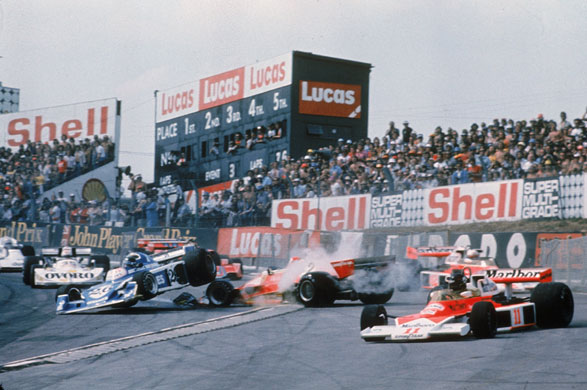
Come the restart the organisers initially refused to allow James to line up on the grid because the team had worked to repair his car while the mess was being cleared up. However people power intervened and fearing a riot from the partisan crowd the organisers relented, James took the win, he and the partisan crowd partied long and hard into the night and later the F.I.A. disqualified both Hunt and Clay Regazzoni from the event for having failed to complete the opening lap.
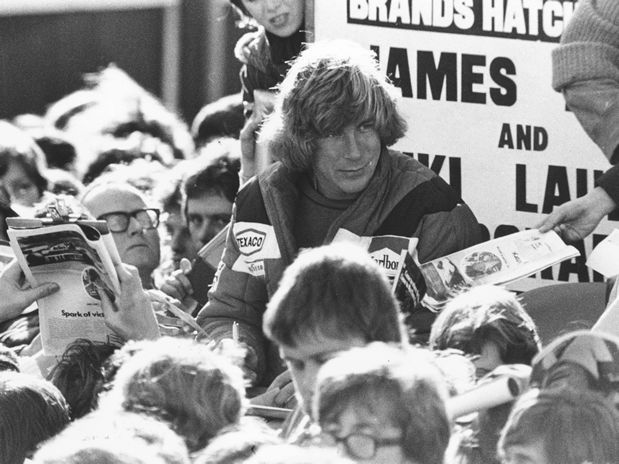
Up until this point reigning Champion Niki Lauda had dominated the 1976 Championship with four wins three seconds, the last of which became 1st after Hunt's disqualification from the British GP and a third. The next race was the ill feted German Grand Prix in which Niki was eliminated in an accident that triggered an inferno from which he was lucky to escape with his life.
James won the German Grand Prix and the Dutch GP while Niki recuperated and 39 days after the inferno at the Nurburgring Niki and James met again at the Italian GP. At the end of practice for the Italian GP James and Mclaren team mate Jochen Mass and John Watson at Penske were found to be running with a fuel octane rating that was too high and had their Saturday times disallowed.

Since it had been raining during the first practice sessions on the Friday Hunt, Mass and Watson had effectively failed to qualify, however the 13 second plus off pace Otto Stuppacher was already on his way home to Austria when the announcement and the Marlboro sponsored Art Mezario withdrew as did Englishman Guy Edwards allowing Hunt, Mass and Watson to start.
Hunt crashed trying to make time and was applauded for doing so by the Tifosi and Lauda came home a remarkable 4th in his first race back.
James won both the Canadian and US Grand Prix while the brave Niki could only amass a further three championship points. Going into he last race of the season the Japanese GP Niki had a 3 point lead over James.

For the race James qualified 2nd behind Andretti with Niki just one place further back. I remember getting up at some unholy hour to watch this race live on TV in the UK and remember the disappointment when I saw the monsoon that unfolded on the track.
After much debate amongst the driver the race started and Niki who had lost his eyelids in the German inferno and yet to have them replaced through plastic surgery had little choice but to retire in the near zero visibility conditions. James took an early lead in the race but as the rain stopped and the track started to dry Hunt started losing ground dropping to 5th after a pit stop to replace a punctured tyre with just a few laps to go.

James charged back into the race managing to regain two positions which left him in third position when the flag came out for Mario Andretti to win by just over a lap from Patrick Depailler, with James Hunt, who had no idea what his position was in the race, right on his tail.
Hunt only learned that he had become champion after he got out of the car and stopped shouting at team manager Teddy Meyer for a less than perfect pit stop.
Hunt won the 1976 World Drivers title by just one point and Great Britain had it's first World Champion since Jackie Stewart had won his last crown in 1973.
The McLaren M23 was pressed into service again in 1977 but its competitiveness was on the wane James winning a non championship race before committing fully to the M26 successor which had gone through a troublesome one year gestation period before coming on song.
The works M23 had a final swan song when it introduced Gilles Villeneuve to the world of Grand Prix racing in Great Britain and Bruno Jack'O'Malley in Italy towards the end of the 1977.
I have done my best to find out exactly which of the 13 M23 chassis this is, The Donington Museum blurb identified this car as McLaren M23/8 and said it was used to win the '76 Spanish and US GP's however M23/8 was destroyed in 1975. The car was then given a new tub with the chassis number M23/8-2 and the old tub was apparently eventually repaired to 1975 tall airbox spec and now resides in the United States.
M23/8-2 went on to become one of the stars of the 1976 season being used to win the controversial Spanish GP along with those in Canada and the US GP. M23/8-2 is said to belong to BCE the man responsible for running the the whole Formula Show since 1981.
It is said that the vehicle in my photograph appeared at the 60th Anniversary celebrations of the World Grand Prix Drivers Championship in Bahrain last year, it is also suggested that the M23 which appeared at Bahrain belongs to the brave octogenarian who started a modelling career with Hublot earlier this year however I have no firm evidence of the ownership of the vehicle in the photograph at the top of this post

at this time.
Most likely the vehicle above seen at the Donington Park Museum is M23/6 which seems to meet many of the criteria hinted at on various threads of The Nostalgia Forum and who's whereabouts is listed as unknown by the respected Old Racing Car site.
M23/6 was used by Denny Hulme to win the Agentine Grand Prix in 1974 then in 1976 James Hunt drove it to win the French Grand Prix, cross the line first in Great Britain only to be disqualified .
At the next race the German Grand Prix I saw James win in this chassis which became one of a rare set of vehicles that crossed the line first in three consecutive races, though it was disqualified from one of them.
In 1977 Emilio de Villota drove M23/6 with little success in Grand Prix events, 2 starts three DNQ's, but did win two rounds of a British series open to all single seat racing cars.

My thanks to Michael Ferner, Wouter Melissen, Steve Holter, Simon Hadfield, Slurp1955, at The Nostalgia Forum for their valuable contributions to todays blog.
Hope you have enjoyed today's 1976 edition of 'Gettin' a lil psycho on tyres' and that you will join me again tomorrow. Don't forget to come back now !
Sunday, 10 July 2011
From Metal Bashing to Autoclave - McLaren MP4/1 #MP4/1-02
Thirty years ago I was extremely lucky to find my self working for six months in an accounts department of a double glazing manufacturer during the one of two industrial experience segments of my degree course. This meant I had the time and funds not only to spend a week at Le Mans but I also had the time and funds to spend a weekend at the British Grand Prix at Silverstone.

During the 1980 / 1981 off season McLaren's long time sponsor Philip Morris, disappointed with three years of under achievement coerced team principle Teddy Meyer into a merger with Project Four a lower tier Formula 2 team run by Ron Dennis which coincidentally was also sponsored by Philip Morris.
Ron Dennis had hired the designer, of the Chaparral 2K Indy Car, John Barnard to design a new car for McLaren which became known as the MP4/1. Outwardly the car was a conventional 'kit car' using a Cosworth DFV engine that had been the motor of choice since 1966.
However beneath the paint work John Barnhard's chassis was the first to be wholly manufactured with carbon composite materials, which until 1981 had been primarily used in the aerospace industry. Carbon composite materials when pressure and heat treated in an autoclave, a process developed by the Royal Aircraft Establishment in 1963, can be used produce objects that have high flexibility, tensile strength and temperature tolerance while at the same time have low thermal expansion and low weight compared to similar metal objects.
By the end of the 1980's all Formula One chassis were being manufactured from carbon composites along with brake discs and suspension components.
John Watson, seen during practice for the British Grand Prix here, qualified fifth for the 1981 British Grand Prix, at the start of the race the two turbo charged Renaults and Ferrari's made the best get away but on lap 3 Gilles Villeneuve clipped a curb and spun,see clip 1m 20secs, an incident which took out Alan Jones on the spot.
Somehow John Watson who was right behind Jones managed to avoid the melee almost coming to a stop as he did so, which in turn caused his team mate Andrea de Cesaris behind him to take evasive action and spin off into the catch fencing.
After loosing a lot of time Watson set off in sixth place behind Piquet, Reutemann, Pironi, Arnoux and Prost. Piquet crashed out with a puncture, Watson then over took first Reutemann and then Pironi who's engine exploded on the next lap. Prost retired with distributor trouble which put John in 2nd place behind Arnoux who had a comfortable lead.
On lap 53 Arnoux started experiencing the same problems as Prost and 8 laps later a huge roar went round the circuit as Belfast born John took the lead of his home Grand Prix which he held until the end of the race.
This was John's second Grand Prix victory his first was in the Penske PC4 in 1976 and the first victory for McLaren under the guidance of Ron Dennis. McLarens last victory had been with James Hunt in 1977.
John drove this same chassis #MP4/1-02 to victory in the 1982 Belgian Grand Prix.
Hope you have enjoyed today's British GP edition of 'Gettin' a lil' psycho on tyres' and that you will join me again tomorrow. Don't forget to come back now !
PS It is with great sorrow that I learned of the passing of William 'Bill' Boddy MBE known to many as 'WB' who edited Motor Sport magazine from 1936 to 1991, an organ which played no small part in my addiction to motoring and motor sport in the 1970's and ultimately to this blog.
He famously ran Motor Sport magazine through the war years during his spare time while working on important Air Publications.
Bill was a vociferous opponent to the 70 mph speed limits introduced to Britain as a temporary measure by Tom Fraser in 1965 after a spate of accidents in fog and the alleged testing of an AC Cobra at speeds up to 180 mph on the M1 motorway.
WB was aged 98, sincerest condolences to his family and many friends. RIP 'WB'.
During the 1980 / 1981 off season McLaren's long time sponsor Philip Morris, disappointed with three years of under achievement coerced team principle Teddy Meyer into a merger with Project Four a lower tier Formula 2 team run by Ron Dennis which coincidentally was also sponsored by Philip Morris.
Ron Dennis had hired the designer, of the Chaparral 2K Indy Car, John Barnard to design a new car for McLaren which became known as the MP4/1. Outwardly the car was a conventional 'kit car' using a Cosworth DFV engine that had been the motor of choice since 1966.
However beneath the paint work John Barnhard's chassis was the first to be wholly manufactured with carbon composite materials, which until 1981 had been primarily used in the aerospace industry. Carbon composite materials when pressure and heat treated in an autoclave, a process developed by the Royal Aircraft Establishment in 1963, can be used produce objects that have high flexibility, tensile strength and temperature tolerance while at the same time have low thermal expansion and low weight compared to similar metal objects.
By the end of the 1980's all Formula One chassis were being manufactured from carbon composites along with brake discs and suspension components.
John Watson, seen during practice for the British Grand Prix here, qualified fifth for the 1981 British Grand Prix, at the start of the race the two turbo charged Renaults and Ferrari's made the best get away but on lap 3 Gilles Villeneuve clipped a curb and spun,see clip 1m 20secs, an incident which took out Alan Jones on the spot.
Somehow John Watson who was right behind Jones managed to avoid the melee almost coming to a stop as he did so, which in turn caused his team mate Andrea de Cesaris behind him to take evasive action and spin off into the catch fencing.
After loosing a lot of time Watson set off in sixth place behind Piquet, Reutemann, Pironi, Arnoux and Prost. Piquet crashed out with a puncture, Watson then over took first Reutemann and then Pironi who's engine exploded on the next lap. Prost retired with distributor trouble which put John in 2nd place behind Arnoux who had a comfortable lead.
On lap 53 Arnoux started experiencing the same problems as Prost and 8 laps later a huge roar went round the circuit as Belfast born John took the lead of his home Grand Prix which he held until the end of the race.
This was John's second Grand Prix victory his first was in the Penske PC4 in 1976 and the first victory for McLaren under the guidance of Ron Dennis. McLarens last victory had been with James Hunt in 1977.
John drove this same chassis #MP4/1-02 to victory in the 1982 Belgian Grand Prix.
Hope you have enjoyed today's British GP edition of 'Gettin' a lil' psycho on tyres' and that you will join me again tomorrow. Don't forget to come back now !
PS It is with great sorrow that I learned of the passing of William 'Bill' Boddy MBE known to many as 'WB' who edited Motor Sport magazine from 1936 to 1991, an organ which played no small part in my addiction to motoring and motor sport in the 1970's and ultimately to this blog.
He famously ran Motor Sport magazine through the war years during his spare time while working on important Air Publications.
Bill was a vociferous opponent to the 70 mph speed limits introduced to Britain as a temporary measure by Tom Fraser in 1965 after a spate of accidents in fog and the alleged testing of an AC Cobra at speeds up to 180 mph on the M1 motorway.
WB was aged 98, sincerest condolences to his family and many friends. RIP 'WB'.
Monday, 4 July 2011
Grand Prix City - Donington Park Museum

(Ayrton Senna & Juan Manuel Fangio)
A couple of weeks ago I had the opportunity to drop in to the Donington Park Museum, home to the Donington Park Grand Prix Collection. Donington Park dates back to at least the Doomesday Book compiled in 1086 and is one of the longest established deer parks in the UK.

(1939 Auto Union Type D)
After serving as a Prisoner Of War camp for German officers in World War 1, a race track was built in 1931 for £12,000. The track played host to Grand Prix races featuring the Mercedes and Auto Union 'Silver Arrows' Grand Prix cars, Tazio Nuvolari driving an Auto Union during practice for the 1938 British Grand Prix fatally struck a stray deer.

(1942 Trippel SG 6)
During World War 2 Donington Park became home to 50,000 vehicles as the largest military transport depot in Europe. In 1971 local building magnate Tom Wheatcroft took over the Donington Park circuit and 8 years later racing was resumed after a nearly 40 year break. The highlight of the resumption of racing at Donington was almost certainly the 1993 European Grand Prix.

(1958 Vanwall VW9)
Tom Wheatcroft alongside his property developing business had a passion for racing, collecting vehicles associated with the circuits pre war history, vehicles used in WW2, during which Tom served in a tank regiment and British built Grand Prix cars.

(1973 March BMW 732)
He also sponsored and entered talented drivers, including Derek Bell, Richard Morgan and in particular Roger Williamson whom Wheatcroft financed in Formula 3 and 2 and an ill fated Grand Prix drive in which Roger met his untimely demise in a horrific accident during the 1973 Dutch Grand Prix.

(1970 McLaren Offy M15)
The Donington Park Museum houses the largest collection of McLaren

(1973 Williams - Ford FW 02)
and Williams vehicles outside of these two prestigious manufacturers own collections.

(1975 Hill - Ford GH2)
I spent several memorable hours going round the museum housing a veritable feast of some of the highs and low's of British Grand Prix endeavour. Situated just of the M1 near Nottingham, at just £8 a visit, I'll look forward to dropping in again when the opportunity next presents it's self.
Slightly off topic, wishing all GALPOT readers in the USA and US readers abroad Happy Independence day.
Thanks for dropping today's Donington Park edition of 'Gettin' a lil psycho on tyres' i hope you'll join me again tomorrow for a look an Independence day cruise in the UK. Don't forget to come back now !
Subscribe to:
Posts (Atom)