
Showing posts with label Studebaker. Show all posts
Showing posts with label Studebaker. Show all posts
Monday, 4 May 2015


Sunday, 27 May 2012
GALPOT Weekly #32
Welcome to the review of blogs at "Gettin' a li'l psycho on tyres", known as GALPOT Weekly #32.

This week started of at the at the Simply Italian parade at the National Motor Museum at Beaulieu. Where GALPOT regular David Root's ALFA Romeo 4C Special, above, won second place in an audience vote for best car present. You can see some of the competition David's Special was up against on this link.

Almost unbelievably the MG 14/40 MK IV sports, which won the Bristol Classic Car show Best Vintage Car Award winner, spent an unknown number of years disassembled and care fully stored under the concrete base of a shed until it was found in 1999.

The first ever DAF passenger car, seen above at last years Goodwood Festival of Speed, was only the second ever production vehicle to be offered with a variomatic gear box, more about the DAF 33 Luxe can be on this link.

For Americana Thursday we traveled back 50 years for the first of two visits to the 1962 Indianapolis 500. Honorary Pace car for the month of May was the recently launched Studebaker Avanti about which you can read more on this link.

The kink in the top rail of the door of the Ferrari 250 GT SWB Berlinetta was the give away clue as to the identity of the car in the photo above. Strangely this is the only photo I took of a Ferrari on track between 1983 and 2011.
For all it's beauty no sooner had the works Cosworth DFX engine been installed in the back of the Lotus 96 Indy Challenger than the money ran out and the project was halted. Find out more about the still born Lotus 96 on this link.

Pole position for the 1962 Indy 500 went to Parnelli Jones who was given one hundred and fifty silver dollars by a rival owner being the first person to average 150 mph on all four of his qualifying laps, at the time a world record. Parnelli can be seen starting the race from the inside of the front row while the race winner Roger Ward starts right next to him. Find out what happened on the Roger's way to victory lane on this link.
I hope you have enjoyed catching up with last weeks events on "Gettin' a li'l psycho on tyres" and I hope you will join me again next week when I'll start by looking at some of the exhibits on display at the National Motor Museum in Beaulieu. Don't forget to come back now !
This week started of at the at the Simply Italian parade at the National Motor Museum at Beaulieu. Where GALPOT regular David Root's ALFA Romeo 4C Special, above, won second place in an audience vote for best car present. You can see some of the competition David's Special was up against on this link.
Almost unbelievably the MG 14/40 MK IV sports, which won the Bristol Classic Car show Best Vintage Car Award winner, spent an unknown number of years disassembled and care fully stored under the concrete base of a shed until it was found in 1999.
The first ever DAF passenger car, seen above at last years Goodwood Festival of Speed, was only the second ever production vehicle to be offered with a variomatic gear box, more about the DAF 33 Luxe can be on this link.
For Americana Thursday we traveled back 50 years for the first of two visits to the 1962 Indianapolis 500. Honorary Pace car for the month of May was the recently launched Studebaker Avanti about which you can read more on this link.
The kink in the top rail of the door of the Ferrari 250 GT SWB Berlinetta was the give away clue as to the identity of the car in the photo above. Strangely this is the only photo I took of a Ferrari on track between 1983 and 2011.
For all it's beauty no sooner had the works Cosworth DFX engine been installed in the back of the Lotus 96 Indy Challenger than the money ran out and the project was halted. Find out more about the still born Lotus 96 on this link.
Pole position for the 1962 Indy 500 went to Parnelli Jones who was given one hundred and fifty silver dollars by a rival owner being the first person to average 150 mph on all four of his qualifying laps, at the time a world record. Parnelli can be seen starting the race from the inside of the front row while the race winner Roger Ward starts right next to him. Find out what happened on the Roger's way to victory lane on this link.
I hope you have enjoyed catching up with last weeks events on "Gettin' a li'l psycho on tyres" and I hope you will join me again next week when I'll start by looking at some of the exhibits on display at the National Motor Museum in Beaulieu. Don't forget to come back now !
Tuesday, 2 August 2011
Awaiting TLC #2 - Rover 75 P4
The Rover P4 range of vehicles was introduced in 1949 to replace the interim out dated P3 vehicles which had been rushed into production in 1948 as the Rover company sort to rebuild itself as a vehicle manufacturer having spent the years during World War 2 manufacturing aircraft.

Drawing inspiration from the 3rd generation Raymond Loewy designed Studebaker Champion launched in 1946, at the request of the Wilkes brothers who owned Rover, Gordon Bashford was responsible for what was known in the factory as the P4. The original P4's came fitted with a central spot lamp mounted in the grill, but this feature was dropped early in production which eased the difficulties keeping the engine cool.

The P4 was continually being upgraded and from 1954 a distinct MkII version was available that was then restyled again into the form shown in these photo's in 1957, a Mk 2.2 if you will.

Because of material shortages immediately after WW2 these vehicles incorporated a high percentage of aluminium content and were to be seen in competitions of the day including the 1955 Mille Miglia in which Lando Barsotti brought his #347 Rover 75 P4 in 271st. The 75 seen here was powered by a 2.2 litre /136 cui 6 cylinder motor featuring the same overhead inlet valves and side exhaust valve design as had been a feature of the earlier P3.

The final MK II P4's were produced in 1959 with 9,974 Mk II's produced over it's five year production run.
I spotted this particular vehicle at the back of the Atwell - Wilson Motor Museum. I am not sure what they planned to do with it, good working examples of the type tend not to fetch more than £ 2000 so the cost of restoration would appear to be a little prohibitive.
Thanks for joining me on this Awaiting TLC edition of 'Gettin' a lil psycho on tyres', I hope you will join me again tomorrow. Don't forget to come back now !
Drawing inspiration from the 3rd generation Raymond Loewy designed Studebaker Champion launched in 1946, at the request of the Wilkes brothers who owned Rover, Gordon Bashford was responsible for what was known in the factory as the P4. The original P4's came fitted with a central spot lamp mounted in the grill, but this feature was dropped early in production which eased the difficulties keeping the engine cool.

The P4 was continually being upgraded and from 1954 a distinct MkII version was available that was then restyled again into the form shown in these photo's in 1957, a Mk 2.2 if you will.
Because of material shortages immediately after WW2 these vehicles incorporated a high percentage of aluminium content and were to be seen in competitions of the day including the 1955 Mille Miglia in which Lando Barsotti brought his #347 Rover 75 P4 in 271st. The 75 seen here was powered by a 2.2 litre /136 cui 6 cylinder motor featuring the same overhead inlet valves and side exhaust valve design as had been a feature of the earlier P3.
The final MK II P4's were produced in 1959 with 9,974 Mk II's produced over it's five year production run.
I spotted this particular vehicle at the back of the Atwell - Wilson Motor Museum. I am not sure what they planned to do with it, good working examples of the type tend not to fetch more than £ 2000 so the cost of restoration would appear to be a little prohibitive.
Thanks for joining me on this Awaiting TLC edition of 'Gettin' a lil psycho on tyres', I hope you will join me again tomorrow. Don't forget to come back now !
Thursday, 5 May 2011
85% Stock Specials - Studebakers 1932 to 1933
Moving forward a couple of decades from yesterdays post today we are looking a couple of Studebakers that appeared at Indy in 1932 and 1933, thanks to photographs by Ed Arnaudin taken in 1962.

In 1932 Studebaker built and entered 5 boat tail specials for the Indianapolis 500.
Unlike most cars entered at Indianapolis at the time 85% of the mechanical parts used in these vehicles were stock items.
Indianapolis chassis specialist Hermann Rigling built the frames and bodies to accommodate the 200 hp 5.5 litre 336 cui straight 8 engines which were sourced from the Studebaker President along with most of the rest of the running gear. The finished cars were said to be capable of 140 mph.
The #22 above was entered for Cliff Bergere and riding mechanic Vern Lake who qualified 10th and finished 3rd in the highest ranking Studebaker at the end of the race.
Cliff from Toledo Ohio first ran at Indianapolis in 1927, this was his best finish which he equalled in 1939. By the end of his career in 1947 Cliff had competed in a then record 16 starts having led 25 laps of a record, at the time, 2,426 laps of racing at the Brickyard.
Cliff is remembered for having completed the 1941 race without a pit stop although he was overcome by fumes after taking the lead and dropped to 5th at the finish line.
He was due to drive a highly rated Novi in 1948, but an ill advised fuel tank enlargement rendered the car unsafe in his opinion, this was in part substantiated after he quit the team.
The popular and ultimately unfortunate Ralph Hepburn took the Novi over he ran at close to record speeds before fatally loosing control and hitting the wall.
In 1940 Bergere helped the 57 year old 'Racing Mayor' Ab Jenkins set a 24 hour average speed of 161 mph in the fearsome Mormon Meteor III powered by a 750 horsepower 12 cylinder Curtis aircraft engine at Bonneville.

After the modest 3rd place success in 1932 Studebaker returned to Indianapolis in 1933 with some improved cars.
For 1933 the factory supported cars again with a combination of Rigling chassis and and 336 cui straight 8 President motors appeared with more streamlined body work than in 1932.
The the Studebaker post race advertising and studebakerracing.com shows Studebaker entered a five car team.
The #34 shown here was driven by Tony Gulotta finished 7th highest place amongst the 5 cars with 336 cui President engines and one place behind a smaller 250 cui Studebaker Commander powered Rigling Chassis known as the Art Rose Special driven by Dave Evans.
Tony Gulotta from New Orleans finished a career high 8th in the 1927 American Championship Car Racing National Championship aboard a Miller.
Thereafter Tony focused his efforts primarily on the 'Indy 500' coming within 18 laps of winning the race in 1928 driving a Stutz Blackhawk Special Miller when a clogged fuel line sent him to the pits resulting in a 10th place finish. Tony's best finish at Indianapolis from 13 starts remained his 3rd place finish in 1927.
My thanks to Steve Arnaudin for sending me the scans of his Dad's slides and to E.B. of The Nostalgia Forum for identifying both vehicles.
Hope you have enjoyed today's 85% stock special edition of 'Getting a lil' psycho on tyres and that you will join me again tomorrow for Ferrari Friday. Don't forget to come back now !
In 1932 Studebaker built and entered 5 boat tail specials for the Indianapolis 500.
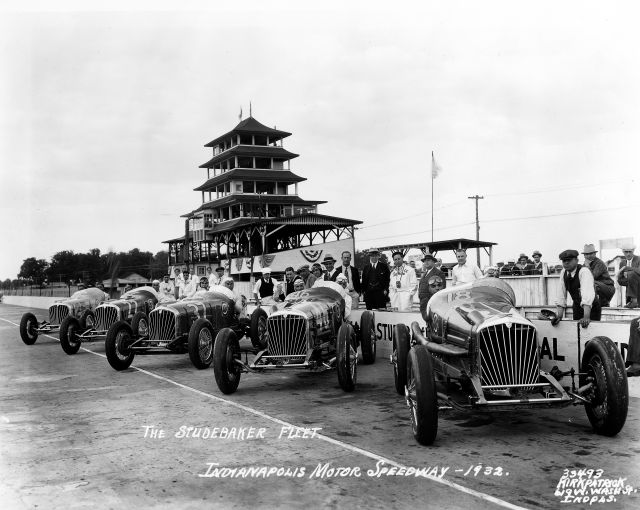
Unlike most cars entered at Indianapolis at the time 85% of the mechanical parts used in these vehicles were stock items.
Indianapolis chassis specialist Hermann Rigling built the frames and bodies to accommodate the 200 hp 5.5 litre 336 cui straight 8 engines which were sourced from the Studebaker President along with most of the rest of the running gear. The finished cars were said to be capable of 140 mph.
The #22 above was entered for Cliff Bergere and riding mechanic Vern Lake who qualified 10th and finished 3rd in the highest ranking Studebaker at the end of the race.
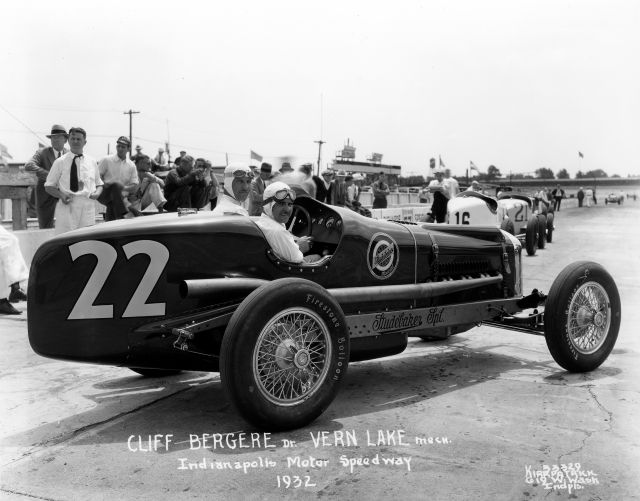
Cliff from Toledo Ohio first ran at Indianapolis in 1927, this was his best finish which he equalled in 1939. By the end of his career in 1947 Cliff had competed in a then record 16 starts having led 25 laps of a record, at the time, 2,426 laps of racing at the Brickyard.
Cliff is remembered for having completed the 1941 race without a pit stop although he was overcome by fumes after taking the lead and dropped to 5th at the finish line.
He was due to drive a highly rated Novi in 1948, but an ill advised fuel tank enlargement rendered the car unsafe in his opinion, this was in part substantiated after he quit the team.
The popular and ultimately unfortunate Ralph Hepburn took the Novi over he ran at close to record speeds before fatally loosing control and hitting the wall.
In 1940 Bergere helped the 57 year old 'Racing Mayor' Ab Jenkins set a 24 hour average speed of 161 mph in the fearsome Mormon Meteor III powered by a 750 horsepower 12 cylinder Curtis aircraft engine at Bonneville.
After the modest 3rd place success in 1932 Studebaker returned to Indianapolis in 1933 with some improved cars.
For 1933 the factory supported cars again with a combination of Rigling chassis and and 336 cui straight 8 President motors appeared with more streamlined body work than in 1932.

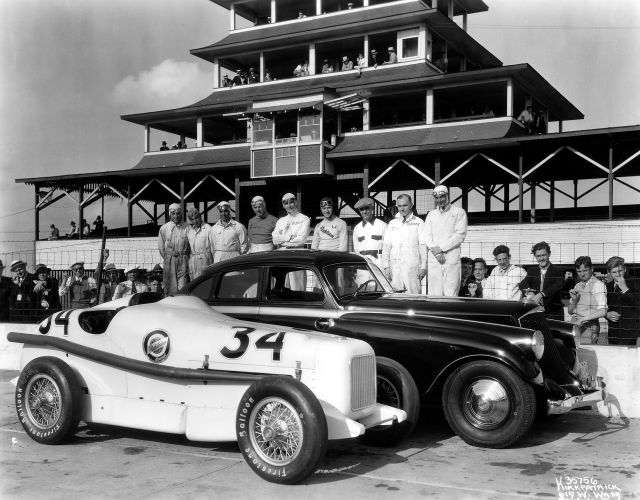
The the Studebaker post race advertising and studebakerracing.com shows Studebaker entered a five car team.

The #34 shown here was driven by Tony Gulotta finished 7th highest place amongst the 5 cars with 336 cui President engines and one place behind a smaller 250 cui Studebaker Commander powered Rigling Chassis known as the Art Rose Special driven by Dave Evans.
Tony Gulotta from New Orleans finished a career high 8th in the 1927 American Championship Car Racing National Championship aboard a Miller.
Thereafter Tony focused his efforts primarily on the 'Indy 500' coming within 18 laps of winning the race in 1928 driving a Stutz Blackhawk Special Miller when a clogged fuel line sent him to the pits resulting in a 10th place finish. Tony's best finish at Indianapolis from 13 starts remained his 3rd place finish in 1927.
My thanks to Steve Arnaudin for sending me the scans of his Dad's slides and to E.B. of The Nostalgia Forum for identifying both vehicles.
Hope you have enjoyed today's 85% stock special edition of 'Getting a lil' psycho on tyres and that you will join me again tomorrow for Ferrari Friday. Don't forget to come back now !
Subscribe to:
Posts (Atom)