
Showing posts with label Series. Show all posts
Showing posts with label Series. Show all posts
Thursday, 28 April 2016


Friday, 8 January 2016

Tuesday, 6 September 2011
Battersea Dogs Car - Rover P6 3500 Series 1 Estoura
Thanks to a timely reminder from David Rootes I made it to the Rare Breeds Car Show at the Haynes International Motor Museum on Sunday.

Amongst a variety of rare vehicles was this 1969 Series I Rover 3500 which preceded the Series II Rover 2200 SC I looked at last week. P6 models fitted with the aluminium 215 Buick derived V8 are easily distinguishable from their 4 cylinder siblings by the extra air intake below the bumper.

The engine compartment of the P6 was originally designed to accommodate a Rover gas turbine motor, but this option never came to fruition and instead the 158 hp twin carburettor V8 as had been fitted to the the Rover P5B was fitted to the top of the range P6 models.

According to the owner of this Estoura variant only 157 P6 saloons were converted to estate / station wagon models between 1969 and 1976. This is the oldest of 4 Series 1 Estoura's known to have survived.

Conversion of the saloon P6 to Estoura spec included replacing the original roof and C pillars with a new pod, designed by Brian Roll, that was riveted and welded in by FLM Panelcraft of Battersea. Although the conversion was approved by Rover and did not affect warranties no rust protection was added to bare surfaces which were simply painted over with the out come that these cars are more prone to rot than standard P6's.

Once FLM had converted the P6 shell the cars were sent to either Crayford, HR Owen or Hurst Park Motors where a variety of interior and exterior trims were fitted.

The load space while significantly improved is not particularly deep or easy to access even for a canine compared to a modern day Estate / Station Wagon or MPV.
Thanks for joining me on this Estoura edition of 'Gettin' a lil' psycho on tyres', I hope you will join me again tomorrow. Don't forget to come back now !
Amongst a variety of rare vehicles was this 1969 Series I Rover 3500 which preceded the Series II Rover 2200 SC I looked at last week. P6 models fitted with the aluminium 215 Buick derived V8 are easily distinguishable from their 4 cylinder siblings by the extra air intake below the bumper.
The engine compartment of the P6 was originally designed to accommodate a Rover gas turbine motor, but this option never came to fruition and instead the 158 hp twin carburettor V8 as had been fitted to the the Rover P5B was fitted to the top of the range P6 models.
According to the owner of this Estoura variant only 157 P6 saloons were converted to estate / station wagon models between 1969 and 1976. This is the oldest of 4 Series 1 Estoura's known to have survived.
Conversion of the saloon P6 to Estoura spec included replacing the original roof and C pillars with a new pod, designed by Brian Roll, that was riveted and welded in by FLM Panelcraft of Battersea. Although the conversion was approved by Rover and did not affect warranties no rust protection was added to bare surfaces which were simply painted over with the out come that these cars are more prone to rot than standard P6's.
Once FLM had converted the P6 shell the cars were sent to either Crayford, HR Owen or Hurst Park Motors where a variety of interior and exterior trims were fitted.
The load space while significantly improved is not particularly deep or easy to access even for a canine compared to a modern day Estate / Station Wagon or MPV.
Thanks for joining me on this Estoura edition of 'Gettin' a lil' psycho on tyres', I hope you will join me again tomorrow. Don't forget to come back now !
Saturday, 13 August 2011
Jaguar V12 E-Type Series 3 #IS 2857
In the summer of 1980 I passed my college entrance exams, at my third attempt and before finally fleeing the family nest in Wembley to attend Trent Polytechnic, I got a summer job at a local Honda dealership to tide me over.

One of the dealership owners many cars, and even more motorcycles, was a black Jaguar E - Type Convertible like the one in these photographs one of the last fifty made, all available only in black, a fact that is noted on a brass plate mounted on the glove box cover.

In 1971 the Series 3 E-Types ushured Jaguars second ever completely new motor into production, an all aluminium 5.3 litre / 326 cui V12 with 2 valves per cylinder design that had it's origins in a design intended for racing dating back to 1954. This motor would eventually be developed into a 7 litre / 427 quad cam that would be used to win at Le Mans twice, 1988 and 1990.

All Series 3 E-types were built around the longer 2+2 chassis pan, most with the V12 engine but a few Series 3 models were built with the older 4.2 litre / 256 cui 6 cylinder motor.

The brass plaque on the right of this photo gives the chassis number as IS 2857 which according to the only list of XKE chassis numbers I have seen suggests this car was originally supplied in Right Hand Drive form.

This particularly splendid example, seen here at the recent Silverstone Classic, has been restored and 'sympathetically' upgraded winning the Speis Hecker World Masterpiece competition for outstanding coachwork re-finishing.

My own 30 year old memories of the V12 E - Type were that it was certainly a buzz taking the car to the petrol pump down the road, it turned heads, the engine was silky smooth, the steering was light but it inspired little or no confidence, even on a roundabout at perfectly legal speeds, in it's handling capabilities, it seemed to lean in the corners rather that hug the road as even my pedestrian FIAT 128 did, and parking a car with such a long nose was an absolute nightmare on a crowded parking lot.
Overall I was disappointed with how the car drove a bit like meeting a rock star whom one has held in high esteem only to find that he / she has all the usual human traits some of which are not so pleasant or different from our selves, or driving an air cooled Porsche for the first time to find that interior has the same smell of fumes as an air cooled VW Beetle, more boulevard cruiser than the track racer which I was expecting.
Thanks for joining me on this E-type edition of 'Gettin' a lil' psycho on tyres' I hope you will join me again tomorrow. Don't forget to come back now !
One of the dealership owners many cars, and even more motorcycles, was a black Jaguar E - Type Convertible like the one in these photographs one of the last fifty made, all available only in black, a fact that is noted on a brass plate mounted on the glove box cover.
In 1971 the Series 3 E-Types ushured Jaguars second ever completely new motor into production, an all aluminium 5.3 litre / 326 cui V12 with 2 valves per cylinder design that had it's origins in a design intended for racing dating back to 1954. This motor would eventually be developed into a 7 litre / 427 quad cam that would be used to win at Le Mans twice, 1988 and 1990.
All Series 3 E-types were built around the longer 2+2 chassis pan, most with the V12 engine but a few Series 3 models were built with the older 4.2 litre / 256 cui 6 cylinder motor.
The brass plaque on the right of this photo gives the chassis number as IS 2857 which according to the only list of XKE chassis numbers I have seen suggests this car was originally supplied in Right Hand Drive form.
This particularly splendid example, seen here at the recent Silverstone Classic, has been restored and 'sympathetically' upgraded winning the Speis Hecker World Masterpiece competition for outstanding coachwork re-finishing.
My own 30 year old memories of the V12 E - Type were that it was certainly a buzz taking the car to the petrol pump down the road, it turned heads, the engine was silky smooth, the steering was light but it inspired little or no confidence, even on a roundabout at perfectly legal speeds, in it's handling capabilities, it seemed to lean in the corners rather that hug the road as even my pedestrian FIAT 128 did, and parking a car with such a long nose was an absolute nightmare on a crowded parking lot.
Overall I was disappointed with how the car drove a bit like meeting a rock star whom one has held in high esteem only to find that he / she has all the usual human traits some of which are not so pleasant or different from our selves, or driving an air cooled Porsche for the first time to find that interior has the same smell of fumes as an air cooled VW Beetle, more boulevard cruiser than the track racer which I was expecting.
Thanks for joining me on this E-type edition of 'Gettin' a lil' psycho on tyres' I hope you will join me again tomorrow. Don't forget to come back now !
Thursday, 4 August 2011
Giant Killing Potential ? - Jedi Mk4
Today we are looking at a Jedi Mk4 run by 2 time 1000 cc Monoposto Champion Arty Cameron that appeared at Castle Combe for the Free Single Seater Series the week before last.

Arty is from a big racing family who's father Tim started racing in 1958, 3 of Arty's 7 siblings also compete.

The Jedi Mk4 was designed by racer John Corbyn and built in Wellingborough to accommodate a variety of motorcycle engines, Arty uses a 1000 cc / 61 cui Yamaha R1 motor which produces 183 hp

that is transmitted to the rear wheels by chain drive.

Thanks to a high power to weight ratio, car and driver 400 kgs a potential acceleration time of 0 - 60 in under 3 seconds is possible,

Arty beautifully translated this potential into this memorable start at Castle Combe two weeks ago in which starting from 5th he led the opening lap

against faster Formula 3 cars with larger tyres and more powerful motors with ease during an all comers race.

The Jedi flew around the corners, Arty displaying masterful car control as it did so.

Unfortunately the giant killing act was judged to have been the result of a jump start and Arty's 10 second penalty became irrelevant after his engine grenaded, possibly the result of an oil leak during qualifying.
I look forward to seeing what Arty can do next time out which I hope will be next weekend at Castle Combe for the August Cup.
If you have an open wheel vehicle that can meet the 108db limit, and I have seen some 7 litre V8's and an 8.3 litre V10 meet that requirement recently, why not come along to Castle Combe and join in the fun. Should you looking be looking for a driver, you could do worse than give double Monoposto Champion Arty a call, he is certain not to disappoint.
My thanks to Geoff E, Simon Lewis and JMH of The Nostalgia Forum for coming up with additional details for today's post.
Hope you have enjoyed today's Monoposto edition of 'Gettin' a lil' psycho on tyres' and that you will join me again tomorrow. May the force be with you and don't forget to come back now !
Arty is from a big racing family who's father Tim started racing in 1958, 3 of Arty's 7 siblings also compete.
The Jedi Mk4 was designed by racer John Corbyn and built in Wellingborough to accommodate a variety of motorcycle engines, Arty uses a 1000 cc / 61 cui Yamaha R1 motor which produces 183 hp
that is transmitted to the rear wheels by chain drive.
Thanks to a high power to weight ratio, car and driver 400 kgs a potential acceleration time of 0 - 60 in under 3 seconds is possible,
Arty beautifully translated this potential into this memorable start at Castle Combe two weeks ago in which starting from 5th he led the opening lap
against faster Formula 3 cars with larger tyres and more powerful motors with ease during an all comers race.
The Jedi flew around the corners, Arty displaying masterful car control as it did so.
Unfortunately the giant killing act was judged to have been the result of a jump start and Arty's 10 second penalty became irrelevant after his engine grenaded, possibly the result of an oil leak during qualifying.
I look forward to seeing what Arty can do next time out which I hope will be next weekend at Castle Combe for the August Cup.
If you have an open wheel vehicle that can meet the 108db limit, and I have seen some 7 litre V8's and an 8.3 litre V10 meet that requirement recently, why not come along to Castle Combe and join in the fun. Should you looking be looking for a driver, you could do worse than give double Monoposto Champion Arty a call, he is certain not to disappoint.
My thanks to Geoff E, Simon Lewis and JMH of The Nostalgia Forum for coming up with additional details for today's post.
Hope you have enjoyed today's Monoposto edition of 'Gettin' a lil' psycho on tyres' and that you will join me again tomorrow. May the force be with you and don't forget to come back now !
Thursday, 14 July 2011
Driver to Sponsor - Simon Lewis
During the early 1980's Simon Lewis was a regular spectator at Castle Combe where the biggest attraction used to be Formula Libre events run for any car built to known regulations.

At the top end of the entry would be vehicles that had run in Grand Prix like Alo Lawlers McLaren Cosworth DFV M30 resplendent in it's original colours and bearing the name of it's original driver Alain Prost,

or Formula 5000 vehicles like Tony Trimmers Lola Chevrolet T330,

and once in a while something extremely exotic like a Can Am 2 Lola Chevrolet T530 would appear.

A car with a large engine was not a pre requisite to be a contender to win as Eddie McLurg found out when he beat the big boys driving a 2 litre Formula 2 March BMW 822 Formula 2 car to victory in May 1989.

When he turned 18 Simon started on the long path to becoming a book mogul, surprisingly he specialised in automotive books with a business called Simon Lewis Transport Book Shop.

As and when resources allowed Simon turned to competing in rally events running against £50,000 Subaru's in an comparatively archaic gargantuan Rover SDI after three seasons the enlarged to 4.5 litre / 274 cui Rover V8 was put into a Ford Escort shell for a season.

When that project proved fruitless Simon moved to circuit racing at Castle Combe with a Rover Montego Turbo and then with some success he ran the Rover 220 Turbo seen above.

Simon has also tried his hand at Grass Track racing with an MG Maestro, that vibrated so bad in top gear that the bits of roll cage in Simon's eye line 'became almost invisible',

and at hill climbing with a Kawasaki powered Morrish built in Cornwall.

(# 6 Roger Orgee Van Diemen RF00 & #17 Alex Drabble Swift SC92)
Inspired by the reaction to a thread on The Nostalgia Forum Simon has taken a leap of faith and decided to sponsor a new Mono Libre series at Castle Combe in 2011.

(Winner of the first race #85 Peter Bragg Nemesis Mygale)
With a snappy title THE SIMON LEWIS TRANSPORT BOOKS FREE SINGLE-SEATER SERIES is open to any open wheeler that can pass the 108 db noise test.

(# 3 David Cox Ralt RT3)
An interesting array of single seaters took part in the first race was on July the 18th, I caught practice the day before and look forward to seeing the next races on July 24th.
If you have a single seater that can pass the 108 db noise test and is in need of exercise you could do worse than make enquiries at the Castle Combe website.
Hope you will join me in wishing Simon and his series all the best.
Thanks for joining me on this Simon Lewis Transports Books Free Single Seater edition of 'Gettin' a lil psycho on tyres', join me again tomorrow for a Grand Prix edition of Ferrari Friday. Don't forget to come back now !
At the top end of the entry would be vehicles that had run in Grand Prix like Alo Lawlers McLaren Cosworth DFV M30 resplendent in it's original colours and bearing the name of it's original driver Alain Prost,
or Formula 5000 vehicles like Tony Trimmers Lola Chevrolet T330,
and once in a while something extremely exotic like a Can Am 2 Lola Chevrolet T530 would appear.
A car with a large engine was not a pre requisite to be a contender to win as Eddie McLurg found out when he beat the big boys driving a 2 litre Formula 2 March BMW 822 Formula 2 car to victory in May 1989.
When he turned 18 Simon started on the long path to becoming a book mogul, surprisingly he specialised in automotive books with a business called Simon Lewis Transport Book Shop.
As and when resources allowed Simon turned to competing in rally events running against £50,000 Subaru's in an comparatively archaic gargantuan Rover SDI after three seasons the enlarged to 4.5 litre / 274 cui Rover V8 was put into a Ford Escort shell for a season.
When that project proved fruitless Simon moved to circuit racing at Castle Combe with a Rover Montego Turbo and then with some success he ran the Rover 220 Turbo seen above.
Simon has also tried his hand at Grass Track racing with an MG Maestro, that vibrated so bad in top gear that the bits of roll cage in Simon's eye line 'became almost invisible',
and at hill climbing with a Kawasaki powered Morrish built in Cornwall.
(# 6 Roger Orgee Van Diemen RF00 & #17 Alex Drabble Swift SC92)
Inspired by the reaction to a thread on The Nostalgia Forum Simon has taken a leap of faith and decided to sponsor a new Mono Libre series at Castle Combe in 2011.
(Winner of the first race #85 Peter Bragg Nemesis Mygale)
With a snappy title THE SIMON LEWIS TRANSPORT BOOKS FREE SINGLE-SEATER SERIES is open to any open wheeler that can pass the 108 db noise test.
(# 3 David Cox Ralt RT3)
An interesting array of single seaters took part in the first race was on July the 18th, I caught practice the day before and look forward to seeing the next races on July 24th.
If you have a single seater that can pass the 108 db noise test and is in need of exercise you could do worse than make enquiries at the Castle Combe website.
Hope you will join me in wishing Simon and his series all the best.
Thanks for joining me on this Simon Lewis Transports Books Free Single Seater edition of 'Gettin' a lil psycho on tyres', join me again tomorrow for a Grand Prix edition of Ferrari Friday. Don't forget to come back now !
Friday, 8 July 2011
Towards Standardisation - Ferrari 250 GT PF Cabriolet Series I #9811GT
A couple of weeks ago I looked at a Ferrari 250 GT Pininfarina Cabriolet Series 2 which is on view at the Haynes International Motor Museum.

Today's featured car, seen competing in the regularity competition on the recent Tour Britannia, is the earlier Series I model which is immediately distinguishable by it's recessed headlights and headlight covers. Notice the chromed edge on the bonnet / hood air intake belies the fact that this in essence a production road car.

This particular Right Hand Drive (RHD), car was delivered painted Yellow to a customer in Johannesburg, South Africa in 1957.

Only 40 examples of this model were built including 4 prototypes of which only two or three appear to have been built to RHD specification. This particular chassis appears to be the 15th in the production run. These models were far from standardised in the traditional sense.

There were for example two distinct variations of the stylised tail lights fitted to the Series I 250 GT PF Cabriolets.

Early examples of this model were supplied with 2 rear quarter bumpers to match the pair of front nudge bars however later examples such as the one seen above were supplied with full width items.

Hong Kong businessman Sir Michael Kadoorie became the owner of this vehicle in 1998, he and co pilot Brian Lewis were not classified in the overall Tour Britannica results. Sir Michael counts among his collection of vehicles a Type 57 Bugatti, a 1932 Rolls Royce Phantom II Thrupp & Maberly and a 1934 Hispano-Suiza J12 Van Vooren Cabriolet.
Thanks for joining me on today's Ferrari Friday edition of 'Gettin' a lil psycho on tyres' I hope you will join me again tomorrow. Don't forget to come back now !
Today's featured car, seen competing in the regularity competition on the recent Tour Britannia, is the earlier Series I model which is immediately distinguishable by it's recessed headlights and headlight covers. Notice the chromed edge on the bonnet / hood air intake belies the fact that this in essence a production road car.
This particular Right Hand Drive (RHD), car was delivered painted Yellow to a customer in Johannesburg, South Africa in 1957.
Only 40 examples of this model were built including 4 prototypes of which only two or three appear to have been built to RHD specification. This particular chassis appears to be the 15th in the production run. These models were far from standardised in the traditional sense.
There were for example two distinct variations of the stylised tail lights fitted to the Series I 250 GT PF Cabriolets.
Early examples of this model were supplied with 2 rear quarter bumpers to match the pair of front nudge bars however later examples such as the one seen above were supplied with full width items.
Hong Kong businessman Sir Michael Kadoorie became the owner of this vehicle in 1998, he and co pilot Brian Lewis were not classified in the overall Tour Britannica results. Sir Michael counts among his collection of vehicles a Type 57 Bugatti, a 1932 Rolls Royce Phantom II Thrupp & Maberly and a 1934 Hispano-Suiza J12 Van Vooren Cabriolet.
Thanks for joining me on today's Ferrari Friday edition of 'Gettin' a lil psycho on tyres' I hope you will join me again tomorrow. Don't forget to come back now !
Wednesday, 22 June 2011
Nikita's Gull - GAZ M13 Chaika
It's always a great pleasure to blog about little known vehicles that were produced behind the Iron Curtain like today's car the GAZ M13 Chaika was seen at Haynes International Motor Museum a few weeks ago.

Since I first blogged about the GAZ M21 I have learned a little more about the company which was founded in 1929 in a cooperation between Ford and the Soviet Union as the Nizhegorodsky Avtomobilny Zavod, NAZ, Nizhegorodsky Automobile Plant, at Nizhny Novgorod in the Volga Region approximately 500 miles east of Moscow.

The factory started out making Ford Model A cars and Model AA light trucks known as NAZ-A and NAZ-AA respectively. In 1933 Nizhny Novgorod was renamed Gorky, after Maxim Gorky a writer who was born in the city and Nizhegorodsky Avtomobilny Zavod was renamed Gorkovsky Avtomobilny Zavod shortened to GAZ.
Gorky, the city, was renamed Nizhny Novgorod in 1990 but the vehicle manufacturer retained the GAZ name.

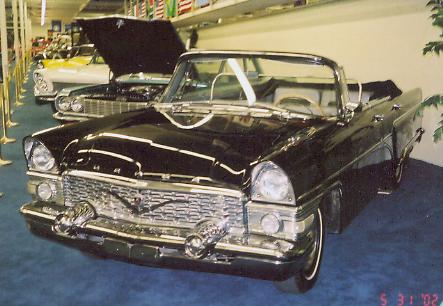
The luxury M13 Chaika seen here was produced from 1959 to 1981, though the mechanical underpinnings remained in production until 1988 fitted with a marginally more modern body until 1988.

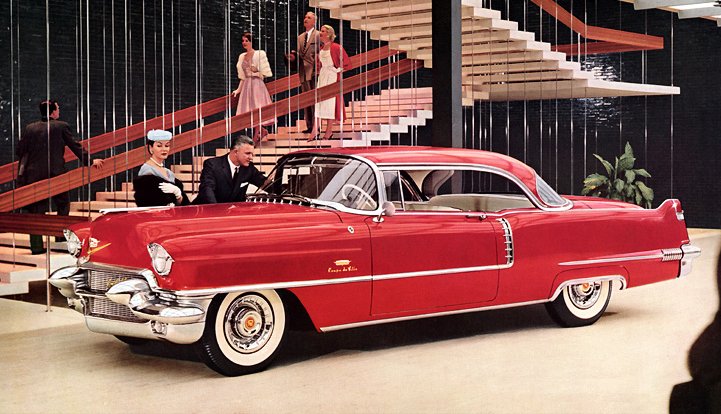
Styling of the Chaika drew heavily on the 1956 Mercury Montclair Phaeton with a potpourri of 1956 Cadillac Series 62 inspired features thrown in. With a 195 hp being transmitted from it's V8 engine via a copy of the push button operated Chrysler TorqueFlite transmission the Chaika, translates into 'gull', was capable of 99 mph.

Seems incredible in this day and age to even conceive the idea that such a luxury vehicle was not made for sale. All 3,100 examples of the Chaika made over a period of 22 years were added to motor pools and issued to top professionals, Communist Party officials, scientists, academics and VIP's. The KGB also ordered these vehicles in large numbers.

Despite being entitled to larger ZIL limousines the Soviet head of state Nikita Khrushchev is known to have expressed a preference for the GAZ M13 even having one kept at his dacha.

Three versions of the Chaika were manufactured most were M13 saloons, but for ceremonial purposes open a 4 dr M13b convertible was produced from 1961 to 1962. The estate / station wagon M13A Universal is the rarest Chaika produced in the 1960's primarily for use as ambulances and funeral cars.

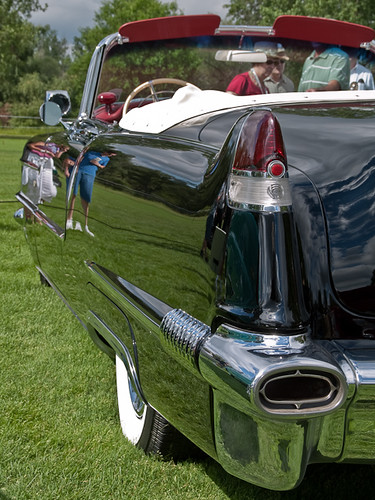
At the time the Chaika was first in production the Soviet Union was leading the space race, a fact possibly not lost on the stylist responsible for the M13's tail light assembly....

though he may also have admired '56 Cadillac Series 62 for its attention to detail and copied the idea of routing the exhaust pipes through the rear bumper !
Thanks for joining me for today's motor pool edition of 'Gettin' a lil' psycho on tyres', I hope you'll join me again tomorrow for a look at a handcrafted Lanchester. As they might say in Russia, Не забудьте вернуться сейчас!
Since I first blogged about the GAZ M21 I have learned a little more about the company which was founded in 1929 in a cooperation between Ford and the Soviet Union as the Nizhegorodsky Avtomobilny Zavod, NAZ, Nizhegorodsky Automobile Plant, at Nizhny Novgorod in the Volga Region approximately 500 miles east of Moscow.
The factory started out making Ford Model A cars and Model AA light trucks known as NAZ-A and NAZ-AA respectively. In 1933 Nizhny Novgorod was renamed Gorky, after Maxim Gorky a writer who was born in the city and Nizhegorodsky Avtomobilny Zavod was renamed Gorkovsky Avtomobilny Zavod shortened to GAZ.
Gorky, the city, was renamed Nizhny Novgorod in 1990 but the vehicle manufacturer retained the GAZ name.
The luxury M13 Chaika seen here was produced from 1959 to 1981, though the mechanical underpinnings remained in production until 1988 fitted with a marginally more modern body until 1988.
Styling of the Chaika drew heavily on the 1956 Mercury Montclair Phaeton with a potpourri of 1956 Cadillac Series 62 inspired features thrown in. With a 195 hp being transmitted from it's V8 engine via a copy of the push button operated Chrysler TorqueFlite transmission the Chaika, translates into 'gull', was capable of 99 mph.
Seems incredible in this day and age to even conceive the idea that such a luxury vehicle was not made for sale. All 3,100 examples of the Chaika made over a period of 22 years were added to motor pools and issued to top professionals, Communist Party officials, scientists, academics and VIP's. The KGB also ordered these vehicles in large numbers.
Despite being entitled to larger ZIL limousines the Soviet head of state Nikita Khrushchev is known to have expressed a preference for the GAZ M13 even having one kept at his dacha.

Three versions of the Chaika were manufactured most were M13 saloons, but for ceremonial purposes open a 4 dr M13b convertible was produced from 1961 to 1962. The estate / station wagon M13A Universal is the rarest Chaika produced in the 1960's primarily for use as ambulances and funeral cars.

At the time the Chaika was first in production the Soviet Union was leading the space race, a fact possibly not lost on the stylist responsible for the M13's tail light assembly....
though he may also have admired '56 Cadillac Series 62 for its attention to detail and copied the idea of routing the exhaust pipes through the rear bumper !
Thanks for joining me for today's motor pool edition of 'Gettin' a lil' psycho on tyres', I hope you'll join me again tomorrow for a look at a handcrafted Lanchester. As they might say in Russia, Не забудьте вернуться сейчас!
Friday, 3 June 2011
Rare Side Vents - Ferrari 250 GT Cabriolet Series 2 #1815GT
Despite the Haynes International Motor Museum having a room full of red vehicles only one of the Rosso Corsa cars is a Ferrari.

The Ferrari 250 GT Cabriolet Series 2 was launched in 1959 featuring a Pinin Farina designed body that was simpler than the Series 1, in part was due to the intention of the Series 2 to be made for series production rather than to order.

This 1960 left hand drive model with a 3185 cc / 194 cui V12 was orginally exported to the USA and in 1987 was sold by Coy's of London with the registration 'Q 999 EGC'.

It is thought around 212 Series 2 models were manufactured as against just 36 of the Series 1 model.

While the Series 2 is known as a model manufactured in series this particular example has extremely rare, for the model type, side vents.
Thanks for joining me on this slightly tardy Ferrari Friday edition of 'Gettin' a lil' psycho on tyres', I hope you'll join me for a stretch limo edition tomorrow. Don't forget to come back now !
The Ferrari 250 GT Cabriolet Series 2 was launched in 1959 featuring a Pinin Farina designed body that was simpler than the Series 1, in part was due to the intention of the Series 2 to be made for series production rather than to order.
This 1960 left hand drive model with a 3185 cc / 194 cui V12 was orginally exported to the USA and in 1987 was sold by Coy's of London with the registration 'Q 999 EGC'.
It is thought around 212 Series 2 models were manufactured as against just 36 of the Series 1 model.
While the Series 2 is known as a model manufactured in series this particular example has extremely rare, for the model type, side vents.
Thanks for joining me on this slightly tardy Ferrari Friday edition of 'Gettin' a lil' psycho on tyres', I hope you'll join me for a stretch limo edition tomorrow. Don't forget to come back now !
Subscribe to:
Posts (Atom)